




Most procurement teams need an efficient way to perform spend analysis. Traditional methods—like one-off spend cubes or backward-looking dashboards—often fall short of providing the forward-looking insights you need. By contrast, artificial intelligence (AI) has changed the game, helping you automate spend analysis, uncover hidden opportunities, and make faster, smarter decisions.
How is AI used in spend analytics? (with examples)
AI in spend analytics automates the slow, manual parts of understanding spend — classification, opportunity detection, and recommendations — and makes them continuous and forward-looking instead of a quarterly spreadsheet exercise. Concrete examples:
- Automated spend classification — machine learning categorizes millions of transactions to a consistent taxonomy without manual tagging.
- Opportunity detection — AI continuously scans for duplicate suppliers, maverick spend, missed discounts, and price anomalies, quantifying each.
- Prescriptive insight — instead of just showing what happened, AI recommends the specific action to take next.
- Autonomous agents — the newest step: agents that monitor spend, contracts, and suppliers 24/7 and can execute actions, not just surface them.
Suplari introduced AI-powered spend analytics back in 2017. Since then, the company has adopted every new AI opportunity, from prescriptive analytics to large language models (LLMs). This article explores what spend analytics is, how AI elevates that process, and how Suplari’s own journey illustrates the power of AI-driven procurement analytics. You’ll also learn practical strategies for implementing AI in your own organization.
What is spend analytics?
Spend analysis in procurement is the practice of collecting, cleansing, categorizing, and interpreting your organization’s expenditure data to drive smarter decisions. At its core, spend analytics involves gathering the details of each transaction—purchase orders, invoices, line items, supplier records—and arranging them into clear categories or segments. This categorization helps you see where your money goes and highlights where changes could yield better cost control or more strategic supplier partnerships.
Accurate spend analytics underpins a strong procurement function: once you understand your spending patterns, you can consolidate suppliers, negotiate volume discounts, or identify maverick spend. In other words, the quality of your spend data dictates the quality of the insights—and ultimately, the impact on your bottom line.
The old way of doing spend analysis
Traditionally, procurement teams relied on manual or semi-automated methods to compile and classify spend data. You might recall sorting records in spreadsheets, setting up pivot tables, or working with basic reporting tools. In many cases, a dedicated consultant or external service provider performed this labor-intensive task.
These manual processes tend to be error-prone and time-consuming. If your data comes from multiple sources (like ERP systems, e-procurement platforms, or legacy databases), classification often becomes inconsistent. Changes to supplier names, item codes, or invoice formats can throw off your categories. You or your team must then spend valuable hours double-checking transactions.
Another drawback of this approach is the lack of real-time visibility. By the time you finish reconciling a quarter’s worth of invoices, the data could already be outdated. Opportunities to renegotiate contracts or catch fraudulent invoices may slip through the cracks. Reactive spend analysis forces you to address problems only after they’ve caused damage.
Automated spend analytics
Automated spend analytics solutions like Suplari use algorithms to perform spend data classification at scale. Rather than manually classifying line items, you can train a machine learning model on historical spend data. Once the model learns to recognize certain keywords, supplier attributes, or transaction structures, it can automatically categorize incoming invoices with high accuracy. These tools often feature anomaly detection as well: if you suddenly see a spike in a particular category, you’ll get an alert right away—giving you the opportunity to act, not just react.
This automated approach delivers several benefits:
- Speed: process thousands of transactions far faster than a human team could.
- Consistency: A well-trained model applies the same classification rules every single time.
- Insights on demand: Instead of waiting for a monthly or quarterly report, you have a near-real-time view of your spend data.
For companies looking to streamline procurement, automated spend analysis is a necessity. You and your team can invest more energy in strategic tasks—like exploring new supplier partnerships or optimizing payment terms—instead of categorizing line items one by one.
Spend classification and harmonization with machine learning
Machine learning (ML) has been instrumental in making this classification more accurate and scalable. At Suplari, ML has been a core feature since its 2017 inception. By training algorithms to recognize and classify line items into precise categories, you establish a reliable data foundation for deeper analysis.
Additionally, ML-enabled data harmonization ensures that different naming conventions align to a single reference point. If one ERP system calls something “IT hardware” and another labels it “computer equipment,” the ML model can map both entries to a unified category. This harmonization saves you from wasting time reconciling details later.
How machine learning works in data classification
From a practical standpoint, ML algorithms learn by example. Suppose you have hundreds (or thousands) of invoices labeled “office furniture.” After exposing your model to all this labeled data, it starts recognizing patterns, such as keywords (“desk,” “chair,” “table”) or specific supplier names. When a new invoice arrives, the model compares its text to known patterns and assigns the most likely category.
The more data you feed the model—and the more varied those examples—the better it becomes at classifying new records. Over time, it adapts to changing supplier catalogs or new product lines, updating its understanding based on fresh data. This continual improvement cycle is a key advantage of AI over static, rule-based systems.
Suplari’s AI journey
Suplari’s timeline offers a real-world illustration of how AI can revolutionize spend analysis. Each milestone highlights a new facet of AI’s potential in procurement.
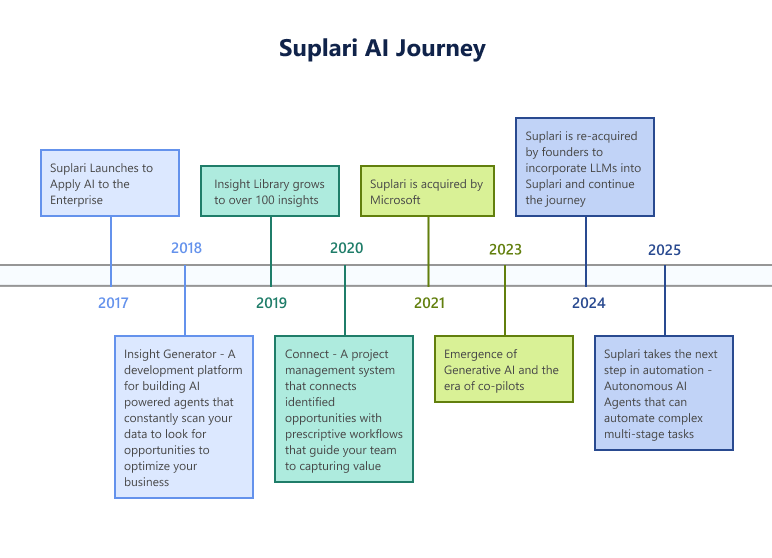
1. The beginning (2017): launching AI for the enterprise
Suplari started by using AI to give enterprises a holistic view of their spend data. If you were in procurement then, you likely recall slogging through spreadsheets. Suplari aimed to automate that effort, giving you instant access to categorized spend information and the ability to spot anomalies.
2. Insight Generator (2018): constant opportunity scanning
One year in, Suplari introduced the Insight Generator—an engine of AI agents that continually scanned spend data. Instead of waiting for a quarterly audit, you could see real-time alerts about issues like compliance gaps or vendor consolidation opportunities. This on-demand insight helped you address cost overruns proactively rather than reactively.
3. Expanding the Insight Library (2019): over 100 insights
By 2019, Suplari’s AI had evolved to include more than 100 specialized insights covering everything from office supplies to marketing services and IT contracts. You could tailor which insights mattered most for your organization, enabling laser-focused spend analysis. Companies quickly discovered hidden savings and optimized supplier strategies by leveraging these actionable insights.
4. Connect (2020–2021): linking insights to action
Recognizing that identification alone isn’t enough, Suplari launched Connect—a project management system that transformed insights into actionable workflows. If the system flagged a high-expense supplier contract, Connect guided you through renegotiating terms or consolidating spend. The acquisition by Microsoft during this period also enhanced the solution’s scalability and integration with other enterprise tools.
5. The era of co-pilots (2023): generative AI emerges
By 2023, generative AI tools became more prevalent, and Suplari integrated these capabilities into co-pilot features. Instead of simply providing data, the system could draft recommended next steps—like negotiation tactics or contract language. This move democratized advanced analytics, making them accessible to teams without deep technical expertise.
6. Next steps in automation (2024–2025): autonomous AI agents
In 2024 Suplari was re-acquired by the founders to embrace the future of AI in the enterprise. Looking ahead, Suplari envisions fully autonomous procurement AI agents. By 2025, the plan is to integrate large language models (LLMs) throughout the platform to automate complex, multi-step tasks.
Imagine AI procurement agents that do more than detect overcharges—they can also launch workflows to dispute them, escalate if no resolution is reached, and even update contract terms automatically. This automation could drastically reduce the time you spend on day-to-day procurement tasks.
What's new in 2026: AI Studio and Worker Agents
The latest additions to Suplari's AI capabilities reflect the broader move toward agentic AI in procurement:
AI Studio lets procurement teams build custom agents without code. Define the data inputs (which spend categories, which suppliers, which time periods), the analysis logic (compare against benchmarks, check contract compliance, identify trends), and the output format (alerts, reports, action recommendations). The agent runs autonomously on your schedule.
Worker agents have expanded coverage. In addition to spend anomaly monitoring, they now cover contract intelligence (expiration tracking, compliance checking, rate comparison), supplier intelligence (risk scoring, performance trending, diversity tracking), and savings tracking (verifying that identified savings are actually realized in invoices).
Natural language queries have gotten deeper. The Assistant can now handle multi-step analytical requests: "Compare our IT consulting spend trend over the last 8 quarters, identify the top 3 cost drivers, and draft a category strategy for the next renewal cycle." This type of request previously required a category manager 2–3 days of work.
The data foundation underneath
Every AI capability Suplari has built rests on its AI data platform. This is worth emphasizing because it's the most common failure point for AI in procurement: garbage in, garbage out.
Suplari's data platform ingests raw data from ERPs (SAP, Oracle, Microsoft), AP systems, contract repositories, and supplier databases. It then:
- Normalizes supplier names, addresses, and identifiers across systems
- Classifies transactions into a consistent taxonomy with 95%+ accuracy
- Enriches records with external data — supplier financials, market benchmarks, risk scores
- Connects spend data to contract terms and supplier performance metrics
This automated procurement data integration is why Suplari deploys in 90 days. Other platforms require you to solve the data problem manually before their AI can function. Suplari's AI solves the data problem as its first act.
What this means for procurement teams
The practical implication of Suplari's AI journey is this: the work of procurement analytics is being automated.
- Spend classification: automated
- Anomaly detection: automated
- Compliance monitoring: automated
- Savings identification: automated
- Category analysis: increasingly automated
- Performance reporting: automated
What's not automated — and shouldn't be — is strategy, relationship management, complex negotiation, and the judgment calls that require deep organizational context. AI agents handle the analytical heavy lifting so procurement leaders can focus on the work that creates the most value.
For a comparison of how different platforms approach AI in procurement, see our guide to the best AI procurement software.
Final thought on AI in spend analytics
By embracing AI in spend analytics, you’re positioning your procurement function as a strategic force for sustained value. Whether you’re planning a pilot or already visualizing a fully autonomous system, intentional planning and clear objectives are key. A well-executed approach to AI can optimize costs, streamline operations, and ultimately reshape how your organization views procurement.
From its launch in 2017 to its forward-looking plans for 2025, Suplari’s trajectory exemplifies the transformative power of AI. Each milestone—Insight Generator, Connect, co-pilots, and, soon, autonomous AI agents—represents a step toward more proactive, data-driven procurement. If you’re considering a similar journey, Suplari’s roadmap offers both inspiration and a glimpse of what’s possible when AI becomes integral to spend analytics.
Your next move is yours to make. If you have questions or need guidance, don’t hesitate to contact us for expert advice. The age of AI in spend analytics is here—why not be at the forefront of it?

