




The U.S. retail sector is grappling with a new wave of tariffs stemming from President Donald Trump’s second term trade policies. In early April 2025, U.S. duties on Chinese imports surged to a staggering 145%, on top of baseline tariffs affecting many other trading partners and countries.
Major retailers – Walmart, Target, Best Buy, Macy’s, and TJX – have been updating investors on how they plan to weather these tariffs. Below, we summarize each retailer’s stance and adjustments, followed by common strategies and takeaways for businesses facing similar challenges. We also share a unique way modern retailers can utilize AI to visualize and mitigate exposure to tariffs.
Walmart: holding the line on low prices and supply flexibility
Exposure: Walmart, America’s largest retailer, imports heavily from Asia – about 60% of its imported merchandise comes from China. This makes Trump’s tariffs a significant concern for Walmart’s supply chain.
Response: CEO Doug McMillon has projected calm and confidence. “Tariffs are something we’ve managed for many years, we’ll just continue to manage that… We can’t predict what will happen in the future, but we can manage it really well. And we’re wired to try and save people money. So that will be our ultimate goal.” Source: retaildive.com
- To offset cost pressures, Walmart has been diversifying its supply chain for years and now sources over two-thirds of products domestically.
- It is also negotiating aggressively with suppliers: behind the scenes, Walmart has asked Chinese manufacturers to trim prices by up to 10% for each round of tariffs. Source: reuters.com.
- A company spokesperson bluntly warned that steep tariffs “could lead to increased costs for our customers at a time when they are still feeling the remnants of inflation.” Source: foxbusiness.com
McMillon told investors at an April meeting. In practice, Walmart is doubling down on its Everyday Low Price strategy and focusing on internal efficiencies. “We’ve learned how to manage through turbulent periods… we’ll be focused on keeping prices as low as we can,” McMillon said, emphasizing strict inventory and expense management during the uncertainty. Source: reuters.com.
Target: accelerating supply chain shifts and “controlling what we can”
Exposure: About half of Target’s merchandise is U.S.-made, and the company has dramatically cut its reliance on China. Target’s Chief Commercial Officer noted they “reduced what [Target] sources from China to about 30% [of owned brand production] currently, from about 60% in 2017,” with plans to get that below 25% by 2026 Source: digitalcommerce360.com.
Response: Target’s leadership is prioritizing affordability for customers and operational agility. “When we think about tariffs and tariff implications, we start with the impact on consumers…making sure we’re providing the affordability and value they’re looking for,” CEO Brian Cornell said. Source: digitalcommerce360.com.
- In the short term, the company has acknowledged that prices on some imports will rise. Cornell told the media that shoppers will “likely see price increases over the next couple of days” on certain items – for example, produce imported from Mexico – due to new tariffs. Source: foxbusiness.com.
- To protect margins and consumers, Target is adjusting its operations. The retailer is shortening supply lead times and building extra budget “flexibility” to navigate tariff volatility. Source: digitalcommerce360.com.
In other words, Target is controlling what it can (costs, sourcing, pricing strategies) while hedging against factors it cannot predict (like consumer spending shifts). The company reassured investors that its decades of sourcing experience give it confidence to weather this storm.
Best Buy: warning consumers will bear the brunt
Exposure: Best Buy’s business is heavily tied to global consumer electronics supply chains. “China and Mexico remain the No. 1 and No. 2 sources for products we sell, respectively,” CEO Corie Barry noted on the company’s earnings call Source: foxbusiness.com.
Response: Best Buy is bluntly preparing its stakeholders for higher prices. In investor discussions, Barry underscored that international trade is “critically important” to the electronics industry, implying there are limited alternatives to sourcing from Asia. Source: retaildive.com.
- With tariffs this high, cost increases will flow through the supply chain. Best Buy’s strategy, therefore, centers on mitigating the impact where possible and communicating transparently.
- The company is working closely with its suppliers to manage pricing, but ultimately, “consumers will feel the brunt of [the tariffs]” in categories like appliances, televisions, and gadgets. Source: foxbusiness.com.
Barry’s messaging suggests Best Buy is balancing realism with resilience: acknowledging likely profit and price impacts, while assuring investors the company will navigate through by leveraging its vendor relationships and inventory management.
Macy’s: flexible supply chain and real-time reactions
Exposure: Macy’s Inc., which includes Macy’s department stores as well as Bloomingdale’s, sources a wide array of apparel, home goods, and cosmetics globally. Like other fashion retailers, Macy’s relies on Chinese manufacturers for some product categories, though it also works with suppliers worldwide.
Response: Macy’s leadership has emphasized flexibility and quick action to soften the tariff blow. “We have worked hard to create a flexible supply chain that allows us to mitigate the impact from potential disruptions to global trade and tariff activity,” said Macy’s CFO and COO Adrian Mitchell. Source: retaildive.com. This means Macy’s can shift orders to alternate countries, adjust styles, or speed up deliveries as needed to dodge the worst of the new import taxes.
- In the short term, Macy’s is actually reasonably insulated – mostly because of timing. CEO Tony Spring noted that the chain’s first-quarter inventories are in good shape, with merchandise already in hand before the tariffs, so “there’ll be no impact from the pending tariffs” on Q1 results. Source: retaildive.com.
- For the rest of 2025, however, Macy’s is taking a “case-by-case” approach, reacting in real time as details evolve. Source: retaildive.com. In practice, Macy’s will likely pass on some costs (especially for higher-end items or luxury brands that customers expect to pay a premium for), while aggressively working with vendors to cut costs or find alternatives for more price-sensitive product lines.
Overall, Macy’s message to investors is that it’s staying agile. With a stronger supply chain network and experience from the 2018-2019 tariff skirmishes, Macy’s plans to monitor consumer response closely and adjust markdowns, sourcing, and inventory mix to maintain its value proposition despite higher import costs.
TJX (TJ Maxx, Marshalls): turning tariffs into a buying opportunity
Exposure: Off-price retail giant TJX (parent of T.J. Maxx, Marshalls, HomeGoods and more) sits in a unique position. It sources from over 21,000 vendors in 100+ countries, often buying opportunistically from excess inventory rather than ordering direct from factories. Source: reuters.com. Typically, “less than 10% of the merchandise [TJX] purchases for its U.S. businesses is directly imported from China,” a recent filing noted.
Response: TJX sees the tariff turmoil as a chance to seize market share and deals. CEO Ernie Herrman told analysts that with many retailers canceling orders or struggling to sell pricier goods, “there’s more availability out there over the next six months… which is going to create more buying opportunities for our teams.” Source: reuters.com.
- Herrman has also emphasized that TJX has navigated economic volatility before. “A few years ago with extreme inflation... we navigated right through that, just as we will on this,” he said confidently. Source: retaildive.com.
- The company is keeping inventories lean and turning stock quickly – a hallmark of off-price retail – which gives it agility to capitalize on whatever merchandise becomes available. Source:reuters.com.
The bottom line: TJX is on offense, treating the tariff situation as a buying opportunity and a chance to attract cost-conscious consumers, rather than a threat to its business model.
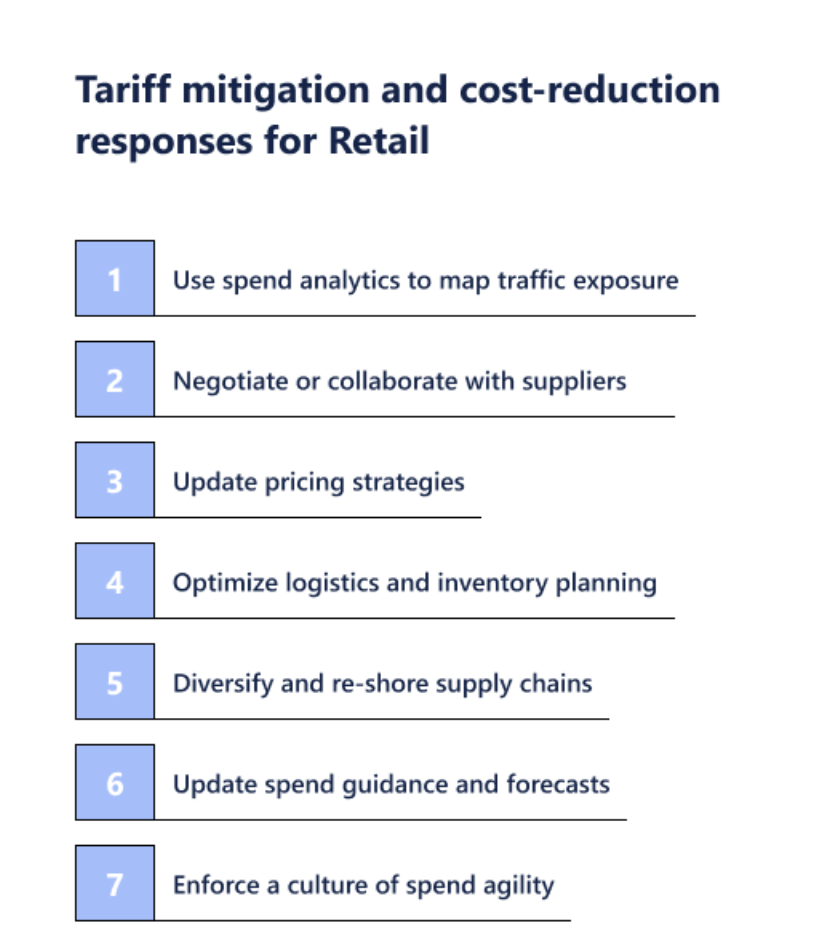
Tariff mitigation and cost-reduction responses
Across these retail giants, a few clear strategic themes emerge in response to the unprecedented tariffs on Chinese imports:
Diversify supply chains
Nearly all retailers highlighted efforts to source from alternative countries or domestically. Target’s halving of China sourcing over several years and Walmart’s shift to buy two-thirds of goods from the U.S. exemplify this long-term strategy. The goal is to reduce reliance on any single country (especially one now hit with 145% import duties) and thereby blunt the impact of trade policy swings.
Negotiate or collaborate with suppliers
Retailers are not absorbing tariffs alone – they’re negotiating. Walmart, for instance, is asking vendors to cut prices to offset tariff costs, and Best Buy expects its manufacturers to shoulder part of the burden (though ultimately some costs will pass to consumers). Macy’s and others mention working “closely with our vendors” to manage cost increases. Strong supplier relationships, as Costco’s CEO noted, are crucial for finding creative solutions.
Pricing strategies to protect customers (and market share)
A common refrain was commitment to the customer’s wallet. Walmart vowed to keep prices “as low as we can and even treat this period as a chance to win loyal shoppers from less prepared rivals. That said, retailers are pragmatic: Target and Best Buy both warned that some price hikes are unavoidable, and they have been transparent about this reality. The take-home point for businesses is to be strategic about pricing – hold the line where you can to stay competitive, but be frank about necessary increases and try to implement them gradually or selectively.
Inventory and timing tactics
Several companies are tweaking inventory management in light of tariffs. Faster turnarounds and shorter lead times can reduce exposure to sudden tariff changes – as Target’s COO put it, cutting 20% off lead times in apparel helps reduce volatility. These tactics show the importance of operational agility. Businesses should explore adjusting order timing, building buffer stock, or swapping out products to mitigate tariff costs.
Financial cushioning and guidance adjustments
The tariff uncertainty has led to more conservative forecasting. Target built a wide earnings guidance range to cover various tariff outcomes, and Walmart widened its margin outlook while maintaining its full-year targets (signaling confidence in offsetting the costs). Many retailers also referenced cost control measures (travel freezes, hiring pauses, etc.) that could be activated to preserve profitability if tariffs start biting harder than expected – essentially having a contingency plan.
Drawing on past experience
A thread running through the commentary is that this is not the first trade turbulence these companies have seen. Walmart’s Doug McMillon cited navigating 9/11, the financial crisis, and the pandemic as proof that Walmart can handle disruption. TJX’s chief likened the situation to surging inflation, which they successfully managed. This perspective helps reassure investors (and employees) that while the scale of a 145% tariff is unprecedented, the skill set required – adaptability, cost discipline, and customer focus – is very much in these retailers’ playbooks.
Using AI to map tariff exposure and act fast
As retailers scramble to adapt to the latest round of U.S. tariffs on imports from China and other major trade partners, visibility is everything. One emerging advantage is the use of AI-driven spend analytics to identify risk, model cost exposure, and inform sourcing decisions in real time.'
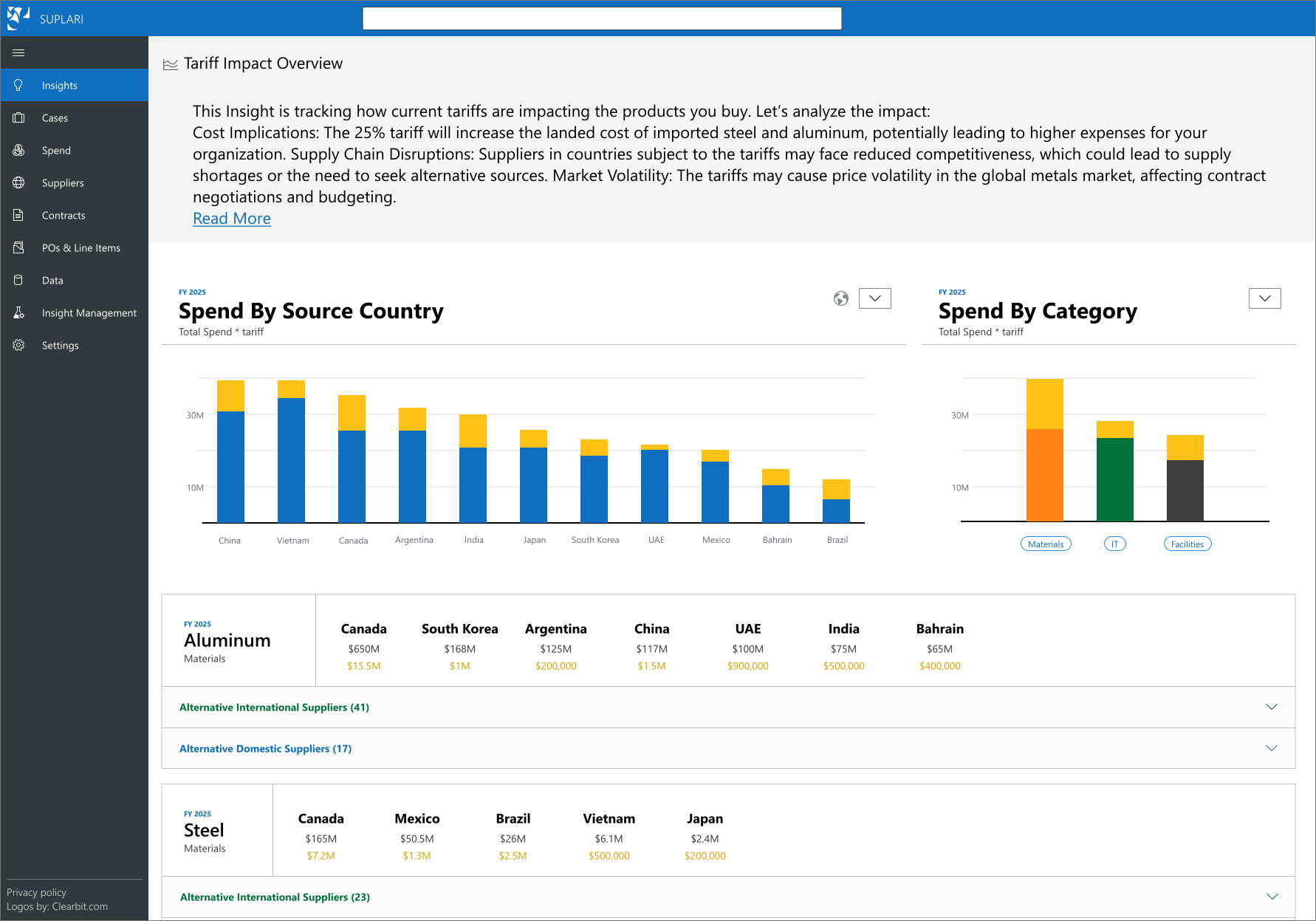
Suplari’s new Tariff Insights Overview, launched in March 2025, gives procurement teams a powerful tool to visualize how tariffs are impacting their supplier network and category spend. It works by layering product-level data (like HTS codes and country-of-origin details) on top of internal transaction data, highlighting where cost increases are likely to hit hardest and where mitigation is most urgent.
With this kind of intelligence, retail procurement and finance leaders can:
- Pinpoint suppliers and SKUs most affected by current or proposed tariffs
- Quantify cost exposure by origin country and tariff bracket
- Identify nearshore or domestic sourcing alternatives
- Benchmark exposure across departments or business units
- Create clear, executive-ready reports to guide response strategies
The 145% tariffs on Chinese goods, for example, might only affect a portion of a retailer’s assortment—but without granular insight, decision-makers could easily miss opportunities to adjust. Suplari’s dashboard allows for targeted, data-informed action rather than reactive cost-cutting.

Retailers that embrace this kind of AI-backed visibility will be better equipped to protect margins, maintain stock availability, and communicate clearly with vendors and consumers alike.
Key tariff mitigation take-aways
The responses from Walmart, Target, Best Buy, Macy’s, and TJX offer a playbook for any company facing sudden cost headwinds due to tariffs or similar trade barriers.
Key takeaways include:
- Diversify your dependencies (suppliers and geographies);
- Communicate honestly with customers about impacts;
- Find creative ways to trim costs and work with partners to share the pain; and
- Stay flexible with plans, ready to pivot as the situation evolves.
- Leverage AI-assisted spend analytics to visualize and mitigate impact.
Perhaps most importantly, maintain a long-term view – much like these retail CEOs, who balance immediate mitigation steps with confidence that their strategies will carry them through until the storm passes. In a tariff era that one CEO described as feeling like “a historic reshaping” of the business environment. America’s top retailers are showing that nimbleness and focus on the customer are critical to coming out stronger on the other side.
Suplari offers the only automated spend analytics solution that allows you to respond to tariffs within 30 days.
Request a meeting to hear more about Suplari’s AI-driven spend analytics and retail sector experience.
Sources for this article's research: Public investor calls, press releases, and media statements from each retailer in March–April 2025 have been cited to verify all quotes and facts above.

