




When a CFO at a global manufacturing company first accessed their Suplari AI Procurement Agent, they asked a simple question: "Show me all suppliers where we're not leveraging our contracted payment terms." Within seconds, the system identified $150,000 in working capital tied up unnecessarily, showing payment terms that should have converted to Net 60 eighteen months earlier but were still processing as immediate payment.
This wasn't a planned savings initiative. It was a transparency win that emerged from asking the right question of an intelligent system that understood procurement context, not just data.
After a decade of implementing AI procurement solutions across enterprises with wildly different maturity levels, I've learned that calculating the business case for AI isn't about picking a percentage savings target from an analyst report. It's about understanding which specific problems AI solves in your environment, quantifying the value of solving them, and building a roadmap that proves ROI incrementally.
This guide walks through the five-step framework we use at Suplari to help procurement leaders build compelling business cases that secure executive approval and deliver measurable outcomes.
What the Deloitte Global CPO Survey reveals about AI investment priorities
The 2025 Deloitte Global CPO Survey of 250+ procurement leaders across 40 countries provides critical validation for organizations building AI procurement business cases. The findings reveal a decisive shift in how leading procurement organizations invest in and measure the value of artificial intelligence.
- Digital Masters are betting big—and winning. The survey identified a cohort of "Digital Masters" who are outpacing their peers through strategic technology investments. These leaders allocate approximately 20% of their procurement budget to technology—nearly double the relative investment reported just two years ago. More importantly, they're seeing returns: Digital Masters achieve an average 2.8x ROI on GenAI investments compared to just 1.6x for their peers.
- RFP generation as the #1 GenAI use case. When CPOs identified their top use cases for generative AI in procurement, 53% mentioned RFP generation, followed by spend analytics and dashboarding (42%) and contract analysis (41%).
- The business case priority is clear. Survey respondents identified the top enterprise priorities driving procurement investment: improving margins via cost reduction (72%), driving operational efficiency (68%), and digital transformation including GenAI (67%). Your AI business case needs to directly connect to these priorities, not abstract technology benefits.
- Investment gaps predict performance gaps. The survey reveals that organizations struggling with AI adoption share common characteristics: lower technology budget allocation (18% vs. 24% for Digital Masters), limited understanding of AI capabilities (only 7% report good/extensive AI knowledge vs. 43% for Digital Masters), and reactive rather than strategic implementation approaches.

5 steps to build the business case for AI in procurement
When presenting your AI procurement investment to executives, you can now cite authoritative research showing that leading organizations are doubling down on these capabilities and achieving measurably superior outcomes. The question isn't whether AI delivers ROI—the data proves it does. The question is whether your organization will invest strategically like the Digital Masters or fall further behind their performance benchmarks across cost savings, stakeholder satisfaction, and risk management.
Step 1: Define the problem and clear goals
Start with what's broken, not what's possible
Most procurement teams approach AI business cases backwards. They start with "AI can do amazing things, let's find applications" when they should start with "Here are our most painful, expensive problems. Can AI solve them?"
I've seen procurement organizations get excited about AI capabilities - natural language processing, predictive analytics, automated categorization - without connecting those capabilities to actual business pain points. The result? Executive teams that nod politely but don't approve budget.
The five categories of procurement problems AI solves
AI procurement software addresses five fundamental problem categories. Your business case should identify which of these creates the most pain and cost in your organization.
Problem 1: Lack of spend visibility and intelligence
Symptoms: You can't answer basic questions about your spend without days of manual analysis. Different stakeholders have different versions of the truth. Category managers build strategies on incomplete data.
AI solution: Automated spend classification, supplier normalization, and natural language query interfaces that democratize access to intelligence.
Problem 2: Manual, repetitive analytical work
Symptoms: Procurement analysts spend 60-70% of their time gathering and preparing data rather than analyzing it. Sales asks "How much do we spend with this customer who's also a supplier?" and it takes two hours to answer.
AI solution: Self-service analytics that let business stakeholders get answers in seconds. Automated insight generation that proactively surfaces opportunities.
Problem 3: Inability to enforce contract compliance
Symptoms: You negotiate great contracts but can't verify if anyone's using them. Pricing leakage happens because matching PO line items to contract terms requires manual work nobody has time for.
AI solution: Automated contract-to-PO matching, pricing variance detection, and compliance dashboards that make enforcement effortless.
Problem 4: Slow, reactive decision-making
Symptoms: You discover savings opportunities during annual category reviews instead of in real-time. Supplier risk issues emerge during crises rather than through proactive monitoring.
AI solution: Continuous intelligence that identifies opportunities and risks as they emerge, enabling proactive rather than reactive procurement.
Problem 5: Procurement bottlenecks that slow the business
Symptoms: Other departments see procurement as a roadblock. You spend enormous time answering repetitive questions. RFP evaluation takes weeks of manual comparison work.
AI solution: Autonomous capabilities that reduce procurement's tactical workload while improving speed and quality of analysis.
Frame your goals in business language, not AI language
Your business case shouldn't say "Implement natural language processing for spend analysis." It should say "Enable category managers to access spend intelligence in 30 seconds instead of 2 hours, freeing 15 hours per week for strategic sourcing activities valued at $500K annually."
Here's how to translate AI capabilities into business goals:
Instead of: "Deploy machine learning for spend classification" Frame as: "Achieve 95% automated spend categorization accuracy, eliminating 200 hours monthly of manual classification work"
Instead of: "Implement AI-powered contract analysis" Frame as: "Reduce contract compliance gaps from 35% to under 5%, recovering $2M in pricing leakage annually"
Instead of: "Build predictive savings models" Frame as: "Identify category optimization opportunities 6 months earlier, accelerating $5M in annual savings realization"
Step 2: Identify high-impact use cases
The AI in procurement use case prioritization matrix
Not all AI applications deliver equal value or require equal effort. I recommend plotting potential use cases on a two-by-two matrix: business impact versus implementation complexity.
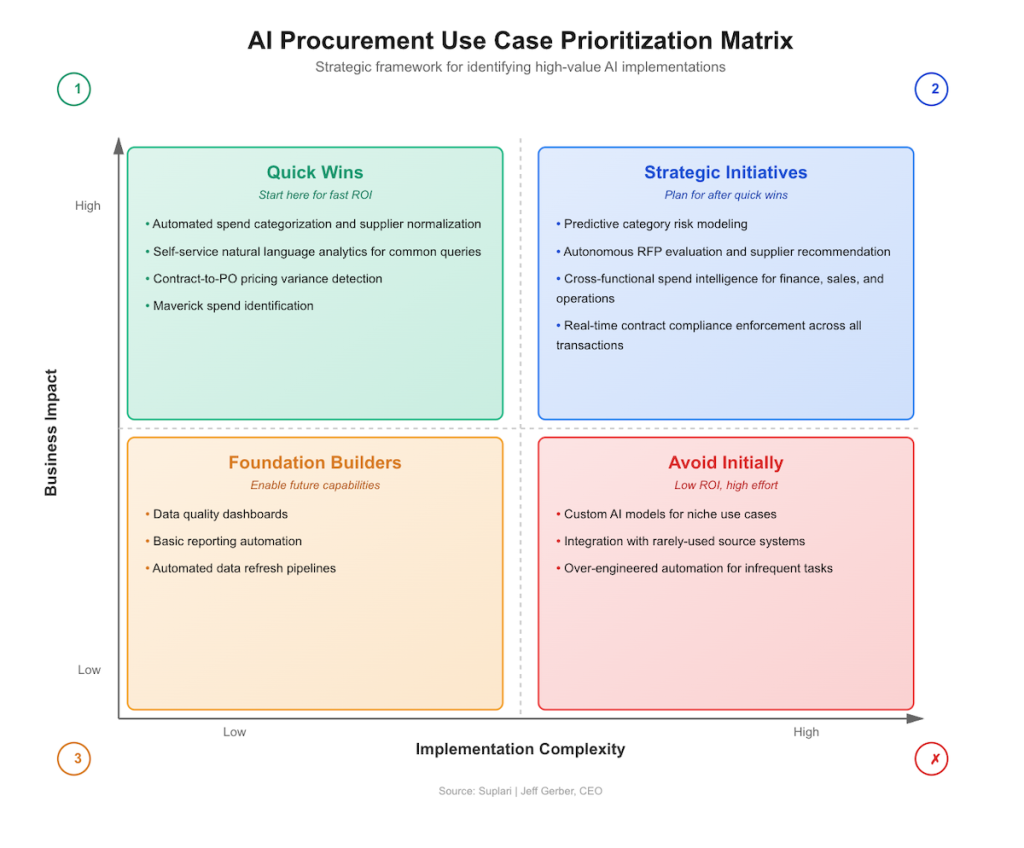
Quick wins (High impact, low complexity):
- Automated spend categorization and supplier normalization
- Self-service natural language analytics for common queries
- Contract-to-PO pricing variance detection
- Maverick spend identification
Strategic initiatives (High impact, high complexity):
- Predictive category risk modeling
- Autonomous RFP evaluation and supplier recommendation
- Cross-functional spend intelligence for finance, sales, and operations
- Real-time contract compliance enforcement across all transactions
Foundation builders (Low impact, low complexity):
- Data quality dashboards
- Basic reporting automation
- Automated data refresh pipelines
Avoid initially (Low impact, high complexity):
- Custom AI models for niche use cases
- Integration with rarely-used source systems
- Over-engineered automation for infrequent tasks
Real AI use cases with quantified outcomes in procurement
Let me share three examples from actual implementations that illustrate how to connect use cases to measurable value.
Use case 1: Marketing category optimization
A enterprise customer recently pulled in just their marketing contracts, not even complete spend data, into Suplari. They used our AI agent to analyze contract performance, identify where they weren't leveraging terms efficiently, and spot alternatives.
The business case they built:
- Problem: Marketing spend growing 20% annually without clear ROI visibility
- Use case: AI-powered contract performance analysis for top 50 marketing suppliers
- Implementation: 6 weeks to integrate contracts and spend data for this category
- Outcome: Identified $1.2M in optimization opportunities, built data-driven category strategy, reduced agency count from 47 to 31
Time to value: Under 2 months from kickoff to strategic recommendations.
Use case 2: RFP evaluation acceleration
Another customer used Suplari to automate their RFP analysis process, letting our AI agent compare pricing, terms, and SLAs across bidders while connecting to historical spend patterns.
The business case they built:
- Problem: Strategic sourcing team spending 3-4 weeks per RFP on manual evaluation
- Use case: AI-powered RFP analysis with automated supplier comparison
- Implementation: 8 weeks to connect RFP data and build evaluation workflows
- Outcome: Reduced RFP cycle time from 6 weeks to 2 weeks, increased annual RFP throughput from 12 to 30, estimated $3M in additional negotiated savings
- Time to value: Immediate acceleration on first RFP processed through the system.
Use case 3: Cross-functional self-service intelligence
A third customer deployed our AI agent as a self-service tool for sales, finance, and operations teams to answer their own procurement questions.
The business case they built:
- Problem: Procurement team fielding 200+ data requests monthly, consuming 120 hours of analyst time
- Use case: AI agent with natural language interface for common procurement queries
- Implementation: 4 weeks to train agent on company terminology and grant access
- Outcome: 75% reduction in procurement data request tickets, freeing 90 hours monthly for strategic work, improved cross-functional satisfaction scores
- Time to value: Week 3 after launch, when business users began self-serving.
How to select your priority use cases for AI in procurement
I recommend starting with 2-3 use cases that meet these criteria:
Criterion 1: Clear before-and-after metrics. You can measure the current state (time spent, error rate, savings missed) and the improved state.
Criterion 2: Stakeholder pain, not just procurement pain. CFOs care about working capital. CIOs care about data democratization success stories. Sales leaders care about customer intelligence. Choose use cases that create value beyond procurement.
Criterion 3: Fast proof points. Select at least one use case deliverable within 30-60 days to build momentum and prove the concept.
Step 3: Quantify the business value and ROI
The multi-metric reality: Why there's no single ROI number
Executives often ask "What's the ROI of AI procurement software?" expecting a simple percentage. The reality is more nuanced. There isn't one metric, there are many metrics. Transparency is the first unlock, and from there you build toward multiple value streams.
I think about AI procurement ROI across four value categories:
Category 1: Hard dollar savings
- Contract compliance improvements recovering pricing leakage
- Supplier consolidation reducing administrative costs
- Payment term optimization freeing working capital
- Maverick spend reduction through better visibility
Category 2: Efficiency gains
- Analyst time redirected from data gathering to strategic work
- Reduced cycle times for RFPs, category reviews, and supplier evaluations
- Elimination of manual categorization and data cleansing work
- Self-service analytics reducing procurement bottlenecks
Category 3: Risk mitigation
- Early warning systems for supplier concentration risk
- Compliance monitoring preventing audit findings and penalties
- Faster identification of supply chain disruptions
- Better visibility into geographic and category exposure
Category 4: Strategic capability building
- Data-driven category strategies replacing gut instinct
- Procurement's elevation from tactical to strategic partner
- Cross-functional value delivery that positions procurement as business driver
- Foundation for autonomous procurement capabilities
Your business case should quantify at least one metric from each category to show comprehensive value.
The framework for calculating ROI for AI in procurement
Here's the framework we use at Suplari to help customers build their ROI models.
Step 1: Baseline your current state
Document current metrics across the four value categories:
- Average time to answer common spend queries: ___ hours
- Percentage of spend with contract compliance verification: ___%
- Monthly hours spent on manual data analysis: ___ hours
- Annual savings opportunities identified through spend analysis: $___
- Average RFP evaluation cycle time: ___ weeks
- Procurement data request backlog: ___ requests
Step 2: Define your improved state with AI
Based on benchmarks and pilot results, project improvements:
- Average time to answer common spend queries: 30 seconds (AI agent)
- Percentage of spend with contract compliance verification: 95%+ (automated matching)
- Monthly hours spent on manual data analysis: 70% reduction (automation)
- Annual savings opportunities identified: 3x increase (continuous intelligence)
- Average RFP evaluation cycle time: 50% reduction (automated comparison)
- Procurement data request backlog: 75% reduction (self-service)
Step 3: Translate improvements to financial impact
This is where you connect operational improvements to dollars.
Example calculation for analyst time savings:
- Current state: 3 analysts spending 30 hours/week on manual data work = 4,680 hours annually
- Improved state: 70% reduction = 3,276 hours freed
- Value of redirected time: Strategic sourcing work generates average $150 per hour in negotiated savings
- Annual value: $491,400
Example calculation for contract compliance:
- Current state: $100M annual spend with 65% contract compliance = $35M off-contract exposure
- Estimated pricing leakage on off-contract spend: 3% = $1.05M
- Improved state: 95% contract compliance = $5M off-contract exposure
- Estimated pricing leakage: $150K
- Annual value recovered: $900K
Example calculation for working capital:
- Current state: Payment terms analysis requires manual work, performed annually
- Result: $150K in missed Net 60 conversions discovered after 18 months
- Improved state: Automated payment term monitoring with quarterly validation
- Annual value: $150K recovered + $200K in future optimization
- Working capital impact: $350K
Step 4: Calculate total ROI with conservative assumptions
I always recommend building three scenarios: conservative, moderate, and optimistic. Present the conservative case to executives so you over-deliver rather than under-deliver.
Conservative ROI example:
- Year 1 hard savings: $1.2M (contract compliance + payment terms)
- Year 1 efficiency value: $300K (analyst time redeployed)
- Year 1 risk mitigation: $200K (avoided audit penalties, earlier risk detection)
- Total Year 1 value: $1.7M
- AI platform investment: $400K (software + implementation)
- Year 1 ROI: 325%
This conservative model doesn't even include strategic capability value or cross-functional benefits. Those become your upside story.
The transparency baseline: Quantifying what you can't see today
The first unlock from AI procurement software is transparency itself. Just being able to see all your spend under management, properly categorized, is really a quick unlock. And to be able to access it in a way that is through a beautiful user experience and doesn't require a lot of cognitive overhead to sort of understand. That really is a huge unlock.
How do you quantify transparency value? Look at what spend visibility enables:
Supplier consolidation opportunities:
Before AI: You think you have 2,500 unique suppliers
After AI: You discover you actually have 1,847 suppliers (653 are duplicates with naming variations)
Consolidation opportunity: Reducing supplier count by 30% saves $180K in administrative costs
Tail spend optimization:
Before AI: Limited visibility into long-tail supplier spend
After AI: Crystal clear view of $15M across 1,200 small suppliers
Consolidation opportunity: Aggregating similar spend to preferred suppliers delivers 8-12% savings = $1.2M-1.8M
Maverick spend identification:
Before AI: Assume 10-15% off-contract purchasing based on annual sample audits
After AI: Precise identification of $8M maverick spend with root cause analysis
Remediation opportunity: Bringing 50% under contract delivers 5% savings = $200K
Add up these transparency-enabled opportunities. That's your baseline ROI before you even get to the advanced AI capabilities.
Step 4: Address implementation and technical requirements
The IT conversation: Making it easy to say yes
Your business case needs to acknowledge implementation reality. Enterprise IT teams face competing priorities from every business unit. Having the fundamental business case in place, based on real identified value, will help prioritize what it means for IT to actually do the work.
Address the data readiness question
Enterprise IT executives will ask: "Do we need to complete our data lake initiative first?" Your business case should directly address this.
The answer: No. You can access data that's already in the lake while simultaneously pulling data a la carte from procurement source systems. Don't let perfect be the enemy of good. Start where data access is easiest.
Modern AI platforms like Suplari are built for flexibility. We've proven we can implement from a very simple customer with one or two source systems to a very complex customer with 50 to 100 source systems.
Your business case should include a phased data integration plan:
- Phase 1 (Weeks 1-4): ERP spend data → Baseline transparency and quick wins
- Phase 2 (Weeks 5-10): Top supplier contracts → Compliance analysis
- Phase 3 (Weeks 11-16): Invoice detail → Maverick spend detection
- Phase 4 (Weeks 17-24): Additional source systems based on priority use cases
Quantify the IT effort required
Be honest about implementation effort, especially if you’re considering building your own AI solutions. Your business case gains credibility when you acknowledge the work required and show why it's worth it.
Example IT effort breakdown:
- Initial data mapping and extraction setup: 40-60 hours IT time
- Ongoing automated data refresh setup: 20-30 hours IT time
- Security review and access provisioning: 10-15 hours infosec time
- Total implementation effort: 70-105 hours across 8-12 weeks
Now show the return on that effort:
- Value delivered: $1.7M Year 1 (from previous ROI calculation)
- IT hours invested: 105 hours
- Value per IT hour invested: $16,190
Compare this to other IT projects requesting similar effort. Few deliver $16K of value per hour invested.
Address the AI trust and governance question
Enterprise executives increasingly ask about AI risks: hallucinations, bias, data security, audit trails. Your business case should proactively address these concerns.
At Suplari, we've architected our system to deliver responsible AI. We don't allow our AI to do any math. We empower it with tools to access our API, so all of the data queries, all of the calculations, the aggregations all happen in our API. AI is really acting as an orchestrator and a reasoning engine on top of all that data.
This architecture matters for your business case because it addresses the trust question directly. Being able to see what your AI's doing in the audit trail of its thinking, and to produce the analysis that you asked it to, and in that audit trail to be able to see where it did a calculation or where it did some aggregation.
Include in your business case:
- Explanation of AI architecture (orchestration vs. black box)
- Data security and access controls aligned with company InfoSec posture
- Audit trail capabilities for compliance verification
- Bias detection and hallucination prevention measures
The change management reality
Technology implementation isn't the hardest part of AI adoption. Change management is.
Your business case should acknowledge resistance patterns and plan for them:
Resistance pattern 1: "I'm comfortable with Excel"
Folks that are used to Excel, Power BI, probably using ChatGPT or Copilot, they're not really getting the full advantage of AI with just data in basic forms. The data model and intelligence that we've put into procurement-specific agents is much more advanced and gives you much higher fidelity, more contextual responses.
Address this in your business case with a parallel operation plan: Let analysts use both tools for 60 days and compare results. When they see the difference, adoption becomes easier.
Resistance pattern 2: "AI will replace my job"
According to research, the procurement professional's role doesn't disappear with AI. It elevates. Focus shifts from data gathering and basic analysis to strategic decision-making, relationship management, and business impact.
Include in your business case: Job evolution plans showing how analyst roles transform rather than disappear. Quantify the strategic work they'll take on with their freed capacity.
Resistance pattern 3: "We don't trust AI results"
It’s good to be cautious about data quality. Good analysts should always be skeptics and pay attention to detail. You should always question data from any system, AI or not. That's why transparency and audit trails matter.
Address this with a trust-building plan in your business case: 90-day validation period where your team verifies AI outputs against manual analysis, building confidence through proven accuracy.
Step 5: Secure stakeholder alignment and plan for change management
Building the executive coalition
Your business case needs support from multiple executives, not just procurement leadership. Each stakeholder cares about different outcomes.
Key to CFO alignment: Working capital and budget performance
CFOs care about cash flow, budget variance, and financial risk. Frame your business case in their language.
Key messages for CFO buy-in:
- Payment term optimization delivers immediate working capital benefits (example: $150K recovered)
- Better budget-to-actual tracking prevents year-end surprises
- Contract compliance reduces pricing leakage that flows straight to margin
- Supplier concentration risk visibility protects against financial exposure
The CFO doesn't care that you're using natural language processing. They care that you can identify $2M in working capital optimization with 90 days of implementation.
Key to CIO alignment: Data strategy validation
CIOs care about enterprise data strategy, successful data democratization patterns, and efficient use of IT resources.
Key messages for CIO buy-in:
- Procurement AI proves value of data lake investments with clear ROI
- Self-service analytics reduce support burden on IT teams
- Success pattern that other business units can follow
- Modern platform that reduces technical debt from legacy tools
It’s smart to partner with IT. Don't make it a transaction. There's value you can deliver to IT by accessing this data. Remember that procurement sits at the intersection of a third-party data landscape rich with supplier and market intelligence that benefits enterprise-wide initiatives.
Key to line-of-business alignment: Better execution
Marketing leaders, operations leaders, and sales leaders care about how procurement intelligence improves their performance.
Key messages for LOB buy-in:
- Marketing: Agency spend optimization and campaign ROI visibility
- Operations: Supplier risk monitoring and performance tracking
- Sales: Customer-supplier relationship intelligence for strategic account planning
Agentic AI platforms can actually allow business stakeholders to self-service instead of having tickets come into procurement. You can really give an agent access to procurement customers and have them self-service. That reduces a huge bottleneck on the team.
From business case to business impact
The business case you build today determines whether your AI procurement initiative gets funded, gets executive support, and delivers measurable value.
It all comes back down to data and intelligence. How can you possibly deliver on any of those things if you don't have the information, if you don't have the intelligence? It all starts there.
The five-step framework we use at Suplari works because it connects AI capabilities to business problems, quantifies value across multiple dimensions, acknowledges implementation reality, and builds stakeholder alignment before you start spending money.
About Suplari
Suplari is a procurement intelligence solution that helps businesses modernize procurement operations using AI. Suplari provides actionable insights to manage suppliers, deliver savings and manage compliance beyond the limits of traditional spend analytics. Suplari's unique AI data management foundation empowers enterprise businesses to modernize procurement operating models with reliable, AI-ready data.
When you're ready to build your AI procurement business case with expert support, connect with our team at Suplari to explore your specific opportunity and develop your roadmap to measurable value.

