




Machine learning was one of the first AI technologies to impact procurement. We used it extensively when building Suplari, the first AI-native spend analytics solution.
Machine learning still offers some benefits and use cases. But its role has shrunk since advanced AI emerged—particularly generative AI and agentic AI. Today, you need to view machine learning's benefits from this broader AI perspective.
Let me walk you through what you need to know about machine learning, its limitations and what's working better.
What is machine learning
Machine learning (ML) is a subset of artificial intelligence where computers learn to make predictions or decisions by finding patterns in data, without being explicitly programmed for each specific task.
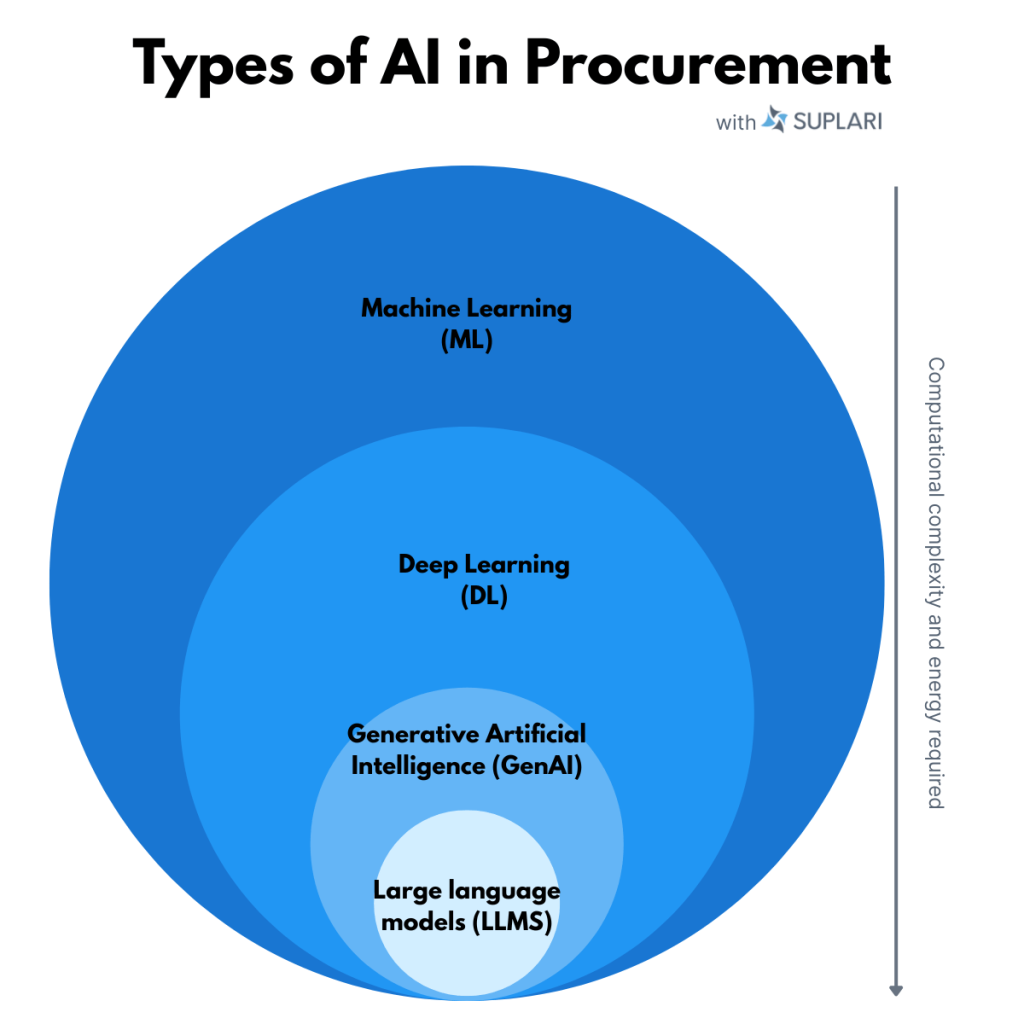
There are different types of machine learning:
- Supervised learning uses labeled examples to make predictions, like training a model on historical supplier performance to predict future risks.
- Unsupervised learning finds hidden patterns in unlabeled data, such as grouping similar suppliers without predefined categories.
- Reinforcement learning improves through trial and error, like optimizing procurement workflows through repeated interactions.
Think of ML like teaching a child to recognize animals. Instead of giving them a list of rules ("dogs have four legs, fur, and bark"), you show them thousands of pictures labeled "dog" or "not dog" until they learn to identify dogs on their own. Machine learning works similarly, but with data instead of pictures. Each form of ML will have their own pre-set training rules to achieve the key task.
Machine learning vs. other forms of AI
The key distinction is between traditional machine learning models and modern generative AI solutions. Traditional ML models focus on narrow, specific tasks and require substantial training data.
You’d rarely encounter them as a procurement executive, but many of the tools you use every day may use ML to solve specific data management tasks.
On the other hand, Generative AI models can understand context, reason through problems, and explain their decisions in natural language. 94% of procurement executives use genAI tools like ChatGPT each week.
What machine learning actually means in procurement
When technical teams talk about machine learning, they mean traditional bespoke models trained on large datasets to perform specific tasks.
These models differ significantly from foundational AI models found in ChatGPT. Building a custom ML model costs significantly less than training a foundational model, which can run $10 million per training session. Only a few companies worldwide can afford that investment.
On the other hand, ML is a more direct and cost effective way to solve specific problems. You could train a model specifically for your data and your use cases. For example, a data scientist or procurement analyst could develop a machine learning model to automate part of the monthly reporting for a procurement organization.
Traditional ML use cases in procurement
Suplari has spent years building and refining AI solutions for procurement, and we've identified the primary use cases where ML delivers real value:
Spend analysis and classification
Spend classification and categorization is the poster child for ML in procurement. At Suplari, we've been developing AI models since 2017, so we know what we're talking about. The idea was simple: train a model on your existing categorized spend data, then let it automatically classify new transactions.
A trained ML model can categorize future transactions, so even if you have thousands already categorized, it would still be useful to have ML categorize future transactions. However, the explainability problem emerges here. If you find the model miscategorizes transactions, you don't know why and you must retrain to fix them—whereas a rule-based system can easily explain errors and be corrected.
Even when we successfully trained these models at Suplari, they created more problems than they solved. Each model was specific to one customer's data structure and categories. Because of the limitations of ML, you couldn't easily reuse the investment across multiple clients.
Supplier risk mitigation
ML has shown some success in identifying supplier risk patterns, particularly in detecting unusual payment behaviors or supplier financial anomalies. These models can flag suppliers showing signs of financial distress or unusual transaction patterns. Suplari integrates these capabilities into its supplier intelligence module to help procurement teams identify risks before they impact operations.
The effectiveness varies significantly by industry and use case. Risk detection works better when you have clear patterns of normal behavior to train against. But even here, the models require constant updating as business conditions and supplier behaviors evolve.
Automated vendor management
ML can assist with automated vendor management by learning patterns in vendor performance data. Some procurement organizations use ML to trigger alerts when vendor performance metrics deviate from historical baselines, enabling faster response to quality or delivery issues.
The challenge is that these models remain narrow in scope—they typically handle one vendor category or performance metric at a time, requiring separate model development for different vendor types.
Demand forecasting and planning
ML excels at time-series forecasting, making it valuable for demand planning in procurement. By analyzing historical purchase patterns, seasonal variations, and growth trends, ML models can predict future demand with reasonable accuracy. This enables procurement teams to optimize inventory levels and negotiate better terms with suppliers based on forecasted needs.
Suplari's demand forecasting capabilities leverage both traditional ML and modern generative AI to provide more robust predictions that adapt to changing market conditions.
Contract management
ML can assist with contract analysis by extracting key terms and clauses from contract documents. Some organizations have deployed ML models that identify contract expiration dates, renewal terms, pricing escalations, and other critical obligations. This supports more proactive contract lifecycle management.
However, contract management remains a domain where explainability is critical. Procurement teams need to understand exactly what terms and obligations the system identified, making the black box problem particularly problematic.
AI chatbots and assistants
Procurement departments increasingly deploy AI chatbots and assistants to answer questions about spend data, supplier information, and procurement policies. While these systems often use ML components, the most effective modern systems integrate generative AI and agentic AI to provide natural language understanding and reasoning capabilities.
Suplari offers AI-powered assistant capabilities that go beyond traditional ML chatbots to understand context and reason through complex procurement questions.
Key limitations of ML in procurement
While machine learning has some use cases in procurement, it also comes with some key limitations.
The data readiness problem
Gartner recently found that 74% of procurement leaders say their data isn't AI-ready. This statistic reveals the fundamental challenge with ML approaches.
Machine learning requires large, curated, cleansed datasets. Most procurement organizations struggle with data scattered across ERP systems, inconsistent formats, and incomplete records. Your spend data might be trapped in systems that make extraction difficult and expensive.
To put it simply: ML models can't work magic with poor data. They amplify existing data quality problems rather than solve them.
The black box dilemma
Traditional ML models operate as black boxes. They take input data and produce outputs, but they can't explain their reasoning. For a spend classification model, you might get a category assignment with no understanding of why the system chose that category.
This lack of explainability creates serious problems in procurement:
- You can't verify the model's logic
- Auditors can't trace decision-making processes
- You can't identify when or why the model makes errors
- Team members can't learn from or improve the system's decisions
In procurement, where you need to justify decisions and maintain compliance, black box systems create more risk than value.
Economic challenges that don't add up
Custom ML models require significant upfront investment. You pay for data preparation, model training, testing, and deployment. Then you need ongoing maintenance as your data and requirements change.
The return on investment rarely justifies these costs. Models address narrow use cases and require specialized expertise to maintain. Many organizations spend more on ML implementation and maintenance than they save through improved processes.
For more information on the cost of building advanced analytics, refer to our “Build or Buy Spend Analytics” guide.
The reusability problem
Each ML model becomes a custom solution for specific data and requirements. You can't easily apply insights from one implementation to another. This makes scaling ML solutions across multiple data sets or use cases extremely expensive.
Error detection and correction also prove difficult. When an ML model makes mistakes, identifying the root cause and fixing it requires significant technical expertise. Most procurement teams lack this specialized knowledge.
Why generative AI changes everything
Generative AI models like Claude or GPT-4 approach procurement challenges differently. Instead of training narrow models for specific tasks, they leverage general intelligence to understand and reason about procurement problems.
Explainable reasoning
Unlike traditional ML models, generative AI can explain its decisions. When it categorizes a line item, it can generate a rule explaining the logic: "I assigned this to consulting because the vendor is McKinsey, the account code indicates professional services, and the description mentions strategic advisory work."
This explainability solves the black box problem. You can understand, verify, and improve the system's reasoning. Your team can learn from the AI's decisions and build institutional knowledge.
No training data requirements
Generative AI doesn't need thousands of pre-categorized examples to work effectively. It can analyze new spend data and apply general reasoning to make categorization decisions. This eliminates the chicken-and-egg problem of needing good data to get good results.
Cross-customer applicability
Because generative AI uses general reasoning rather than pattern matching on specific datasets, solutions work across different organizations and data structures. You can apply the same approach to multiple customers without custom model training. GenAI can be customized with more specific prompts, additional documentation and tools specific to a task or customer domain whereas ML needs to be retrained.
Better performance with reasoning
Generative AI doesn't just match patterns; it reasons through problems. It can handle complex scenarios that would require multiple specialized ML models. The reasoning capability means it can adapt to new situations without retraining.
ML vs GenAI cost comparison
While Generative AI is largely superior to ML, you should also recognize the cost impact when evaluating different options.
Generative AI costs more per transaction than traditional ML models. Running AI analysis on large datasets can cost hundreds or thousands of dollars compared to pennies for ML inference.
But this comparison misses the bigger picture. Generative AI eliminates the massive upfront costs of model development, training, and maintenance. You get better results with lower total investment and faster implementation.
For most procurement use cases, the superior accuracy and explainability of generative AI justify the higher per-transaction costs.
The procurement data challenge
Your procurement data presents unique challenges that make traditional ML particularly difficult. Most organizations deal with billions of tokens worth of data across multiple systems and formats.
New economic unit: tokens
When you’re exploring the cost of generative AI and agentic AI solutions, you’re introduced to a new way to measure costs - tokens. A token in AI is the basic unit that language models use to process text. Think of tokens as the "chunks" that AI systems break text into before analyzing it.
When foundational model providers announce support for millions of tokens, procurement professionals sometimes think this solves their data challenges. A million tokens sounds impressive, but it represents roughly 750,000 words, not millions of data records.
Your spend data, contract archives, and supplier information typically require processing billions of tokens. No single foundational model can analyze your complete dataset in one operation.
This is where agentic AI approaches shine. Instead of trying to process everything at once, AI agents can work systematically through your data, applying reasoning and analysis to manageable chunks while maintaining context across the broader dataset.
Moving beyond traditional machine learning
The procurement technology landscape has evolved beyond traditional ML approaches. Instead of training narrow models for specific tasks, leading organizations now deploy AI agents that can reason through complex procurement challenges.
These agents don't just categorize spend or detect anomalies. They can monitor contract performance, analyze supplier risk, optimize sourcing strategies, and provide ongoing intelligence about your procurement operations.
The shift represents moving from reactive pattern matching to proactive intelligence that adapts to your changing needs.
Bottom line on machine learning in procurement
Machine learning represented an important step in procurement technology evolution. It showed us the potential of automated spend analysis and pattern recognition. But the limitations have become clear: high costs, narrow applications, black box decision-making, and demanding data requirements.
Generative AI addresses these fundamental limitations while delivering superior results. Instead of training narrow models for specific tasks, modern AI systems, like Suplari’s AI Procurement Agent reason through complex procurement challenges and explain their decisions in plain language.
The lesson isn't that machine learning failed. It's that better alternatives now exist. Focus your technology investments on solutions that provide explainable reasoning, work with imperfect data, and adapt to your evolving needs without constant retraining. To compare your options, request a demo with Suplari today.


