




SAP Spend Control Tower is SAP's spend analytics command center, announced at SAP Spend Connect Live in October 2023, generally available from 2024, and the replacement for SAP Ariba Spend Analysis, with existing Ariba Spend Analysis customers transitioned across in organized waves. The alternatives divide into three groups: best-of-breed spend analytics such as Suplari, which runs alongside SAP, rival source-to-pay suites from Coupa, GEP, Zycus, Ivalua and Jaggaer, and Oracle's ERP-native analytics. The decision axis is how much of your spend actually flows through SAP systems, and how much configuration work the non-SAP sources will need.
SAP has recently started migrating from SAP Ariba Spend Analysis to a new SAP Spend Control Tower, but many organizations find that its complexity, steep learning curve, and SAP ecosystem dependency drive them to consider other solutions.
In this article we compare SAP spend analytics against other highly rated procurement analytics software. Six alternatives are covered in full, one best-of-breed platform and five source-to-pay suites, each with the trade-off that decides it stated in both directions.
- Suplari
- Coupa
- GEP Quantum Intelligence (GEP Qi)
- Zycus
- Ivalua
- Jaggaer
To compile this list, we looked at Gartner Peer Insights reviews by customers, comparable spend management suites and best-of-breed spend analytics providers, combined with our own research.
The table carries eight rows because it also shows the two ERP-native incumbents, SAP Ariba and Oracle Fusion, for reference. The six vendor sections below cover the alternatives themselves.
For this comparison we read Gartner Peer Insights customer reviews, checked each vendor's own product documentation, and added our own research on SAP-adjacent analytics deployments. Vendor facts were verified on 25 August 2026.
Full disclosure: we're a little biased. Suplari sells procurement intelligence software and appears first in the list below. Suplari also sits alongside SAP as the intelligence layer, which is the honest framing for most SAP estates.
What is SAP Spend Control Tower?
SAP Spend Control Tower is SAP's next-generation spend analytics software, serving as a command center for enterprise-wide spend analysis within SAP's data ecosystem. SAP positions it as the single place where spend across the estate is analyzed.
Announced in 2023 and made generally available in 2024, it replaces SAP Ariba Spend Analysis as SAP's primary spend analytics offering. Customers with current contracts for SAP Ariba Spend Analysis are being transitioned to SAP Spend Control Tower in organized waves. As of August 2026, sap.com still presents Spend Control Tower under that name and still describes it as the replacement for SAP Ariba Spend Analysis, so the naming in this guide holds.
SAP Spend Control Tower is designed to provide visibility and actionable insights into enterprise spend flowing to SAP solutions such as SAP S/4HANA and SAP ERP Central Component (SAP ECC), as well as non-SAP systems. Teams running several ERPs report that the non-SAP half of that promise carries additional configuration and technical support work.
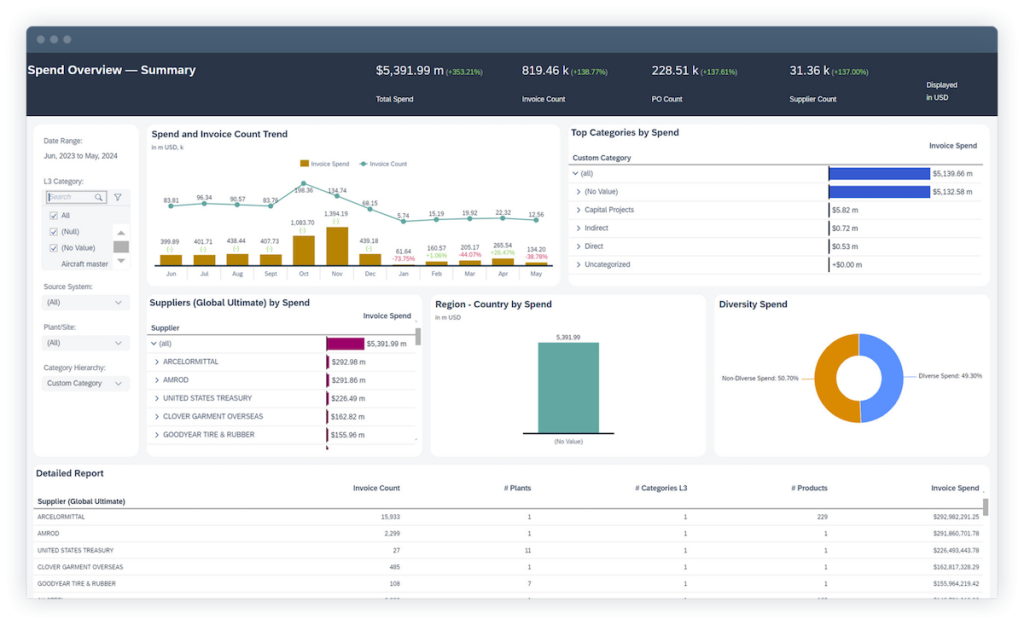
SAP Spend Control Tower spend analytics dashboard. Source: sap.com
Announced in 2023 and made generally available in 2024, it will replace SAP Ariba Spend Analysis as SAP's primary spend analytics offering. Customers with current contracts for SAP Ariba Spend Analysis are being gradually transitioned to SAP Spend Control Tower in organized waves.
SAP Spend Control Tower is specifically designed to provide visibility and actionable insights into enterprise spend flowing to SAP solutions like SAP S/4HANA or SAP ERP Central Component (SAP ECC), as well as non-SAP systems.
What is SAP Ariba Spend Analysis?
SAP still offers a spend analytics module as part of its broader SAP Ariba spend management solution, deeply integrated within the SAP ERP data ecosystem. The platform builds on comprehensive source-to-pay capabilities and uses the extensive SAP Business Network for supplier collaboration.
Core architecture and approach
SAP Ariba's spend analytics module relies on SAP's Datasphere and SAP Analytics Cloud frameworks, creating a deep connection to broader SAP ERP implementations. This architecture emphasizes standardizing procurement workflows while drawing on network effects from one of the industry's largest supplier ecosystems.
The methodology focuses on process orchestration and supplier collaboration, with AI-powered capabilities delivered through SAP's Joule copilot integration. The approach prioritizes structured, compliant procurement processes aligned with SAP's enterprise resource planning philosophy.
Key characteristics of SAP Ariba Spend Analysis
- Deep SAP ERP integration: native connectivity to SAP Datasphere and SAP Analytics Cloud frameworks provides direct data flow within SAP environments, removing many integration challenges for SAP-committed organizations.
- Extensive supplier network: access to SAP's global supplier ecosystem with proven collaboration tools enables efficient supplier relationship management and procurement execution.
- SAP Joule copilot: generative AI integration automates inquiries, generates supplier summaries, and provides AI-driven invoice processing capabilities.
- Standardized workflows: an emphasis on structured, repeatable procurement processes ensures consistency and compliance across the organization.
SAP Ariba's approach works well for organizations fully committed to the SAP ecosystem. It presents real challenges for companies with mixed technology environments, non-SAP ERP systems, or teams that need faster implementations.
Top options for SAP spend analytics
1. Suplari, best alternative for AI-first procurement intelligence
Type: best-of-breed spend analytics
Suplari is a procurement intelligence solution that helps businesses modernize procurement operations using AI. Suplari provides actionable intelligence to manage suppliers, deliver savings and manage compliance beyond the limits of traditional spend analytics. Suplari's AI data management foundation lets enterprise businesses modernize procurement operating models with reliable, AI-ready data.
Key differentiators:
- AI procurement agents: autonomous execution of multi-step tasks including overcharge detection and automatic dispute workflow launching
- Real-time continuous analytics: algorithms run continuously rather than in batch processes, providing immediate alerts and insights
- Insight Generator with Connect workflows: AI-powered opportunity identification wired directly into workflow tools
- Customer satisfaction: 4.6/5 on Gartner Peer Insights, from 15 ratings, checked 25 August 2026
Integrations: SAP, Oracle, NetSuite, Microsoft Dynamics, Workday, Coupa, and other major ERP and S2P systems. As a spend analytics platform, Suplari connects to any data source without requiring organizations to change their existing transaction platforms.
Why choose Suplari over SAP Spend Control Tower: Suplari's autonomous agents go further than SAP's Business AI features, and the interface requires less training than SAP Analytics Cloud. Implementation runs to weeks or months, against many months for an SAP transition. Suplari works across any ERP environment, SAP included, so it sits alongside SAP Ariba and S/4HANA as the intelligence layer over data those systems already hold.
Best for: mid-to-large enterprises with mature procurement functions seeking early adoption of AI-driven procurement analytics. Suits organizations managing complex, multi-ERP environments that need advanced data integration without SAP dependency.
Pick Suplari if a meaningful share of spend sits outside SAP and you want analytics without a migration project. Look elsewhere if you need transactional procurement modules such as sourcing, contracts and invoicing from the same vendor, because Suplari does not sell them.
2. Coupa, transaction-based intelligence
Type: source-to-pay suite
Coupa's spend analytics solution is built around the Spend360 technology acquired in 2017, now deeply embedded in Coupa's source-to-contract suite. The platform processes transactions directly, capturing spending data in real time as employees make purchases. Coupa is owned by Thoma Bravo and acquired the orchestration vendor Tonkean in May 2026.
Key differentiators:
- Transaction-based data collection: real-time spend visibility as purchases happen through the Coupa platform
- Benchmarking against anonymized data: insights drawn from approximately $8 trillion in annual customer transactions
- Pre-built ERP connectors: SAP, Oracle and NetSuite integrations reduce implementation complexity
Integrations: SAP, Oracle, NetSuite and other major ERP systems via pre-built connectors. Coupa's analytics integrate natively with other Coupa S2P modules covering sourcing, contracts, invoicing and payments, drawing on the Coupa Business Spend Management platform's transaction data. Third-party data integration is available, and analytics capabilities are strongest for spend flowing through the Coupa platform itself.
Why choose Coupa over SAP Spend Control Tower: Coupa's interface requires less training than SAP's, and the platform works across diverse technology environments without SAP dependency. Implementations are typically faster and less resource-intensive than SAP transitions, and the transaction-based approach provides visibility without waiting for batch processing.
Best for: enterprise businesses looking to consolidate most procurement activities within a modern, user-friendly platform. Organizations needing both spend analytics and transaction processing in one place.
Pick Coupa if you are willing to move transactional procurement as well as analytics. Look elsewhere if you are staying on SAP for transactions, because Coupa's analytics are weakest for spend that never touches Coupa.
3. GEP Quantum Intelligence (GEP Qi), S2P with professional services
Type: source-to-pay suite
GEP has consolidated GEP SMART and GEP NEXXE into GEP Quantum Intelligence, branded GEP Qi, with GEP SMART fully supported and no forced migration. It is a unified, cloud-native source-to-pay solution built from one code base, originating from the GEP Worldwide consulting firm.
Key differentiators:
- Unified architecture: a single code base with native Microsoft Azure integration, which removes module integration challenges
- Full S2P coverage: comprehensive modules for most procurement technology needs
- Cross-industry experience: deep expertise across diverse customers and digital transformation initiatives
Integrations: Microsoft Azure native, with connectors for SAP, Oracle and other major ERP systems. GEP's professional services team supports complex integration projects.
Why choose GEP Qi over SAP Spend Control Tower: the cloud-native Microsoft Azure architecture carries fewer infrastructure requirements than SAP's, and the professional services heritage brings dedicated transformation expertise to the implementation. The platform offers deep customization without SAP-specific skills on your side of the table.
Best for: large, complex global enterprises with sophisticated procurement requirements seeking comprehensive S2P solutions for digital transformation outside the SAP ecosystem.
Pick GEP Qi if you want the software and the consultants who operate it from one supplier. Look elsewhere if your SAP investment is deep and recent, where a second suite duplicates what you already own.
4. Zycus, GenAI-first S2P suite
Type: source-to-pay suite
Zycus iAnalyze combines spend analysis and data management capabilities within the broader Zycus source-to-pay platform, emphasizing generative AI features. As of August 2026 Zycus presents spend analysis under its Merlin Agentic AI branding, with iAnalyze and the AutoClass engine continuing underneath it.
Key differentiators:
- AutoClass spend classification: a self-developed engine with four-level taxonomy classification
- Broad S2P platform: extensive capabilities across intake, negotiation and contract management
- Global presence: international market coverage beyond core North American and European markets
Integrations: SAP, Oracle and other major ERPs. Zycus provides pre-built connectors and supports EDI, cXML and other procurement data standards. Our guide to Zycus iAnalyze alternatives covers the platform in more depth.
Why choose Zycus over SAP Spend Control Tower: organizations prioritizing early adoption of GenAI-powered features will find the Zycus AI-first approach more advanced than SAP's Business AI integration. The platform offers faster time to value and greater flexibility without requiring SAP infrastructure or SAP-specific expertise.
Best for: large enterprises and mid-market companies seeking early adoption of GenAI-powered source-to-pay features with strong change management capabilities, without SAP infrastructure dependencies.
Pick Zycus if you want one vendor across intake, sourcing, contracts and analytics. Look elsewhere if your data is messy today, because reviewers consistently report significant upfront cleansing before classification accuracy settles.
5. Ivalua, unified platform
Type: source-to-pay suite
Ivalua's Spend Analytics module is part of a broader source-to-pay platform built on a single-codebase philosophy developed organically. Franck Lheureux has been CEO since January 2025, with founder David Khuat-Duy serving as Executive Chairman and Chief AI Officer.
Key differentiators:
- Unified platform architecture: a single codebase and data model that removes data silos
- High configurability: on-demand classification with simple user interface imports
- Transparency: classification rules visible within the user interface
Integrations: SAP, Oracle and other major ERP systems. Ivalua's single-codebase architecture simplifies data integration across the platform.
Why choose Ivalua over SAP Spend Control Tower: Ivalua offers deeper configurability and more transparent classification than SAP Spend Control Tower, with more room for organizations whose procurement processes do not fit a standard template. Implementation complexity is typically lower than an SAP transition, and the platform works across diverse technology stacks.
Best for: large enterprises and sophisticated mid-market organizations ($500M-5B+ revenue) seeking a unified S2P platform with deep configurability outside the SAP ecosystem.
Pick Ivalua if your processes are genuinely unusual and you need to see and change classification logic. Look elsewhere if you want opinionated defaults and a short configuration phase.
6. Jaggaer, direct spend focus
Type: source-to-pay suite
Jaggaer ONE centralizes spend data from all departments using machine learning algorithms that automatically classify and group transactions, with a particular focus on direct spend management. Jaggaer has been owned by Vista Equity Partners since August 2024.
Key differentiators:
- Direct spend expertise: deep domain knowledge in direct material sourcing for manufacturers
- BOM management: bill of materials costing capabilities for complex manufacturing requirements
- Machine learning classification: automated transaction classification with continuous validation
Integrations: SAP, Oracle and other major ERPs, with specialized connectors for manufacturing systems, MRO platforms and direct materials procurement.
Why choose Jaggaer over SAP Spend Control Tower: organizations with significant direct spend and complex manufacturing requirements benefit from Jaggaer's specialized functionality, which goes beyond SAP's general-purpose approach. The platform offers industry-specific capabilities without requiring SAP ecosystem commitment or extensive SAP expertise.
Best for: large enterprises in manufacturing, healthcare, higher education and government requiring industry-specific functionality and complex direct spend capabilities without SAP ecosystem requirements.
Pick Jaggaer if direct materials and BOM costing are the analytics problem. Look elsewhere if your spend is overwhelmingly indirect, where the specialization stops earning its cost.
Why consider SAP spend analysis alternatives?
SAP Ariba holds a strong position in the ERP data landscape. Five limitations still drive organizations to explore alternative solutions.
- User experience challenges: consistent feedback highlights cumbersome and non-intuitive interfaces requiring extensive training. Even basic functionality often involves complexity that slows adoption.
- Integration complexity with non-SAP systems: organizations with mixed technology environments face additional configuration requirements and technical support needs when connecting non-SAP systems to SAP's spend analytics.
- Steep learning curve: the extensive feature set creates significant training burdens for teams needing to accomplish straightforward procurement tasks.
- Implementation resources: SAP implementations typically require substantial investment in training, change management, and often external consultants to achieve successful deployment.
- Vendor lock-in concerns: tight coupling with the SAP ecosystem creates challenges for organizations wanting flexibility in their technology choices.
If you want more intuitive interfaces, faster implementations, advanced AI capabilities independent of SAP infrastructure, or solutions that work across diverse technology stacks, these alternatives deserve serious consideration. Where none of those describes your estate, the migration to Spend Control Tower is the lower-effort path and the next section says why.
Key selection criteria for SAP spend analytics alternatives
Seven factors decide most SAP Spend Control Tower shortlists. They appear here in the order buyers usually hit them, starting with the one that settles the question fastest.
- Technology stack independence: if you operate in a mixed technology environment or want to avoid vendor lock-in, best-of-breed solutions such as Suplari offer more flexibility than SAP's ecosystem dependency allows.
- User experience priority: organizations prioritizing user adoption and minimizing training requirements should consider alternatives with more intuitive interfaces, such as Suplari or Coupa, against SAP Spend Control Tower's SAP Analytics Cloud interface.
- Implementation timeline and resources: if faster time to value is critical, best-of-breed solutions typically implement in weeks to months, against the many months required for SAP Spend Control Tower transitions.
- AI and automation maturity: Suplari's autonomous agents and the Zycus GenAI-first approach offer more accessible AI functionality than SAP's Business AI integration within Spend Control Tower. Our roundup of the top procurement intelligence platforms sets these side by side across a wider field.
- Data environment complexity: organizations with multiple ERP systems, including non-SAP, need solutions with advanced data integration that works across platforms, a strength of Suplari next to SAP Spend Control Tower's SAP-optimized approach.
- Migration considerations: organizations currently using SAP Ariba Spend Analysis should evaluate whether migrating to Spend Control Tower makes sense against adding a technology-agnostic analytics layer over what they already run.
- Total cost of ownership: consider licensing costs alongside implementation expenses, ongoing training requirements, change management resources, and the need for specialized SAP expertise. SAP Spend Control Tower typically requires substantial investment across all of these.
When SAP Spend Control Tower makes sense
Four scenarios make SAP Spend Control Tower the right choice. All four turn on how much of the estate SAP already holds.
- Organizations with fully SAP-centric environments deeply committed to the SAP ecosystem
- Enterprises already using multiple SAP solutions such as S/4HANA, Ariba, Fieldglass and Concur, seeking maximum native integration
- Companies with existing SAP Ariba Spend Analysis contracts and dedicated SAP support teams willing to invest in the transition
- Highly regulated industries prioritizing standardized, structured procurement processes aligned with SAP's compliance frameworks
Even SAP-committed organizations increasingly add best-of-breed spend analytics such as Suplari to gain deeper analytical capability and AI-powered automation, while keeping SAP Ariba or other SAP solutions for transactional processes. The two layers do different jobs, and running both is a common and sensible pattern.
Bottom line on SAP spend analysis
SAP Spend Control Tower is an improvement on the legacy SAP Ariba Spend Analysis platform. Its complexity, SAP ecosystem dependency, implementation requirements and learning curve still drive many enterprises to explore more flexible and more intuitive alternatives.
Suplari is the highest-rated SAP Spend Control Tower alternative on Gartner Peer Insights at 4.8/5, with AI procurement agents that go beyond SAP's Business AI capabilities and real-time continuous analytics behind an interface that requires minimal training. Organizations choosing Suplari gain autonomous procurement intelligence that works across any ERP environment, SAP included, which is why it usually runs alongside SAP rather than replacing it.
Whether you are facing the Spend Control Tower transition, evaluating SAP's analytics capabilities for the first time, or looking to add an analytics layer above a mixed estate, the alternatives in this guide offer workable paths forward.
Ready to see how this works against your own SAP data? Book your Suplari demo.

