




The strongest Coupa alternatives for spend analytics are Suplari for AI-native intelligence across every system, GEP Quantum Intelligence, Ivalua, Zycus and JAGGAER for full source-to-pay consolidation, and SAP Ariba or Oracle Fusion for ERP-committed estates. Coupa Analytics itself is the spend analytics capability inside Coupa's source-to-pay suite, built on Spend360 technology acquired in 2017, so it sees spend flowing through Coupa clearly and spend outside it far less well. That single fact decides most comparisons.
Based on how the market segments, the alternatives fall into three types. The type you need is usually decided before any feature comparison starts.
- Best-of-breed spend analytics. Suplari, an AI-native procurement intelligence platform that unifies spend from every system and deploys in 45-90 days without a suite replacement.
- Source-to-pay suites. GEP, Ivalua, Zycus and JAGGAER, for organizations that want full source-to-pay consolidation under one vendor.
- ERP suites. Oracle Fusion and SAP Ariba, for organizations already committed to that ERP.
Ratings were read from Gartner Peer Insights on 25 August 2026. The suite and ERP vendors sit in the Source-to-Pay Suites market and Suplari sits on its own product profile, so these scores rank satisfaction within a review population rather than head to head. Review volumes differ by a factor of forty, which matters more than the decimal places do.
Full disclosure: we're a little biased. Suplari sells procurement intelligence software and appears in the list below, in the role we actually play, as the intelligence layer that runs across whatever suites and ERPs an enterprise already owns.
Coupa Analytics platform overview
Coupa's spend analytics is built around Spend360, one of the early best-of-breed spend analytics platforms, which Coupa acquired in 2017 and has since embedded across its source-to-contract modules. The architecture captures spend at transaction level as employees buy through Coupa, so the analysis reflects procurement activity as it happens.
Key features of Coupa Analytics:
- Transaction-based data collection. Spending data is captured as purchases move through Coupa, giving real-time visibility tied directly to transaction flow.
- Benchmarking. Coupa draws on anonymized data across its customer base, representing roughly $8 trillion in annual transactions, so buyers can compare performance against industry peers.
- Prebuilt ERP connectors. Native integrations with SAP, Oracle, NetSuite and other major systems reduce the work of connecting external data sources.
- Embedded suite integration. Since the Spend360 acquisition the analytics have been tied into Coupa's source-to-contract modules, giving one platform experience across sourcing, contracts, invoicing and payments.
Two ownership facts belong in any 2026 evaluation. Coupa has been owned by Thoma Bravo since taking the company private, it acquired the intake and orchestration vendor Tonkean on 21 May 2026, and on 24 August 2026 it named Mike Lipps interim CEO after Leagh Turner stepped down. Coupa states that neither its business direction nor its ownership structure changes with the leadership transition.
The approach works well for organizations that route most procurement through Coupa. It gets harder for companies carrying several ERPs after acquisitions, or with significant spend that never touches the platform, where the analysis only sees the part of the picture Coupa processed.
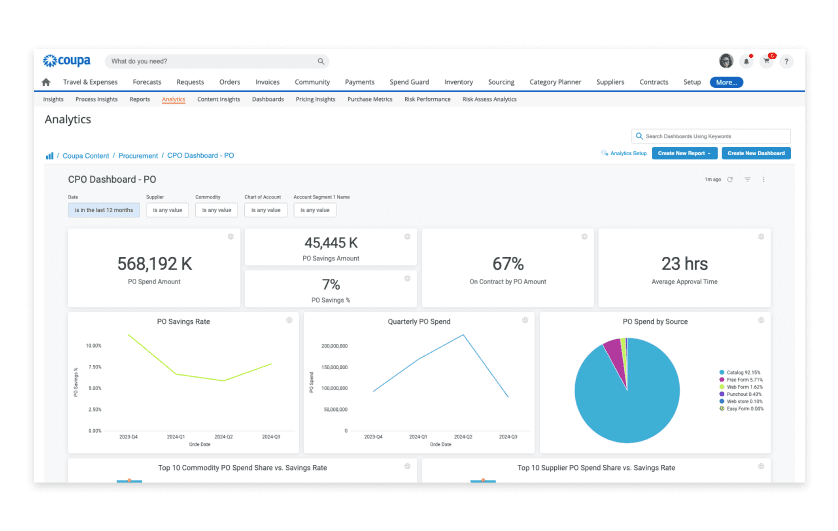
Coupa Spend Analytics Dashboard. Source:coupa.com
The 7 best Coupa Analytics alternatives
1. Suplari, best alternative for AI-first procurement intelligence
Suplari is a best-of-breed procurement intelligence platform that unifies enterprise spend data and applies procurement-specific AI agents to it, so teams can manage suppliers, deliver savings and monitor compliance without replatforming what sits underneath. Its AI data foundation is built to work with imperfect data from day one, which is the condition most multi-ERP estates are actually in.
Key differentiators:
- AI procurement agents that execute multi-step tasks, including overcharge detection and launching a dispute workflow
- Continuous processing so alerts arrive when the anomaly happens, not at the next batch refresh
- 175+ prebuilt insights generated automatically against unified spend data
- Closed-loop savings tracking that ties an identified opportunity to a realized P&L number
Integrations: SAP, Oracle, NetSuite, Microsoft Dynamics, Workday, Coupa and other major ERP and source-to-pay systems. Suplari connects to any data source and leaves existing transaction platforms in place, which is why it runs on top of a Coupa estate as readily as beside one.
Time to value: deployment typically runs 45-90 days, with most customers reaching spend visibility and initial ROI within 90 days. Automated classification and normalization across multiple ERPs is what makes that timeline possible.
How it differs from Coupa Analytics: Coupa analyzes the spend its own workflows created. Suplari is the spend analytics platform above the suite layer, reading Coupa alongside every other system that holds spend, which is the difference that matters for estates where Coupa covers part of the buying.
Recognition: ProcureTech100 (2025/26), The Hackett Group "50 to Know" (2025/26), top scores in Spend Matters SolutionMap (2025), and 4.6/5 from 15 ratings on its Gartner Peer Insights product profile as of 25 August 2026.
Pick Suplari if your spend sits in several systems and you want intelligence and savings tracking running before any suite decision is settled. Look elsewhere if you need the transactional plumbing itself, since Suplari does not run sourcing events, contracts or payments.
2. GEP, source-to-pay with professional services
GEP is a source-to-pay suite backed by a consulting and managed services business. It originated in the GEP Worldwide consulting firm and is built from a single code base with native Microsoft Azure integration.
A naming note that matters in 2026. GEP has consolidated GEP SMART and GEP NEXXE into GEP Quantum Intelligence (GEP Qi), its AI-native agentic platform, and states that GEP SMART "remains fully supported" with no forced migration timeline. Vendor lists published earlier this year still say GEP SMART, and so does Gartner Peer Insights, so both names refer to the same software estate. Our GEP SMART spend analytics alternatives page covers the rename and what sits under Qi in detail.
Key differentiators:
- One code base across sourcing, contracts, supplier management, category management, procure-to-pay, risk and ESG
- Software, consulting and managed services sold as one engagement, with GEP teams able to run data management and classification on the client's behalf
- Placed in the Leaders quadrant of the Gartner Magic Quadrant for Source-to-Pay Suites published 21 January 2026, its second consecutive year
- $150B in spend managed across 140 countries, per GEP
Integrations: Microsoft Azure native, with connectors for SAP, Oracle and other major ERP systems, supported by GEP's professional services team on complex integration projects.
Pick GEP over Coupa if you want one partner accountable for the software and the procurement work itself, and you are running a transformation program on that scale. Look elsewhere if you want to keep data management capability in house, because the managed services dependency is the point of the model.
3. Zycus, GenAI-first source-to-pay
Zycus iAnalyze combines spend analysis and data management inside the broader Zycus source-to-pay platform. The company has pushed generative AI across its modules earlier and harder than most of its peers.
Key differentiators:
- AutoClass classification engine with a four-level taxonomy structure
- Broad platform coverage across intake, negotiation and contract management
- International presence beyond core North American and European markets
- Change management support scoped for large deployments
Integrations: SAP, Oracle and other major ERPs, with prebuilt connectors and support for EDI, cXML and other procurement data standards.
Pick Zycus over Coupa if early generative AI adoption inside a single suite is a stated goal and you want one vendor carrying it. Look elsewhere if the analytics requirement is urgent and independent of a suite decision. Our Zycus iAnalyze alternatives page compares it against best-of-breed options.
4. Ivalua, unified platform
Ivalua's spend analytics module is part of a source-to-pay platform built on a single code base and grown organically, which shows up as consistency in the data model across modules. Franck Lheureux has been CEO since January 2025, with founder David Khuat-Duy now Executive Chairman and Chief AI Officer.
Key differentiators:
- One codebase and one data model across the procurement lifecycle
- Configurability well beyond suite norms, with on-demand classification and interface-level data imports
- Classification rules visible and editable inside the interface
- 4.7/5 from 130 reviews on Gartner Peer Insights
Integrations: SAP, Oracle and other major ERP systems.
Pick Ivalua over Coupa if your procurement processes are genuinely unusual and you need to see and change how classification decides things. Look elsewhere if you want a fast standard implementation, because configurability of this depth is paid for in project time.
5. JAGGAER, direct spend focus
JAGGAER ONE centralizes spend data across departments using machine learning to classify and group transactions, with unusual depth in direct materials. Vista Equity Partners has owned the company since 13 August 2024.
Key differentiators:
- Direct materials expertise for manufacturers, covering categories most suites treat as an afterthought
- Bill of materials costing for complex manufacturing requirements
- Machine learning classification with continuous validation
- Sector-specific functionality for manufacturing, healthcare, higher education and public sector
Integrations: SAP, Oracle and other major ERPs, plus specialized connectors for manufacturing systems, MRO platforms and direct materials procurement.
Pick JAGGAER over Coupa if direct spend and BOM cost breakdown are where your savings live. Look elsewhere if your spend is mostly indirect and services, where the specialization stops paying for itself.
6. SAP Ariba, SAP ERP specialists
SAP Ariba's spend analytics module is built to sit inside the SAP data estate, drawing on SAP Datasphere, SAP Analytics Cloud and the SAP Business Network. SAP has not renamed Ariba, and the supplier module is still SAP Ariba Supplier Lifecycle and Performance.
Key differentiators:
- Native connection to SAP Datasphere and SAP Analytics Cloud
- Access to the SAP Business Network supplier ecosystem
- SAP Joule for automating inquiries and generating supplier summaries
- The second-largest review population in its Gartner Peer Insights market at 557 reviews
Integrations: native SAP integration across S/4HANA, Datasphere and Analytics Cloud, with less flexibility for non-SAP sources than best-of-breed solutions offer.
Pick SAP Ariba over Coupa if SAP is the system of record and you want procurement analytics inside that architecture. Look elsewhere if you run several ERPs, since the native advantage weakens fast outside SAP.
7. Oracle Fusion Procurement Analytics, enterprise ERP integration
Oracle Fusion Procurement Analytics uses unified ERP architecture to combine financial, procurement and operational data in one analytical layer. The coupling is tight because the analytics live in the same cloud as the transactions they describe.
Key differentiators:
- Native connectivity across the Oracle application suite, removing separate data pipeline work
- A prebuilt analytics library of over 1,000 KPIs covering the procure-to-pay cycle
- Embedded generative AI for supplier recommendations and automated classification
- 4.3/5 from 104 reviews on Gartner Peer Insights
Integrations: native Oracle Cloud integration across ERP, HCM and SCM, best suited to organizations standardized on Oracle and weaker in multi-ERP environments.
Pick Oracle Fusion over Coupa if you are deeply invested in Oracle Cloud and want analytics inside that data model. Look elsewhere if Oracle is one ERP among several, where the native advantage does not apply.
Why procurement teams look for Coupa alternatives
Coupa's analytics are embedded in its source-to-pay platform. That integration pays off for organizations fully committed to the Coupa ecosystem, and three limitations drive the rest to look around.
Spend visibility stops at the platform edge. Transaction-based analysis means spend that never routed through Coupa never enters the analysis, which is a blind spot, and blind spots do not show up as missing rows in a report.
Implementation scope. Full platform implementations take more time and resource than best-of-breed analytics deployments, and a team under pressure to show savings this fiscal year notices the difference.
Configurability. Organizations wanting deep customization and control over classification often find Coupa's analytics less flexible than specialist tools built for that job.
How to choose between Coupa and the alternatives
Suite strategy or specialist layer. If procurement execution is being consolidated onto one platform anyway, the suite's analytics module comes with the decision. If execution stays distributed across systems, a specialist layer avoids forcing a suite decision you are not ready to make. Our essay on looking beyond your suite works through the architecture question, and our best spend analysis software comparison covers both routes vendor by vendor.
Data environment complexity. Multiple ERPs, recent acquisitions and separately run business units all raise the value of source-agnostic ingestion. Single-platform organizations get less from it.
Implementation timeline. Best-of-breed analytics reaches first insight in weeks. Suite programs are measured in quarters. Decide which clock you are on before the demos.
AI and automation maturity. Agentic capability is a live differentiator across this list. Ask each vendor which decisions its agents make without a human in the loop, what evidence they show for the decision, and what happens when one is wrong.
Existing technology stack. Organizations committed to SAP or Oracle often find the native ERP analytics a better long-term fit than adding a cross-platform suite. Our spend analysis solution guide covers how to scope the requirement before shortlisting.
The bottom line on Coupa Analytics
Coupa Analytics is a capable spend analytics layer for organizations whose buying already runs through Coupa, and its 695 Gartner Peer Insights reviews at 4.8/5 reflect a large, satisfied installed base. It is the right answer when the platform is the system of record for procurement.
The alternatives divide along three lines. GEP, Ivalua, Zycus and JAGGAER offer the same suite bargain with different strengths, so choosing among them is mostly about direct spend, configurability and existing footprint. SAP Ariba and Oracle Fusion are the answers when the ERP is the centre of the estate. A best-of-breed layer such as Suplari is the answer when spend lives in several systems and the analytics cannot wait for a suite decision. If you are scoping the wider market first, our guide to the top procurement intelligence platforms covers the category beyond the suite vendors.

