



The procurement technology landscape is evolving rapidly, accelerated by advances in artificial intelligence. The AI revolution is more than just a trend—it's a platform shift that redefines how organizations manage spend, optimize operations, and maintain competitive advantage over the next decade.
The latest trend to emerge is AI procurement agents, which combine the revolutionary potential of generative AI with the real-world business impact of process automation. Discover how agentic AI is changing the game and how Suplari can help you stay ahead.
What is an AI agent?
An AI agent is an autonomous system that uses advanced AI techniques to handle complex, multi-stage tasks with minimal human intervention. An AI agent doesn’t just automate; it adapts to new information in real time and refines its performance through continuous learning.
According to recent research by Deloitte, 74% of companies plan to deploy agentic AI within two years, up from 23% using it moderately today. Agentic AI is expected to have the highest impact in customer support, supply chain management, R&D, knowledge management, and cybersecurity. 85% of companies expect to customize agents to fit their unique business needs.
How AI agents work
AI agents are intelligent systems that perceive their environment, process information, and take autonomous actions to achieve specific goals. Here’s a breakdown of how they operate:
- User input or environmental triggers: AI agents can be activated by direct user input (e.g., a command or query) or by detecting signals from their environment through sensors, IoT devices, or other data sources.
- Decision-making process: At the core of an AI agent is its decision-making capability. Using large language models (LLMs), AI models, and best practice methodologies, the agent processes the input or environmental signals to determine the best action.
- Accessing tools and resources: AI agents interact with various tools to carry out their tasks, including application programming interfaces (APIs) or accessing the Internet.
- Autonomous actions and task delegation: Once the agent processes information and selects the best action, it can either perform the action directly or delegate tasks to other systems or team members to drive outcomes.
- Continuous learning and adaptation: Many AI agents improve over time by learning from their actions and outcomes. They adjust their behavior based on feedback, making them increasingly effective and responsive to changing conditions.
In summary, AI agents combine perception, decision-making, and action execution into a single, intelligent system. They leverage powerful tools and models to automate complex tasks, making them extremely adaptable to many procurement and sourcing tasks.
How AI agents differ from traditional AI
Until now, most artificial intelligence tools used in the enterprise consist of rule-based machine learning (ML) or human-in-the-loop generative AI technology. Their use has been limited to a high level of human oversight.
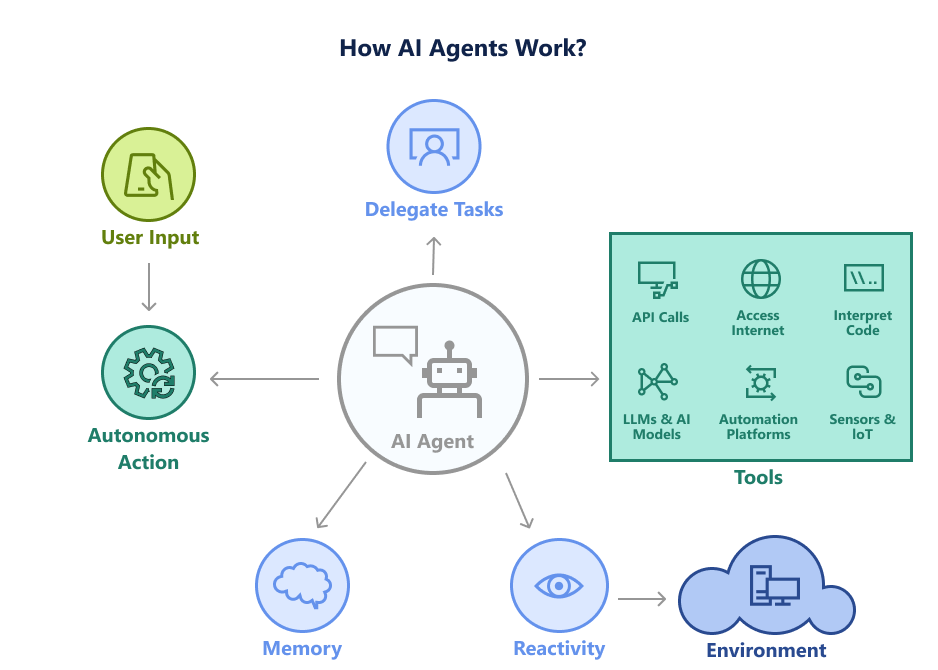
AI agents are designed to autonomously perceive their environment, process information, and take actions to achieve specific goals. Here’s how they stand apart from traditional AI interfaces:
Autonomous identification of opportunities
AI agents actively perceive their environment—such as data from spend analysis tools, supplier databases, and ERP systems—and process this information to execute multi-step processes.
For example, they can identify spend opportunities, gather supplier performance data, and schedule follow-up actions based on a single prompt or trigger event. By acting independently and leveraging real-time insights, they reduce manual effort and accelerate decision-making.
Self-learning adaptability
Unlike traditional AI, which requires human guidance for adjustments, AI agents learn continuously from past outcomes and real-time feedback. They process signals from their environment—such as sudden shifts in supply chain data—and recalibrate their actions accordingly. This makes them highly responsive and capable of adjusting their behavior without human intervention, even during disruptions or changing business conditions.
Strategic decision-making and task management
AI agents go beyond executing tasks—they can process contextual information and provide actionable recommendations.
By analyzing patterns in procurement data and best practices, they can assign tasks to stakeholders, monitor progress, and even suggest improvements for complex sourcing events or contract negotiations. Their ability to reason and act toward achieving business goals makes them valuable virtual advisors, aligning operations with strategic objectives.
This distinction highlights how AI agents differ from traditional AI: they actively sense, decide, and act to drive outcomes with autonomy, adaptability, and strategic insight.
Types of AI Agents
We’re still in the early days of agentic AI procurement technology. There are five key types of AI agents commonly used today:
1. Simple Reflex Agents
Simple reflex agents are the most basic type of AI agents. They act based on current inputs using predefined rules without considering past experiences. Their behavior is driven by "if-then" conditions, similar to many machine learning algorithms.
Example: A thermostat that turns on the heater when the temperature drops below a certain level.
2. Model-Based Reflex Agents
Model-based reflex agents use an internal model of the environment to make decisions. They track the state of the world and respond based on both current observations and stored information about how the world works.
Example: A self-driving car that uses maps and sensor data to navigate obstacles.
3. Goal-Based Agents
Goal-based agents act to achieve predefined objectives. They make decisions by evaluating different possible actions and selecting those that bring them closer to their goals.
Example: A navigation app that finds the shortest route to a destination.
4. Utility-Based Agents
Utility-based agents aim to optimize their actions for the best possible outcome. They use a utility function to measure the desirability of different states and choose the actions that maximize their overall benefit.
Example: A movie recommendation system that suggests films based on predicted user preferences.
5. Learning Agents
Learning agents can learn and improve from past experiences. They adapt their behavior over time based on feedback from their actions, allowing them to handle new situations more effectively.
Example: A virtual assistant that becomes better at understanding user commands the more it is used.

Why are AI agents emerging now?
AI agents are the next major technology shift after generative AI. You can see them as the smarter, more sophisticated versions of “co-pilots.” They can handle an even greater share of operational complexity and deliver tangible results in areas like cost savings, compliance, and supplier risk management.
Analysts at Deloitte predict that by 2025, a quarter of all companies using generative AI will launch agentic AI pilots—growing to half by 2027. If you’re aiming to keep your procurement strategies on the cutting edge, ignoring AI agents could mean missing out on significant gains in efficiency and agility.
AI agent examples in procurement
Suplari was among the first to adapt AI agents in 2018 in the form of our Insights Generator. This smart agent constantly scans your spend data looking for and highlighting opportunities to improve your business spend management.
It is expected that AI agents will be developed across many other sourcing and operational procurement functions over the next 12-24 months.
Imagine you want to define a strategy for a critical spend category. An AI agent could automatically gather all relevant data—transactional details, market insights, and supplier performance metrics—and propose a category plan based on that information.
Or consider contract performance: if you have multiple suppliers for the same service, an AI agent can monitor payment terms, performance history, and risk factors in real time, then build a plan to renegotiate or switch vendors where needed. It can even create a project plan, assign tasks, and handle follow-up actions autonomously.
In each of these scenarios, your role shifts from data collector to decision overseer. With an AI agent, you gain the freedom to focus on strategic questions—like long-term sourcing goals or new sustainability initiatives—while the agent tirelessly handles the operational details.
How AI agents transform procurement workflows
When you consider your current procurement processes, you might see a series of discrete activities: data gathering, spend analysis, sourcing strategy, negotiations, supplier performance management, and so forth. Each step often relies on different tools—an ERP for requisitions, a contract lifecycle management platform, a supplier risk database, and a manual spreadsheet somewhere in the mix. You or your team might spend hours pivoting between these applications, transferring data back and forth, and making sure everything aligns.
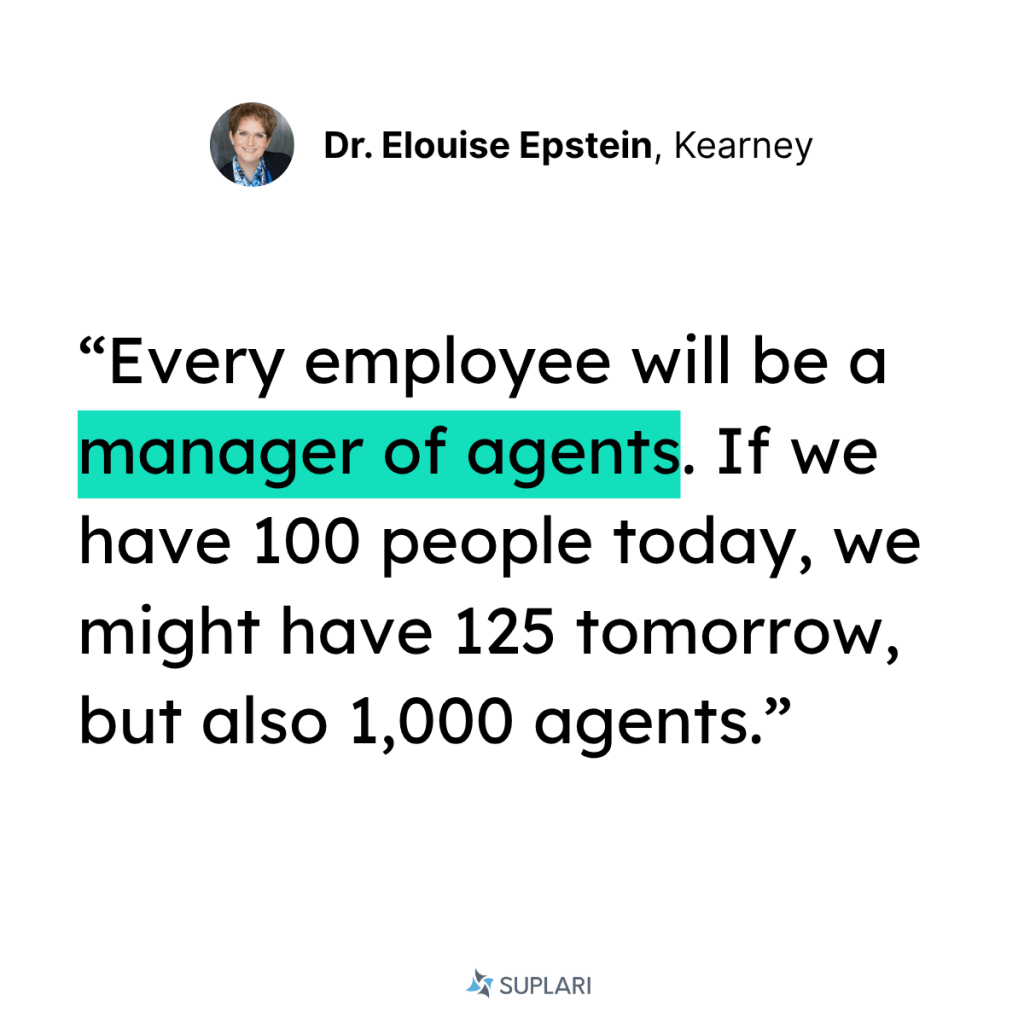
AI agents can drastically streamline this workflow. Think of an AI agent as a digital colleague that handles the repetitive, data-intensive tasks, thereby freeing you to focus on strategic decisions. Here’s a concrete scenario: Instead of manually collating spend information each month, you can delegate that responsibility to an AI agent. The agent pulls the latest spend data from your ERP, cross-references contract details, calculates variances, and then highlights anomalies or opportunities—such as an underutilized supplier agreement or a spike in particular category spend.
From there, the agent can go a step further. If it detects that certain supplier contracts are nearing expiration, it might prompt you (or the appropriate category manager) to launch a renegotiation process. But it won’t just schedule a reminder. Armed with historical performance data, market benchmarks, and any risk alerts, the agent can recommend negotiation angles and even draft an outline of key points. All you need to do is review the agent’s recommendations, adjust as necessary, and then give the green light.
The essentials of an AI Agent Platform—and how Suplari fits in
Implementing AI agents isn’t a matter of flipping a switch or merely installing a new module. You need the right platform—one designed for robust data handling, orchestration, and domain-specific knowledge. In procurement, that means unifying data from source systems like ERP, P2P, supplier portals, and financial records in a way that’s easy for AI to interpret.
- Data & analytics backbone
You’ve likely seen firsthand how messy procurement data can get: incomplete supplier profiles, inconsistent naming conventions, and outdated contract terms scattered across multiple systems. An effective AI agent platform must seamlessly ingest this data, cleanse it, and apply business logic that reflects your procurement policies. Real-time analytics capabilities then allow agents to make rapid, informed decisions—whether it’s recognizing an upcoming contract renewal or spotting a price discrepancy in an invoice.
- Orchestration & workflow coordination
AI agents operate best when they can interact with different data points and people in your organization without bottlenecks. Orchestration ensures that tasks happen in the right sequence and that dependencies are properly handled. For example, if an agent identifies a savings opportunity by switching a specific spend category to a new supplier, it can automatically create a sourcing project, assign tasks to the right team members, and even coordinate scheduling for stakeholder reviews. A comprehensive orchestration layer frees you from micromanaging each step.
- Messaging & notifications
You already receive a flood of emails and alerts every day. However, with AI agents, notifications become more contextually relevant. Instead of an inbox full of system pings, you get alerts that include actionable recommendations or next steps. For instance, an alert might say, “Supplier X’s lead times have increased by 20% this quarter. I’ve drafted a plan to renegotiate terms—please review and approve.” This level of specificity reduces noise and accelerates decision-making.
- Embedded domain knowledge
Procurement best practices, contract clauses, common negotiation tactics—these are assets an AI agent can leverage. When the platform includes a corpus of industry and organizational knowledge, agents can tailor their strategies to your context. If you’re leading procurement at a large healthcare network, the agent can incorporate HIPAA compliance checks. If your business is in manufacturing, it can track inventory fluctuations and integrate them into supplier recommendations.
Suplari’s approach aligns closely with these requirements. Since 2017, Suplari has prioritized AI-driven insights for procurement and built a data layer specifically optimized for automated spend analytics, risk detection, and supplier performance. Now, it’s extending that platform with autonomous, large-language-model (LLM) powered agents capable of automating not just the identification of savings opportunities, but also the execution of value-capture strategies.
The road ahead for procurement leaders
Looking forward, you’ll see increasing pressure to demonstrate measurable ROI from procurement operations. AI agents can help by scaling your efforts without massively expanding your team. They reduce reliance on external consulting for every tweak or optimization, allowing you to keep expertise in-house. As these agents learn from each project, they refine their playbooks, making future initiatives more effective and less time-consuming.
Ultimately, this shift toward agent-based procurement isn’t just a technology change—it’s a change in how you lead your department. By offloading routine tasks, you free your team to focus on strategic initiatives that differentiate your organization. It also means adopting new governance models, performance metrics, and training programs so that your people are ready to collaborate with, and supervise, AI agents.
Final thoughts on AI agents in procurement
Procurement is on the cusp of a major transformation, and AI agents stand to be an integral driver of that shift. With Suplari’s AI-driven platform, you gain a partner that’s been built with an “AI-first” philosophy since day one, ensuring that your procurement workflows are both data-driven and insight-rich. By embracing AI agents in procurement, you position your organization not only to streamline current processes but also to stay one step ahead in an increasingly competitive and complex marketplace. When you’re ready to explore how AI agents can reshape your procurement strategy, book a 1-1 consultation with our experts.
About Suplari
Suplari is a procurement intelligence solution that helps businesses modernize procurement operations using AI. Suplari provides actionable intelligence to manage suppliers, deliver savings and manage compliance beyond the limits of traditional spend analytics. Suplari’s unique AI data management foundation empowers enterprise businesses to modernize procurement operating models with reliable, AI-ready data.


