




In recent years, generative AI tools and methods have emerged as a radical enabler for procurement. Unlike rule-based machine learning, which follows predefined instructions, generative AI can analyze vast amounts of structured and unstructured data independently, generate insights, and even execute procurement tasks with minimal human intervention.
Over the past two years the adoption of generative AI tools has increased rapidly. In 2025 36% of procurement teams have gen AI technology deployed. By 2028 it's expected 80% of procurement teams will actively use generative AI in their work.
With the right leadership approach this shift can turn procurement into a more agile, predictive, and strategic function. Here are key best practices and pitfalls based on a decade of experience building AI solutions for procurement at Suplari.
The skill gap in Gen AI adoption
Generative AI has the potential to transform businesses, but many enterprise leaders are not prepared to drive its adoption. Recent research from Capgemini reveals a significant gap: employees believe skills like data management, agility, continuous learning, technological literacy, and change management are crucial for AI success, yet they feel their managers are falling behind in these areas.
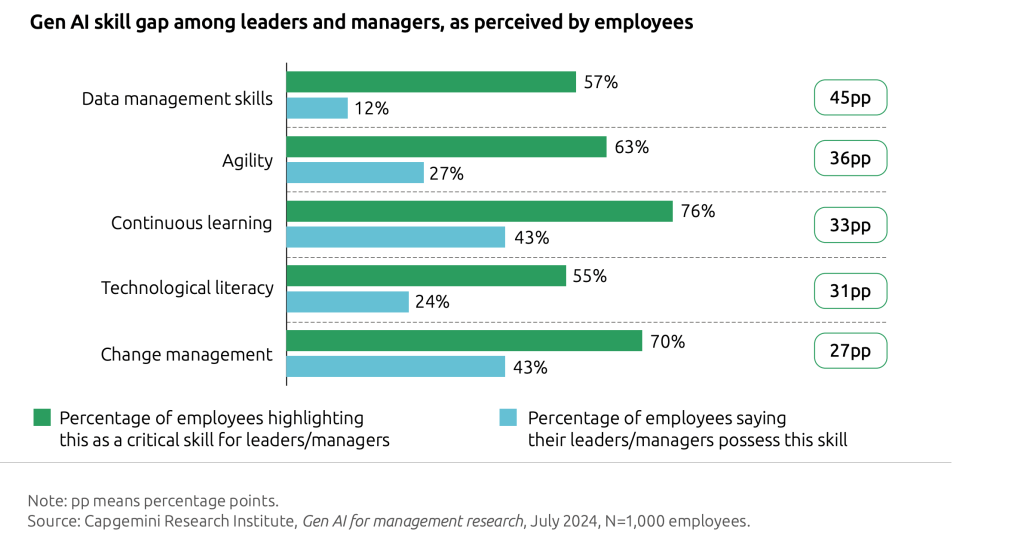
For procurement leaders, this skills gap presents both a challenge and an opportunity. Without strong leadership, AI adoption efforts can stall, limiting procurement’s ability to untap the potential of AI. But for those leaders who step up, generative AI offers the chance to elevate procurement into a more strategic, proactive function.
How you can avoid the skills gap in Gen AI
The Capgemini research highlights five critical skills that leaders need to drive generative AI adoption: data management, agility, continuous learning, technological literacy, and change management.
1. Improve data management skills
AI thrives on high-quality data, but many procurement teams still struggle with inconsistent, siloed, or incomplete data. As a leader, you don’t need to be a data scientist, but you must understand how to structure and manage procurement data effectively.
- Get your data ready for AI by investing in data pipelines that integrate spend, supplier, and contract data from multiple sources. Suplari can help you get started within 2 weeks.
- Ensure data governance by defining clear policies for data accuracy, security, and compliance. Remember, this is not something you do alone. Collaborate with your friends in IT to define a governance framework that fits best your resources and needs.
- Encourage data-driven decision-making by making insights accessible to procurement teams through actionable dashboards and AI-powered spend analytics.
2. Build agility in procurement operations
AI adoption requires procurement teams to move fast, experiment with new tools, and adapt to changing technologies. However, only 27% of employees believe their managers possess agility, compared to 63% who see it as a critical skill.
- Foster a culture of experimentation by running small AI pilots and iterating based on results. Involve your team in the experimentation.
- Streamline decision-making so AI adoption isn’t slowed down by rigid approval processes. Enable your team to securely experiment with generative AI tools and technology.
- Train teams to work alongside AI by focusing on adaptability rather than fixed workflows. The goal is to free up team for more strategic work. Make sure this is clear from the start.
3. Embrace continuous learning
AI is evolving rapidly, and procurement leaders need to keep up. The research shows that 76% of employees see continuous learning as critical, but only 43% say their leaders actively engage in it.
- Stay updated on AI trends by following industry reports, attending procurement tech conferences, and engaging with AI thought leaders.
- Provide AI training programs to ensure your team understands how to leverage AI tools effectively.
- Encourage cross-functional learning by collaborating with IT and data science teams to understand AI’s potential beyond procurement wherever possible.
4. Strengthen technological literacy
Understanding AI tools and their applications is no longer optional. 55% of employees see technological literacy as a must-have skill for managers, yet only 24% believe their leaders have it.
- Get hands-on with AI tools by testing supplier scouting platforms, contract automation software, and predictive analytics solutions. For inspiration, see what BT Sourced have been able to accomplish with their Digital Garage.
- Work closely with technology vendors to understand AI capabilities and limitations before making procurement decisions. Download our guide “4 Questions to Cut Through AI Hype.”
- Develop a roadmap for AI adoption that aligns AI investments with your procurement strategy and key enterprise stakeholders.
5. Lead change management effectively
Even the best AI tools won’t succeed if teams resist change. The study shows that 70% of employees believe change management is critical, but only 43% say their leaders handle it well.
- Communicate the value of AI clearly by showing how it enhances procurement rather than replacing jobs.
- Involve employees early in AI adoption by gathering feedback and addressing concerns.
- Set clear expectations and provide support so teams feel confident using AI-driven systems.
Shift the mindset: AI as a collaborator vs. replacement
A common concern about AI is whether it will replace human roles. In procurement, AI is more likely to act as a collaborative tool, not a replacement. Procurement requires negotiation, strategic thinking, and relationship management—skills AI cannot fully replicate.
Rather than eliminating jobs, you should view the potential of generative AI in improving productivity by automating repetitive tasks, freeing you to focus on higher-value activities like supplier strategy and risk mitigation. AI-powered tools process structured and unstructured data, providing real-time insights that support better decision-making.
For example, automated spend analytics software can automate spend categorization and harmonization, detect anomalies, and suggest cost-saving opportunities. Suplari’s Insights Generator can pull insights from internal and external sources, giving you a comprehensive view of supplier performance, pricing trends, and risks. This can save your team up to 80% in the time needed to analyze spend and create category strategies.
Beyond automation, AI can strengthen internal and external relationships. With AI handling administrative work, your team can focus on supplier negotiations and long-term partnerships. Procurement professionals who embrace AI will see their roles evolve into more strategic, high-impact positions, with AI acting as a real-time support system rather than a replacement.
Where to adopt generative AI in procurement processes
Most procurement teams start using generative AI by tactically using tools like ChatGPT to save time in their everyday tasks. If you’re looking for a more strategic approach, you can consider a few high-potential areas to build out more systematic approaches in your team:
1. Document creation and management
Generative AI automates the creation of essential procurement documents, including requisitions, purchase orders, invoices, RFXs, and contracts. By inputting specific prompts, procurement teams can quickly generate documents in the desired format, reducing the time and effort required for manual creation. For instance, AI-driven tools can draft comprehensive RFPs based on predefined criteria, ensuring consistency and accuracy across procurement activities.
3. Decision support and supplier evaluation
Advanced data processing capabilities enable generative AI to assist in supplier identification and evaluation. By analyzing parameters such as location, historical performance, financial health, service capability, and pricing, AI tools can recommend suitable suppliers. This data-driven approach enhances negotiation strategies and supports supplier relationship management by conducting periodic performance evaluations through customized scorecards.
3. Demand forecasting and inventory management
Generative AI provides accurate demand forecasts by analyzing historical data and market trends. For example, a retail chain can use AI to predict product demand during specific seasons, optimize inventory levels, and reduce excess stock. This proactive approach ensures that procurement aligns closely with actual market needs, minimizing waste and improving efficiency.
4. Risk management and compliance
AI's ability to monitor procurement processes helps identify potentially fraudulent activities or anomalies. By incorporating insights from historical noncompliance, AI systems can recognize similar patterns in the future, enabling organizations to minimize risks, ensure ethical practices, maintain legal compliance, promote transparency, enhance stakeholder trust, and support sustainable and responsible procurement practices.
5. Process automation and efficiency
By automating routine tasks such as supplier onboarding, contract reviews, and invoice processing, generative AI reduces manual workloads. This automation minimizes errors and frees up procurement professionals to focus on strategic initiatives, such as supplier negotiations and risk management. The result is a more agile and responsive procurement function that can adapt quickly to changing business needs.
The future of generative AI in procurement is agentic
The next evolution of generative AI in procurement is agentic AI—AI systems that can operate autonomously, executing complex, multi-step procurement tasks with minimal human intervention. According to Jeff Gerber, Co-founder and CEO of Suplari, the future of procurement AI lies in intelligent agents that move beyond co-pilot models and take on strategic execution roles.
Product update: see how Suplari's AI agents transform strategic procurement
Unlike traditional AI tools that assist procurement teams through suggestions and insights, agentic AI will handle end-to-end procurement workflows. This includes automating research, generating reports, fixing transaction errors in source systems, and even identifying miscategorized spend. These agents will continuously monitor procurement activities, detect inefficiencies, and propose actionable strategies.
Gerber envisions procurement evolving in two phases. First, AI will automate tactical, repeatable tasks, such as spend classification, contract monitoring, and supplier research. These foundational agents will build the groundwork for a second phase—strategic procurement AI agents that can handle project planning, supplier negotiations, and category strategy. Procurement teams will shift from executing tasks to directing AI-driven processes, increasing their impact on business outcomes.
AI agents will not operate in isolation. They will function as teams of agents, collaborating across procurement, finance, and supply chain functions. These interconnected AI systems will autonomously trigger workflows based on real-time signals, such as supplier risks, demand fluctuations, or compliance changes. The shift toward autonomous, intelligent procurement will enable procurement leaders to focus on innovation, supplier partnerships, and long-term value creation.
Bottom line on adopting generative AI in procurement
Successful generative AI adoption starts with addressing the key skill gaps within your procurement organization and leadership team. Once you have all stakeholders on the right page you can target high-impact areas, such as supplier risk management, contract automation, and spend analysis. Organizations that systematically integrate AI into their procurement functions will see gains in cost savings, risk mitigation, and supplier performance. AI is not a replacement for human expertise; it is a collaborative tool that enhances procurement teams’ capabilities.
Looking ahead, the future of AI in procurement is agentic—AI-driven systems that go beyond decision support to autonomously execute procurement tasks. These AI agents will proactively manage workflows, optimize sourcing strategies, and automate end-to-end procurement operations.
To explore AI native procurement software in practice schedule a personalized demo of Suplari.
About Suplari
Suplari is a procurement intelligence solution that helps businesses modernize procurement operations using AI. Suplari provides actionable intelligence to manage suppliers, deliver savings and manage compliance beyond the limits of traditional spend analytics. Suplari’s unique AI data management foundation empowers enterprise businesses to transform procurement operating models with reliable, AI-ready data.

