




For decades procurement analysts have supported enterprise businesses in unifying data, gathering insights and developing analytics capabilities. In recent years, the role has become more influenced by advanced analytics and AI, transforming from a data management to a stakeholder management role.
In this article we go through what you need to know about the role of procurement analysts in the age of AI based on a decade of experience working with procurement analysts at Suplari.
What exactly do procurement analysts do?
Procurement analysts serve as the analytical backbone of strategic sourcing decisions, directly impacting bottom-line results through data-driven insights and recommendations. They examine spending patterns, evaluate supplier performance, and identify cost-saving opportunities across the entire procurement lifecycle.
Typical procurement analyst responsibilities include:
- Spend analysis: Examine purchase orders, contracts, and supplier agreements to identify trends, risks, and opportunities
- Supplier performance evaluation: Assess vendor capabilities, financial stability, and delivery performance
- Cost optimization: Identify savings opportunities through consolidation, negotiation, and market analysis
- Market research: Analyze supplier landscapes, pricing trends, and regulatory changes
- Strategic planning: Collaborate with stakeholders to translate business needs into procurement strategies
- Risk management: Evaluate supplier financial stability, geographic risks, and market volatility
Modern procurement analysts spend their days diving deep into data to uncover insights that drive strategic decisions. They analyze purchase orders, contracts, and supplier agreements to identify trends, risks, and opportunities. This analysis helps organizations negotiate better deals, reduce costs, and improve supplier relationships.
Typical challenges of the procurement analyst role
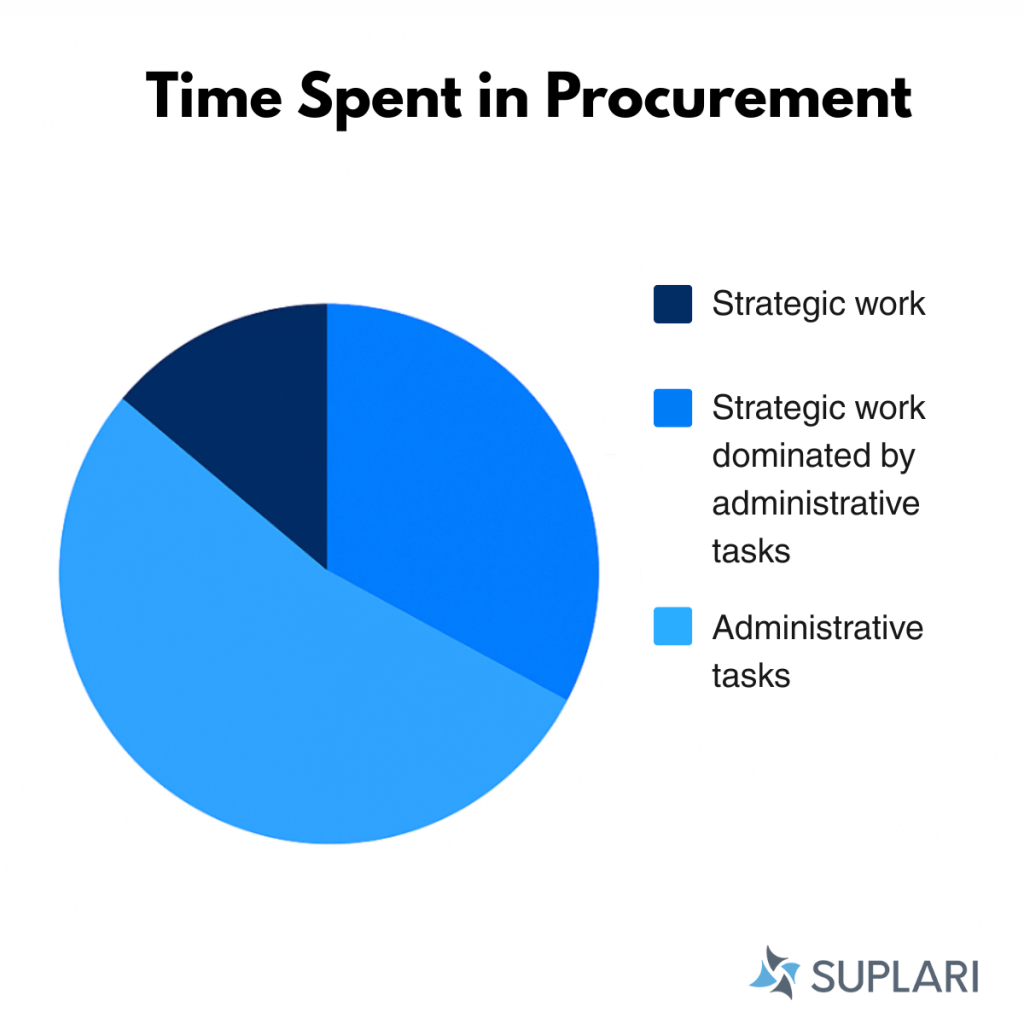
Many procurement analysts face a significant productivity challenge where manual reporting and administrative tasks consume the majority of their time, leaving limited capacity for strategic analysis and value-added activities. Despite being hired for their analytical skills to identify cost savings, optimize supplier relationships, and drive procurement strategy, these professionals often find themselves bogged down in data compilation, spreadsheet maintenance, and routine reporting tasks. This administrative burden prevents them from focusing on higher-impact work like market analysis, supplier performance evaluation, and strategic sourcing initiatives that could deliver substantial cost savings and operational improvements to their organizations.
Essential skills for procurement analysts
Successful procurement analysts combine analytical prowess with business acumen and communication skills. Data analysis capabilities top the skill list, as these professionals must extract meaningful insights from complex datasets. They use statistical methods, data visualization tools, and financial modeling techniques to support their recommendations.
Key procurement analyst technical skills:
- Data analysis: Statistical methods, pattern recognition, financial modeling
- Software proficiency: ERP systems (SAP, Oracle), procurement platforms, analytics tools
- Spend analytics: Category management, supplier segmentation, benchmark analysis
- Financial modeling: Cost-benefit analysis, ROI calculations, budget forecasting
Important procurement analyst soft skills:
- Negotiation: Contract terms, pricing discussions, supplier agreements
- Stakeholder management: Cross-functional collaboration, executive presentations
- Market intelligence: Industry expertise, regulatory compliance, sustainability requirements
- Project management: Initiative coordination, timeline management, deliverable tracking
In essence, procurement analysts need to bridge the gap between raw procurement data and actionable business strategy. They transform complex datasets into insights that drive measurable value for their organizations. To do this, they need to have a combination of both technical data analytics skills and competencies to manage complex stakeholder relationships.
A typical career path of a procurement analyst
These days corporate career paths are not linear. However, having worked with many talented procurement executives over the years, we can spot some common threads in the career journeys of procurement analysts.
Entry-level procurement analysts typically start with fundamental responsibilities like data collection, basic analysis, and administrative support. New professionals often focus on specific categories or suppliers while building their analytical skills and industry knowledge under experienced mentors. They learn to navigate procurement systems, understand organizational processes, and develop familiarity with supplier ecosystems.
Mid-level procurement analysts typically take on more strategic responsibilities, including supplier relationship management, contract negotiations, and cross-functional project leadership. They develop specialized expertise in particular categories or markets while expanding their influence across the organization. At this stage, analysts often lead specific initiatives and begin mentoring junior team members.
Senior procurement analysts often transition into strategic roles like procurement transformation, strategic sourcing, or even the role of CPO. The career trajectory increasingly favors those who can demonstrate value creation through cost savings, process improvements, and strategic insights beyond data analytics.
Career advancement in procurement can depend heavily on demonstrated value creation through measurable outcomes. Successful procurement analysts build reputations as trusted advisors who understand both the technical aspects of procurement and the broader business implications of their recommendations. They become known for their ability to translate complex data into actionable strategies that drive organizational success.
How AI is transforming procurement analytics
Artificial intelligence fundamentally changes how procurement analysts approach their work, automating routine tasks while enabling more sophisticated procurement analytics. This transformation addresses a critical challenge in modern procurement: the gap between generating insights and acting on them fast enough to capture value in today's hyper-accelerated business environment.
Key AI capabilities relevant to procurement analytics:
- Pattern recognition: Machine learning processes historical data to identify patterns that would take humans weeks or months to discover manually
- Automated spend analysis: AI categorizes purchases automatically, flags anomalies, and highlights savings opportunities in real-time
- Supplier performance insights: Advanced systems like Suplari analyze vendor performance across multiple dimensions to inform relationship and contract renewal decisions
- Predictive analytics: Forecasts demand, anticipates price fluctuations, and identifies potential supply disruptions before they occur
- Scenario modeling: Enables rapid evaluation of different strategic options, giving analysts unprecedented flexibility
- Contract intelligence: Natural language processing extracts key terms, identifies compliance issues, and summarizes complex agreements
Key AI challenges procurement analysts need to be aware of:
- Data quality dependencies: Poor data quality can compromise AI accuracy and effectiveness.
- Integration complexity: System integration requires significant technical expertise and resources.
- Skills gap: Analysts must learn to work alongside AI tools while understanding their capabilities and limitations.
- Oversight requirements: Human judgment remains essential for maintaining critical oversight and validation. For many analysts, this means a “trust-but-verify” approach.
According to Jeff Gerber, CEO of Suplari, the biggest change comes through advances in generative artificial intelligence. "With traditional machine learning, you'd train a model to do one very specific thing. Generative AI in procurement lets us address a broad set of use cases with a single model—it's a much more powerful foundation." This shift enables procurement analysts to work with AI systems that understand context and can adapt to different situations.
How AI impacts procurement job market
The procurement job market will experience significant transformation over the next three years, with demand shifting toward professionals who can effectively combine human judgment with AI capabilities. Organizations will prioritize candidates who demonstrate adaptability and willingness to embrace technological change while maintaining strong analytical and strategic thinking skills.
Entry-level positions may decrease as AI automates basic analytical tasks, but opportunities for strategic roles will expand. According to Suplari's analysis of procurement job roles most impacted by AI, procurement analysts face a 60% estimated chance of role reduction, but this represents transformation rather than elimination. Analysts who develop AI literacy and advanced analytical skills will find themselves in high demand across industries.
The changing nature of data analyst work
The nature of analyst work will shift dramatically. Instead of spending time on data collection and basic analysis, successful analysts will focus on interpreting AI-generated insights, developing strategic recommendations, and managing complex stakeholder relationships. The role becomes more consultative and strategic, requiring different skills but offering greater impact.
Compensation patterns will likely favor professionals who can demonstrate measurable value creation through AI-enhanced spend analysis. Those who master the integration of human insight with artificial intelligence will likely command premium salaries and advancement opportunities. The ability to bridge technical AI capabilities with business strategy becomes a differentiating factor.
Will AI replace the role of the procurement analyst?
"I think one of the things that we need to do at this moment is actually to start changing the way we talk about job replacement," says Jeff Gerber, CEO of Suplari. "The good news is that there are very few jobs where AI can perform all of the skills required for that job."
This perspective reflects a crucial reality: while AI excels at specific tasks, procurement analysts bring irreplaceable human capabilities to their roles. Complex stakeholder management, strategic thinking, and nuanced decision-making remain firmly in the human domain. AI can process data and identify patterns, but analysts provide the context, judgment, and creativity that turn insights into action.
The 50% rule of AI’s impact on jobs
According to Suplari estimates current AI technology can handle approximately 50% or more of the skills and tasks required in roughly two-thirds of all jobs. However, this statistic tells a story of augmentation rather than replacement. Procurement analysts will find their roles transformed, not eliminated. The routine aspects of their work become automated, freeing them to focus on strategic activities that create greater value.
According to Jeff Gerber, “the next three years promise changes equivalent to thirty years of internet-driven evolution. Just as the internet transformed how procurement analysts access information and communicate with suppliers, AI will fundamentally reshape how they analyze data and make decisions. This acceleration means that adaptation cannot be delayed—organizations and individuals must prepare now.”
Procurement analysts re-imagined, not replaced
"I think this is really about something bigger than that. It's about a reimagination of jobs. It's about redistribution of how we work," Gerber continues. "And as a people person and an optimist, I have a lot of faith and optimism about how humans throughout history have actually adapted and leveraged technology for progress."
The emergence of AI agents in procurement further supports this transformation narrative. These autonomous systems don't replace analysts but work alongside them, handling routine tasks while enabling analysts to focus on strategic initiatives. AI agents can process massive volumes of information, identify opportunities, and even suggest actions, but they require human oversight and strategic direction.
How you can prepare for the AI-augmented future
Procurement analysts who thrive in the AI era will need to focus on several key areas:
Essential procurement analyst skills for the AI era:
- Understanding AI capabilities and limitations for making informed decisions about when to rely on automated insights versus human judgment
- Building comfort with new technologies and data visualization tools without a need to build them yourself
- Developing soft skills like creativity, emotional intelligence, and complex problem-solving
- Learning to collaborate effectively with IT teams and data scientists
- Staying informed about AI developments through industry publications and professional associations
Building hands-on experience with AI-powered platforms will separate successful professionals from those who struggle with digital transformation. Procurement analysts should actively seek opportunities to contribute to implementation projects, as this experience builds confidence and competence that translates to career advantage.
The ability to translate between technical and business perspectives becomes a valuable differentiator. As AI handles routine analytical tasks, uniquely human capabilities will differentiate top-performing procurement analysts in an AI-augmented environment.
The case for embracing AI as a procurement analyst
The question isn't whether AI will impact procurement analysts—it already has. The real question is how professionals will adapt and evolve to maximize the benefits of human-AI collaboration. Organizations that embrace this transformation while supporting their teams through the transition will gain significant competitive advantages.
The way Jeff Gerber describes it is “Procurement analysts who view AI as a powerful ally rather than a threatening replacement will find themselves better positioned for long-term success. The future belongs to professionals who can blend human insight with artificial intelligence to drive unprecedented value for their organizations.”
Collaboration over competition
Rather than fearing obsolescence, procurement analysts should embrace the opportunity to elevate their strategic impact. AI handles the routine work, freeing professionals to focus on the complex, creative, and relationship-driven aspects of procurement that truly drive business success.
According to Jeff Gerber, “the transformation has begun, and the next three years will define how procurement analysts and their organizations navigate this exciting new landscape. Those who adapt quickly and thoughtfully will discover that AI doesn't replace their value—it amplifies it. The future of procurement analysis lies not in competition with AI, but in collaboration with it.”
Bottom line on procurement analyst jobs in the age of AI
According to the real-word experiences we see at Suplari, AI won't replace procurement analysts, but it will fundamentally transform their roles. While AI can automate approximately 50-80% of procurement analyst tasks, no single job exists today where AI can perform all required skills. This is about job reimagination, not job elimination.
The answer lies not in replacement, but in reimagination. If you’re looking to future-proof your career as a procurement analyst in the age of AI, you’ll find no better partner than Suplari. As the first AI-native spend analytics solution recognized by industry analysts like Spend Matters and Gartner we’ve led every wave of AI development over the past decade. Book a demo to find out more.

