



Procurement compliance is the systematic adherence to internal policies, external regulations, and supplier contracts, ensuring purchases are ethical, transparent, and legally sound to mitigate risk. It involves embedding controls across the source-to-pay process — from purchasing approval to vendor onboarding — to prevent fraud, maverick spending, and reputational damage.
For procurement leaders navigating rising workloads and shrinking teams, compliance is no longer a back-office checkbox. The Hackett Group's 2026 Key Issues Study found that procurement workloads have increased by 8% while staffing has declined by 0.9%, creating an 8.9% productivity gap. That gap means compliance obligations are growing faster than the teams responsible for enforcing them — making automated compliance infrastructure not just helpful, but essential.
This guide outlines the key components, risks, best practices, and measurement frameworks for procurement compliance, based on a decade of experience supporting enterprise procurement at Suplari.
Why procurement compliance matters
Procurement compliance is about following all the rules when you buy supplies, services, or equipment for your business. These rules come from your company policies, government laws, and industry standards.
Think of it like following traffic rules when you drive. Just as traffic rules keep everyone safe on the road, procurement rules keep your company safe from legal trouble and financial loss.
Good compliance means every purchase gets approved by the right person. It also means you keep good records and treat all suppliers fairly. This builds trust and protects your company's reputation.
Companies that ignore compliance face serious problems. They might get fined by the government. They could lose money from bad deals. Their reputation might get damaged if people think they're not trustworthy.
- Lack of compliance leads to fraud. A survey by SAS involving over 2,000 professionals found that 33% of businesses lack awareness of their losses due to procurement fraud.
- Procurement fraud is on the rise. According to research by Accuracy, the amount of procurement fraud in the United Kingdom increased by 13% from 2023 to 2024.
- Fraud impacts supplier relationships. 39% of companies experienced issues with suppliers as a result of fraud in 2023 according to research by Treasury & Risk.
Compliance isn’t just about risk mitigation. It also helps companies make better decisions. When you have clear rules and good records, you can see what's working and what isn't.
Key components of procurement compliance
Effective procurement compliance rests on three pillars: internal policy enforcement, external regulatory adherence, and contractual obligation monitoring. Each requires distinct controls and visibility mechanisms.
Internal policy compliance
Internal policy compliance means enforcing the approval hierarchies, budget controls, and preferred vendor lists that your organization has established. Without consistent enforcement, maverick spending proliferates — purchases made outside approved channels that erode negotiated savings and introduce risk.
Key internal controls include:
- Approval workflows: Ensuring every purchase routes through the correct authorization levels based on spend thresholds and category
- Budget controls: Tracking departmental and project-level spending against approved budgets in real time
- Preferred vendor lists: Directing spend toward vetted, contracted suppliers rather than ad-hoc alternatives
- Segregation of duties: Separating requisition, approval, and payment functions to prevent conflicts of interest
Suplari's spend analytics monitors purchasing activity against internal policies continuously, flagging deviations in approval workflows and identifying maverick spend patterns before they become systemic issues. Rather than relying on periodic manual reviews, Suplari provides procurement teams with real-time visibility into policy adherence across the entire organization.
External regulatory compliance
Procurement teams must comply with a growing web of external regulations, including tax laws, labor standards, environmental regulations, trade restrictions, and ESG (Environmental, Social, and Governance) requirements. These regulations vary by geography, industry, and supplier tier, making manual tracking impractical at scale.
Critical regulatory domains include:
- Tax compliance: Correct classification and reporting of purchases, import duties, and VAT/GST obligations
- Labor standards: Ensuring suppliers adhere to fair wage, working condition, and anti-child-labor requirements
- Environmental regulations: Tracking supplier compliance with emissions standards, waste disposal requirements, and sustainability commitments
- ESG requirements: Meeting increasing stakeholder and regulatory expectations around responsible sourcing and supply chain transparency
- Anti-corruption and anti-bribery: Complying with frameworks such as the Foreign Corrupt Practices Act (FCPA) and UK Bribery Act
Suplari's spend visibility capabilities help procurement teams track regulatory compliance by categorizing spend across regulatory dimensions and surfacing areas where supplier activity may intersect with regulatory risk zones. When regulations change, Suplari's analytics enable rapid assessment of exposure across your entire supplier base.
Contractual obligations
Monitoring supplier performance, price accuracy, and adherence to contract terms is the third critical component of procurement compliance. Contract leakage — paying more than negotiated rates or accepting substandard terms — is one of the most common and costly compliance failures in procurement.
Contractual compliance monitoring should cover:
- Price accuracy: Verifying that invoiced prices match contracted rates and that discount tiers are correctly applied
- Volume commitments: Tracking purchase volumes against minimum and maximum thresholds in supplier agreements
- Service level adherence: Monitoring supplier performance against contracted SLAs, delivery timelines, and quality benchmarks
- Term and renewal management: Tracking contract expiration dates, auto-renewal clauses, and renegotiation windows
Suplari's contract intelligence connects spend data to contract terms, automatically detecting price discrepancies, missed volume rebates, and upcoming expirations. This transforms contract compliance from a reactive, audit-driven exercise into a continuous monitoring function that captures savings and reduces risk in real time.
Spend under management
Spend under management (SUM) measures the percentage of total organizational spend that flows through approved procurement channels and is subject to compliance controls. It is arguably the most important single metric for procurement compliance.
- Target: Leading organizations manage 80% or more of total spend through controlled procurement processes
- Why it matters: Unmanaged spend is, by definition, non-compliant spend — it bypasses approval workflows, avoids preferred suppliers, and lacks audit trails
- How to improve: Expand procurement coverage to new categories, simplify requisition processes to reduce incentives for maverick purchasing, and use analytics to identify and redirect off-channel spend
Suplari tracks spend under management automatically by aggregating data across ERP systems, purchasing platforms, and payment channels to provide a complete picture of where organizational spend is flowing — and where it is not.
Contract compliance rate
Contract compliance rate measures the percentage of spend that adheres to negotiated contract terms, including pricing, volume commitments, and supplier selection requirements.
- Target: Best-in-class organizations achieve contract compliance rates above 90%
- Why it matters: Every dollar spent outside of contract terms represents leaked savings and increased risk
- How to improve: Improve contract visibility, automate price verification against contracted rates, and make contract terms easily accessible at the point of purchase
Suplari's contract intelligence calculates contract compliance rates in real time by matching transactional spend data against contract terms, highlighting discrepancies and quantifying the financial impact of non-compliance.
Non-compliant incidents
Tracking the number, severity, and root cause of non-compliant incidents provides insight into where compliance controls are weakest and where remediation efforts should be focused.
- Target: Declining trend quarter over quarter, with zero critical incidents
- Why it matters: Incident tracking transforms compliance from a binary (compliant/non-compliant) assessment into a continuous improvement process
- How to improve: Implement real-time monitoring, establish clear incident classification frameworks, and conduct root cause analysis on every significant violation
Suplari logs and categorizes compliance exceptions automatically, providing procurement leaders with trend analysis and drill-down capabilities that support both immediate remediation and long-term compliance program improvement.
How automation helps with compliance
Compliance automation uses technology to handle routine tasks automatically. Instead of people doing everything by hand, computers can check rules, send alerts, and keep records. This makes compliance much easier and more reliable.
PwC reports that automated systems can continuously monitor supplier performance, leading to an increase in supplier compliance rates by 30-40%. Here are some core benefits of automated compliance solutions.
Better record keeping
Automated spend analytics keep perfect records of everything. They track who approved what, when purchases were made, and why decisions were made. These records are easy to search and always available when you need them.
Automated spend visibility
Automated spend visibility can create reports that show you how much you're spending, where you're spending it, and whether you're following your budget. These reports help you make better decisions and spot problems early.
Instant alerts
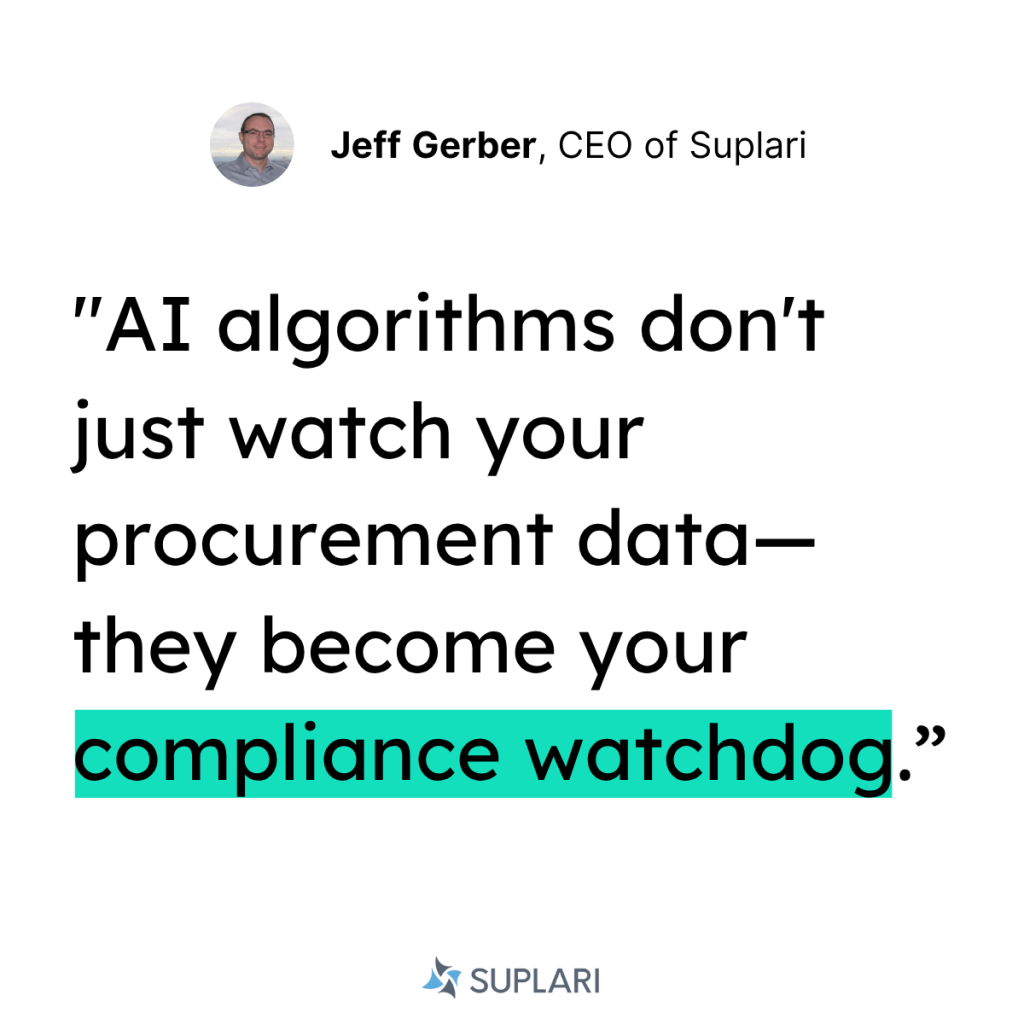
When something unusual happens, AI-assisted procurement analytics can send alerts right away. Maybe someone is trying to spend too much money or work with a banned supplier. The system catches this and warns the right people immediately.
AI-powered integrations
Modern AI procurement tools can connect to other systems your company uses, like accounting software or inventory management. This means information flows smoothly between systems without manual data entry.
How to implement automated compliance
Here are some practical steps to automate your procurement compliance initiatives:
1. Map your current spend process
Before you automate anything, you need to understand how things work now. Draw out your current procurement process step by step and update your spend analysis reports. This helps you see where problems occur and where automation can help most.
2. Get everyone involved
Automation affects many people in your organization. Talk to users, managers, and other stakeholders early in the process. Find out what they need and what concerns they have.
3. Start small
Don't try to automate everything at once. Pick one or two areas where automation can make the biggest difference. Start there and learn from the experience before expanding.
4. Train your team
Make sure everyone knows how to use the new system. Provide training that's easy to understand and relevant to their job. Give people time to practice and ask questions.
5. Track your progress
Set up ways to measure whether the automation is working. Track things like how fast purchases get processed, how many compliance problems you have, and how much money you're saving.
6. Regular check-ups
Don't just set up your compliance system and forget about it. Check regularly to see how it's working. Look for ways to make it better and fix any problems you find.
Contract expiration prevention
Imagine your AI agent automatically scanning all your contracts and finding that 15 critical IT software contracts expire in May. Instead of discovering this during a crisis, you get a detailed report with renewal timelines, budget requirements, and negotiation strategies. The agent even identifies which contracts have auto-renewal clauses you might want to avoid.
Supplier risk monitoring
Your AI agent continuously watches your key suppliers for early warning signs. When a major supplier shows financial stress or faces geopolitical risks, you get immediate alerts with specific impact analysis.
Smart spend analysis and compliance
The AI agent can analyze years of spending data in minutes and spot compliance issues you never knew existed. Thanks to smart spend analysis, you might discover that you've got a major supplier past its expiration date or missing necessary compliance documentation.
Make compliance automation your competitive edge
Companies that embrace smart compliance automation pull ahead of their competitors. They have better relationships with suppliers, lower costs, and faster decision-making. They also avoid the compliance failures that can damage reputations and cost millions.
The future belongs to organizations that make compliance easy and automatic. When your system handles routine compliance tasks, your team can focus on innovation and growth. This transforms procurement from a cost center into a strategic driver of business success.
Book a demo with Suplari to get started with agentic procurement compliance.

