




After a decade building procurement software solutions, it's hard not to notice a troubling pattern. I see Global 2000 companies lose millions in sourcing initiatives. It’s not because they lack data, but because they can’t act on it fast enough.
At Suplari we’re on a mission to change that. We’ve put AI at the heart of data management.
What is modern procurement data management?
Modern procurement data management goes far beyond collecting and organizing spend information. It's about creating autonomous systems that don't just analyze procurement data. They act on it.
Traditional procurement data management follows a predictable pattern: collect data, clean data, analyze data, generate insights, present insights, get approval, then maybe—if you're lucky—execute on those insights before market conditions change.
Modern procurement data management flips this model entirely. Instead of humans analyzing AI insights and manually executing responses, autonomous agents continuously monitor business conditions, identify opportunities, and take immediate action within pre-defined strategic parameters.
Why proactive data management matters in procurement
Just last month, I spoke with a CPO at a Fortune 500 retailer who told me something that stopped me cold: "Jeff, we identified a $3.2 million cost savings opportunity in Q4. We're finally implementing it now, in Q2, because it took us four months to analyze, socialize, and get approval to act."
Four months to act. In today's market, supplier prices change weekly, and competitive advantages disappear before procurement teams can mobilize traditional workflows .
But here's what really keeps me up at night: This isn't about having better dashboards or prettier reports. The fundamental problem is that over decades we've built procurement data systems that still require human bandwidth at every step from insight to action.
The hidden cost of traditional procurement data management
From my work with enterprise procurement teams, I've identified three critical bottlenecks that traditional data management creates and AI can solve:
Analysis paralysis
Most procurement teams spend 60-70% of their time on data analysis and report generation. I've watched brilliant strategic minds get buried in spreadsheets when they should be driving supplier innovation and category transformation. One procurement director recently told me: "I have five procurement analysts, and they're all too busy creating reports to help me make strategic decisions."
The human bottleneck
Even with sophisticated spend analytics platforms, every insight requires human interpretation, every opportunity needs manual planning, and every action demands human execution. Market conditions change overnight, but procurement responses take weeks. I've seen companies miss entire market cycles because their "insights-to-action" workflow couldn't keep pace.
The velocity gap
Business stakeholders increasingly bypass procurement for urgent decisions because they know the lead time for procurement analysis and action. When finance needs immediate market intelligence or operations requires rapid supplier diversification in response to tariffs, they can't wait for traditional procurement workflows. As Cyril Pourrat, the CPO of BT Group described recently, “I want results in two clicks [...] not 20 minutes.”
The AI revolution: from insights to autonomous action
Recent McKinsey research shows that generative AI dramatically increases automation potential for procurement data management tasks. Data processing tasks jumped from 75% to nearly 100% automation potential.
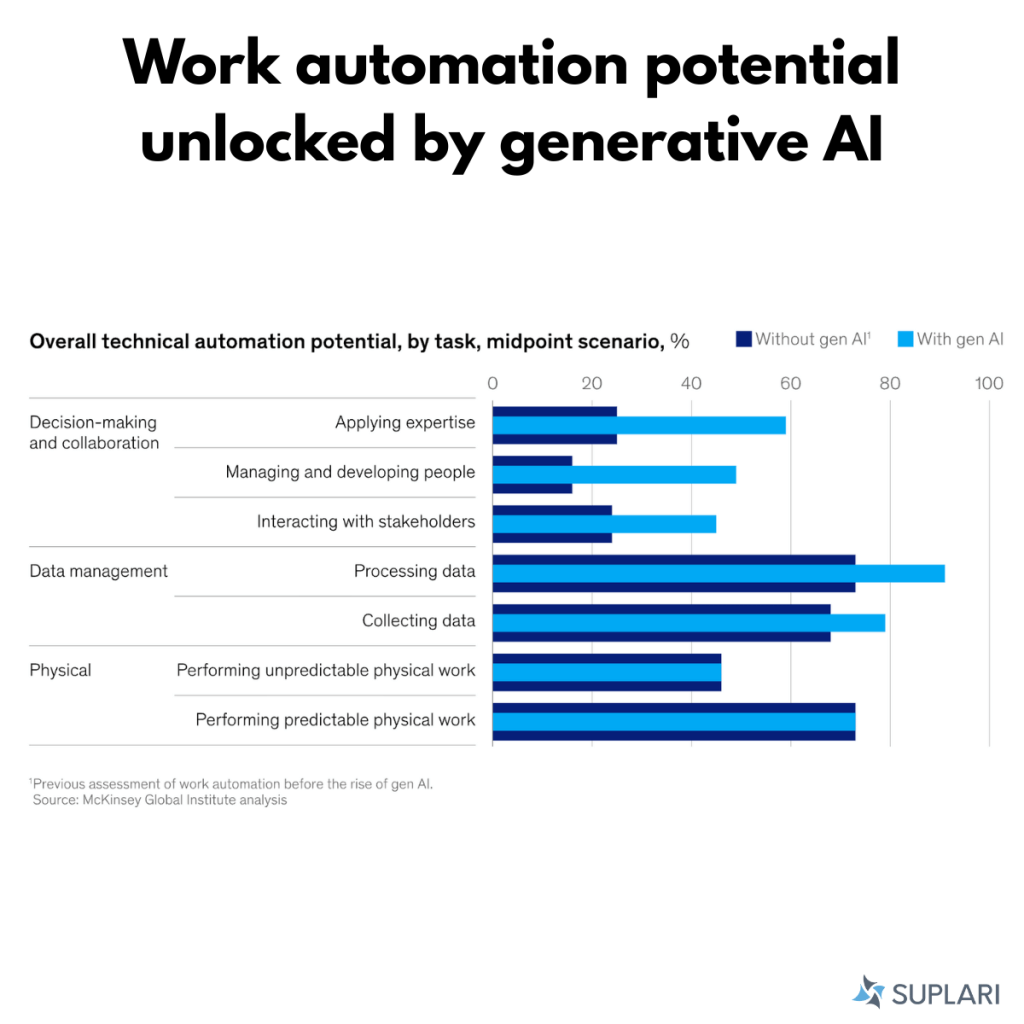
But here's what the research doesn't capture: the transformation from automated processing to autonomous execution.
What autonomous procurement data management looks like
From my conversations with Global 2000 procurement leaders and our actual customer implementations, I can tell you what autonomous execution really delivers.
AI agents handle complex, multi-step tasks requiring planning and coordination, with the goal to automate impactful workflows with minimal human interaction—but still keep them observable and controllable.
In procurement, there are many repetitive manual tasks like emailing spreadsheets, logging into systems, coordinating with teams. AI agents can take over these tasks, allowing procurement professionals to focus on strategy and execution.
But here's what I find most compelling: We have a customer using the agent that got their payback in one day—they got insights that would have paid their entire amount for the agent, with $150K in cash flow savings from one question to the agent. The controller was able to simply ask a question he was never able to ask before: "We still have 30% of our suppliers on the wrong payment terms"—and that single insight unlocked massive working capital optimization.
AI agents are not just co-pilots that assist humans. They can be truly autonomous, responding to signals, monitoring data, and executing tasks without direct human intervention. Finally, the CPO, the controller, the CFO, the CRO, the CMO can all get straight answers. Instead of procurement being "a pain in the ass" where people hate dealing with complexity, you can finally just ask a quick question and get a quick answer.
The pattern is clear: AI agents can take over and free up your people to think more strategically, improve execution, and increase their scope of what they can address. Instead of spending 80% of their time on analysis and reporting, they focus entirely on supplier innovation, category transformation, and business partnership.
Five best practices for AI-powered procurement data management
Based on implementations across dozens of Global 2000 organizations, here are the practices that separate successful transformations from expensive experiments:
1. Start with natural language business outcomes, not technical implementation
The wrong approach: "Let's implement AI tools and see what happens."
The right approach: Define your desired business outcomes in natural language, then let the agent execute the plan.
I've watched procurement teams transform when they start asking questions like: "Create a plan to renew our contract with Oracle by June. Recommend strategies and timing to achieve a cost reduction of 20%" or "Show me how to defer $10M in payments into next year and cascade this plan to my vendor managers."
The key insight: your AI agent should understand your business context and procurement processes, not just provide generic analytics. When you can specify outcomes in plain English and get executable plans back, you've crossed the line from tool to strategic partner.
2. Design for collaborative execution across all roles and stakeholders
Traditional thinking treats AI as a single-purpose tool for analysts. Autonomous thinking recognizes that every procurement role—from VP to buyer—needs different capabilities.
Your VP of Procurement should be able to ask: "Identify supplier risks I should be aware of over the next 3 months" while your Category Manager gets market trend analysis and your Vendor Manager receives automated contract compliance alerts.
Smart companies deploy agents that understand role-specific pain points. The agent automatically provides strategic decision-making support for leadership, market analysis for category managers, relationship insights for vendor managers, and negotiation data for buyers—all from the same underlying intelligence.
3. Implement domain-specific intelligence, not generic AI
Generic LLMs don't understand procurement. I've seen too many companies try to force ChatGPT-style tools into procurement workflows and wonder why they don't get business value.
The most successful deployments use AI agents with procurement best practices baked-in. These agents understand your spend data, your supplier relationships, your contract terms, and your business processes. They can tell you not just "how much we spent with Oracle last year" but also "For each of my suppliers based in APAC, identify 2-3 alternates that are based in another geographic region."
This isn't about having better dashboards. It's about having intelligence that truly understands procurement strategy and execution.
4. Focus on collaborative intelligence that amplifies human expertise
The best implementations don't replace procurement professionals. They amplify their capabilities. Your AI agent should work collaboratively with your team, understanding that a Category Manager needs different support than a Strategic Sourcing Manager.
For Category Managers, the agent provides market analysis and optimization strategies. For Vendor Managers, it offers relationship insights and performance metrics. For strategic sourcing professionals, it delivers supplier evaluation and cost reduction opportunities.
The pattern I see in successful deployments: AI agents handle the routine, data-intensive work while humans focus on relationship building, strategic thinking, and complex negotiations. The agent becomes an extension of each team member's capabilities, not a replacement for their expertise.
5. Aim for end-to-end process automation, not just analysis
In the future, your AI agent should handle complete workflows, not just provide insights. The transformation happens when your agent can "Execute our category plan for buying aluminum this year, coordinate the activities of the category manager and buyers and automate routine tasks and schedules."
At Suplari we estimate procurement teams can increase their strategic capacity by 200% when they move from agents that analyze to agents that execute. The agent should be able to schedule meetings, coordinate with team members, track compliance, manage renewals, and handle routine purchasing decisions—all while keeping you informed and in control.
Common pitfalls to avoid
Don't try to automate broken processes. If your current procurement workflows are inefficient, AI will just make them inefficiently faster. Fix your processes first, then add autonomy.
Don't ignore change management. I've seen technically perfect AI implementations fail because procurement teams weren't prepared for the transformation from tactical execution to strategic orchestration.
Don't underestimate data quality requirements. Autonomous agents need clean, consistent data to make good decisions. Garbage in, garbage out applies even more to autonomous systems than traditional analytics.
The future is already here
The companies embracing autonomous procurement data management aren't just saving costs. They're gaining competitive advantages that traditional approaches simply cannot match.
If you're still managing procurement data the traditional way—collecting, analyzing, reporting, then manually executing—you're operating at a fundamental disadvantage.
The question isn't whether autonomous procurement data management will become standard. It's whether you'll be an early adopter or a late follower.
The technology exists today. The business case is proven. The only question left is: Are you ready to unlock the future of procurement, or will you keep fighting yesterday's data management battles?
Want to see autonomous procurement data management in action? Suplari Agent is already transforming procurement operations for Global 2000 companies. The agent works 24/7, making decisions and executing actions within your strategic parameters while you focus on driving business value. Book a demo to see how autonomous procurement execution can transform your organization.
About Suplari
Suplari is a procurement intelligence solution that helps businesses modernize procurement operations using AI. Suplari provides actionable intelligence to manage suppliers, deliver savings and manage compliance beyond the limits of traditional spend analytics. Suplari’s unique AI data management foundation empowers enterprise businesses to modernize procurement operating models with reliable, AI-ready data.

