




One of the hardest tasks for any procurement executive is to build a roadmap for digital transformation. With so many needs and solutions on offer, where do you get the most value?
This guide gives you a clear roadmap to procurement transformation based on a decade of experience supporting enterprise procurement at Suplari.
What is procurement transformation?
Procurement transformation is the strategic shift from reactive, tactical purchasing to a proactive, value-driven function by leveraging technology, AI, and improved processes. It enables organizations to reduce costs, enhance supplier relationships, increase transparency, and improve supply chain resilience.
Rather than viewing procurement as a cost center, transformation reframes it as a strategic value driver. This means digitizing workflows, upskilling teams, and adopting sustainable, data-driven practices that align purchasing decisions with enterprise goals.
Core elements of procurement transformation initatives include:
- category management
- supplier collaboration
- risk and sustainability controls
- intelligent automation
- talent upskilling
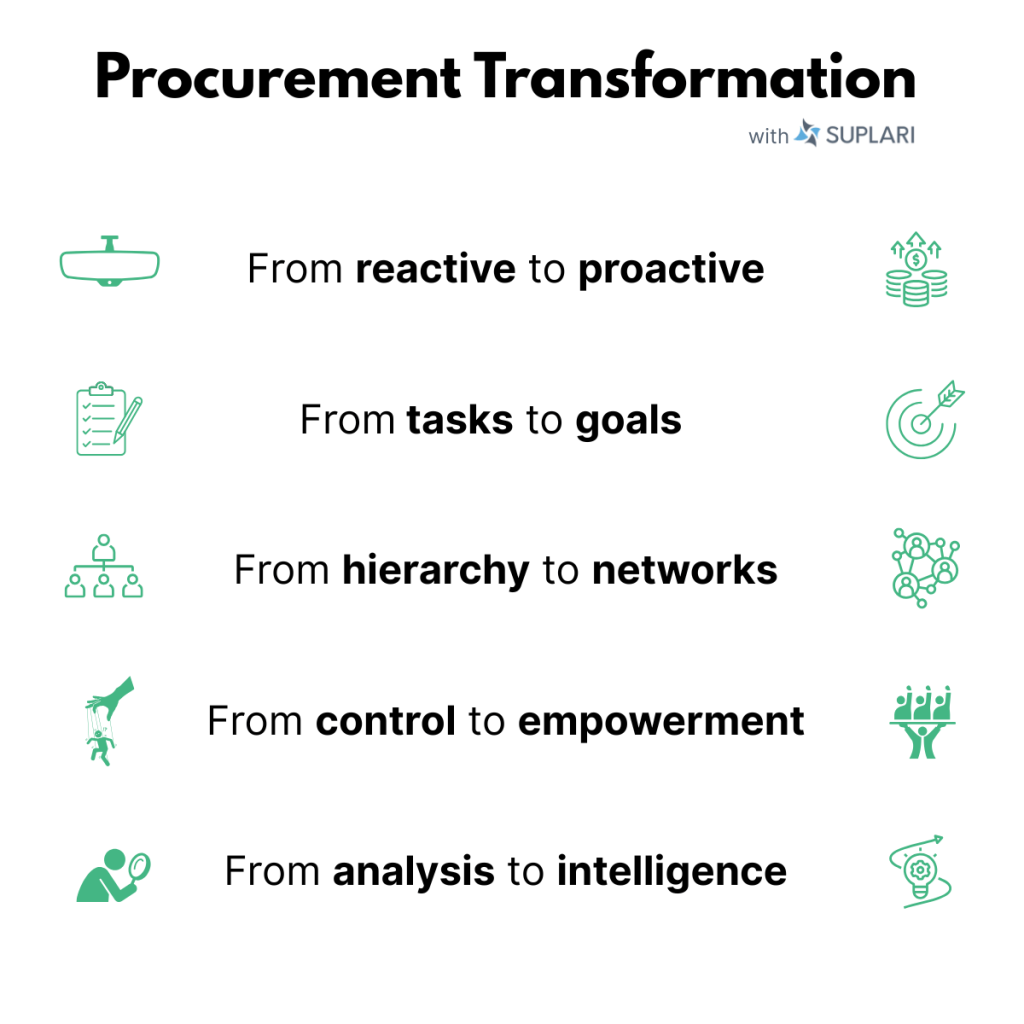
By redesigning processes, policies, and performance metrics, you can shift from transactional order processing to proactive spend management. Successful digitalization programs integrate cloud platforms, predictive analytics, and agile governance, enabling real-time insight and faster decision cycles. The outcome is lower total cost, stronger supply resilience, and contribution to revenue, ESG ambitions, and sustained competitiveness.
Why spend visibility matters in procurement transformation
External supplier spend represents 40-80% of most companies' total costs, making procurement optimization crucial for bottom-line impact. Without robust spend visibility, procurement teams are essentially flying blind.
Recent market disruptions have exposed the strategic importance of spend analytics in building organizational resilience:
- Organizations with strong spend visibility navigated COVID-19 and tariff disruptions far more effectively
- Companies waste an estimated $15-55 million on every $500 million of spend due to missed savings opportunities
- World-class procurement organizations using spend analytics report 2.6× higher ROI on procurement investments
Key components of procurement transformation
Effective procurement transformation requires building across five critical dimensions. Each reinforces the others, and success requires investment in all five:
Digitalization & AI - Modern procurement demands cloud-based platforms that integrate with your ERP, contract management, and supplier systems. AI-powered tools automate data preparation, detect anomalies, and generate insights instantly. At Suplari, we've built spend analytics specifically for procurement—eliminating the manual work that slows traditional approaches. Advanced AI solutions accelerate the shift from backward-looking reporting to forward-looking optimization.
Strategic Sourcing & Category Management - Transformation requires shifting from reactive buying to strategic category planning. This means understanding your spend landscape deeply, identifying consolidation opportunities, and developing sourcing strategies that balance cost with risk. Data-driven category management—powered by spend analytics—reveals opportunities that would remain hidden in spreadsheets.
Process Optimization - Digitalization only works when processes are redesigned for the new environment. This includes streamlining approval workflows, automating purchase-to-pay cycles, and simplifying supplier onboarding. Process optimization should be informed by spend data—automate the high-volume, low-complexity activities first, freeing teams for strategic work.
Change Management & Culture - Technology alone doesn't transform procurement. Your teams need new skills, mindsets, and governance structures. This means upskilling analysts on data interpretation, training managers on data-driven decision-making, and establishing new performance metrics tied to strategic outcomes rather than just transaction volume.
Supplier Relationship Management (SRM) - Strong supplier partnerships amplify transformation benefits. With better visibility into spend and performance, you can segment suppliers strategically, negotiate smarter contracts, and collaborate on innovation and sustainability. SRM platforms—integrated with spend analytics—enable two-way visibility and faster issue resolution.
Why spend analytics should come first
In planning a digital transformation in procurement, it's tempting to chase the newest shiny tools. This might be an intake management workflow, a sourcing platform, or contract management system. However, most experts agree that data comes first.
Starting with spend analytics software creates a solid foundation that makes all other technology investments more successful. It prevents wasted effort and ensures projects address the highest-value areas.
There are five compelling reasons to prioritize an analytics solution before other procurement tech projects:
1. Build a fact base for all other initiatives
Think of spend analytics as laying the groundwork. If you implement a flashy procurement intake tool without understanding your current spend and processes, you risk automating the wrong things.
By first achieving spend visibility, you establish a single source of truth on expenditures that will inform everything else. It's much easier to deploy other solutions when you have baseline metrics and a clear picture of where the pain points and opportunities lie.
2. Quick wins and funding for future projects
One of the biggest advantages of leading with spend analytics is the fast payback. A good analytics tool uncovers immediate savings (often in the millions) by highlighting things like pricing discrepancies or off-contract spend.
These quick wins create positive momentum and credibility for the procurement team. Successful CPOs use initial spend analysis savings to build trust and self-fund larger initiatives.
3. Data cleanliness before process automation
A classic mistake in digital transformations is automating chaos. That means implementing new workflows on top of messy underlying data. Procurement data is notoriously fragmented across ERP systems, AP ledgers, P-card systems, etc.
If you try to roll out a supplier management system without first consolidating and cleaning your vendor data via spend analysis, the result might be garbage-in, garbage-out.
4. Alignment of the team on priorities
When you begin with a thorough spend analysis, it naturally fosters internal alignment on what the procurement priorities should be. The data often surprises stakeholders and busts myths.
For example, revealing that marketing spend is twice what people assumed, or that a "preferred" supplier is actually getting only a fraction of the business. Spend analytics sets the records straight.
5. Ease of implementation relative to other tools
Of all the major procurement tech deployments, a cloud-based spend analytics solution is typically one of the lighter lifts.
Modern procurement analytics solutions like Suplari connect to your data sources and start delivering insights in a matter of weeks, not months. There's no complex process change needed upfront. You don’t need multi-year roll-outs across the enterprise.
The bottom line: Spend analytics delivers immediate impact, informs your strategy, and lays the groundwork for everything else. It's the logical first investment for procurement teams pursuing digital excellence.
Where traditional spend analysis falls short
A key mistake in procurement transformation is to settle for legacy spend analysis reporting.
Traditional approaches to spend analysis—primarily Excel spreadsheets and basic business intelligence tools like Power BI—simply can't handle the complexity and scale of modern procurement data.
Excel's critical limitations
Excel remains the default choice for many procurement analysts, but it's fundamentally inadequate for enterprise-scale spend analysis. Spreadsheets break down when handling millions of transaction records, leading to crashes, corrupted files, and incomplete analysis. Manual data manipulation is error-prone and time-consuming, with analysts spending 70-80% of their time on data preparation rather than insight generation.
Version control becomes a nightmare when multiple team members work on different Excel files, creating conflicting datasets and undermining decision-making. Perhaps most critically, Excel lacks real-time connectivity to source systems, meaning insights are always outdated by the time they're delivered.
Power BI's blind spots
While Power BI offers better visualization capabilities than Excel, it still falls short for sophisticated spend analysis. The platform requires significant technical expertise to build meaningful dashboards, creating bottlenecks when only a few team members can generate insights. Data preparation remains largely manual, and the tool struggles with the complex data relationships typical in procurement systems.
Power BI also lacks procurement-specific intelligence. It can't automatically classify suppliers, identify spend categories, or detect procurement anomalies without extensive custom development. For most procurement teams, this means months of setup time before seeing any value.
The hidden costs of outdated analytics
Organizations relying on traditional spend analysis tools face several hidden costs:
- Analysis paralysis: Teams spend months preparing data instead of acting on insights
- Missed opportunities: Slow, manual processes mean savings opportunities expire before they're identified
- Compliance risks: Lack of real-time visibility makes it difficult to monitor contract compliance and spending thresholds
- Strategic limitations: Without automated insights, procurement remains reactive rather than strategic
These limitations explain why many procurement teams feel overwhelmed by data despite having access to more information than ever before. The solution isn't more data. It's better tools designed specifically for procurement challenges.
Advanced spend analytics has proven ROI
The ROI case for best-of-breed spend analytics is compelling across multiple dimensions.
- Organizations leveraging advanced spend analytics software can achieve 31% faster procurement cycle times and see 72% fewer late supplier deliveries.
- McKinsey research shows that effective data use in procurement can increase value-creation initiatives by up to 200%.
- According to research by the Hackett Group, world-class procurement organizations using spend analytics report 2.6× higher ROI on procurement investments
- One CPO using Suplari’s spend analytics recently reported: "I can set clear goals, check daily progress, and get AI-based recommendations... It's a game changer."
The bottom line: Spend analytics creates the data foundation necessary for all other procurement initiatives while delivering immediate savings that can fund future technology investments. It's the logical first step for procurement digital transformation.
Your AI revolution begins with spend analytics
Spend analytics is also key for any enterprise looking to adopt AI in procurement. It is the essential data layer that artificial intelligence needs to generate procurement-specific insights. Success with AI starts with trusted data. According to a recent survey by Deloitte, over 50% of CPOs see spend analytics as the top use case for generative AI in procurement in 2025.
The case for AI in spend analytics
AI has also changed how data analytics solutions are built. Modern AI-first solutions like Suplari have transformed spend analytics from a backward-looking reporting exercise into a forward-looking optimization engine that drives proactive decision-making.
Key AI-driven improvements include:
- Machine learning algorithms reduce supplier consolidation and spend classification time over 90%,
- Companies using Suplari report 5-15% annual cost savings - up to 50% more than other spend analysis solutions,
- Procurement executives can get within minutes insights that have taken teams of up to 6 procurement analysts weeks to collect and analyze.
Five game-changing capabilities of AI-powered spend analytics include:
1. Automated data preparation
AI streamlines the most laborious aspect of spend analysis by automatically pulling data from disparate systems and cleaning it in real-time. Machine learning algorithms standardize supplier names, categorize line items, and create reliable datasets in minutes rather than months.
2. Natural language insights
Modern spend analytics solutions allow users to interact with spend data conversationally. A CPO can ask "Show me our biggest cost reduction opportunities in IT spend" and get instant answers with charts, democratizing data access beyond power analysts.
3. Predictive analytics
AI unlocks forward-looking views by analyzing historical patterns and external variables to forecast future spend and identify emerging trends before they fully materialize.
4. Anomaly detection
AI can act as an always-on auditor, learning normal spend behavior and flagging outliers like unusual vendor spikes or purchases outside approved contracts.
5. Strategic scenario analysis
Advanced AI solutions provide prescriptive analytics, suggesting specific actions like supplier consolidation opportunities or optimal contract renegotiation timing.
The bottom line: AI-first spend analytics solutions move procurement from reactive reporting to proactive optimization, positioning teams as strategic partners rather than just cost cutters.
Accelerate your transformation with AI agents
If you’re looking to keep up with the latest trends in procurement digital transformation, a key solution you should research is AI agents. This is a revolutionary new form of AI with the capability to perceive its environment and take actions on your behalf.
Many procurement leaders believe AI agents to be the next big platform shift in procurement technology. According to recent research by ProcureCon, 90% of procurement teams plan to adopt AI agents within 2025.
Go beyond generic co-pilots
Recently Gartner estimated that up to 70% of generative AI investments will fail to achieve positive ROI. In many cases this is because co-pilots and generative AI tools lack access to reliable data.
Agentic AI platforms like Suplari can connect your data with insights from the external world. For example, you can instantly map out your exposure to new tariffs or changing supply conditions. With reliable data, spend analytics also delivers more value. The outcome? According to a recent survey by Deloitte, 67% of CPOs see enhanced analytics and decision making as the key value driver from generative AI.
From data to action
Suplari is building a roadmap from showing what happened to automatically taking action. This represents a fundamental shift from software tools to procurement automation that can replace manual tasks.
The real opportunity isn't in more shiny AI procurement tools. It's in cost reduction and efficiency. With AI-first spend analytics you can engage our C-level executives with concrete cases of how you use generative AI in procurement to reduce costs.
Towards enterprise-wide automation
In the future, AI automation does not just transform your team. This goes beyond just making procurement incrementally better. It's about fundamentally changing how work gets done across the enterprise and the performance of your supply base.
Just as agentic coding tools like Cursor are transforming software development, Suplari’s agentic spend analytics transforms procurement and finance. You generate insights based on your own spend data and unique enterprise goals, and transform bottom-line impact.
The path forward
Procurement transformation requires strategic sequencing of technology investments. The evidence overwhelmingly supports starting with AI-powered spend analytics as the foundation for all other initiatives. Start by assessing your procurement transformation maturity stage.
In today's volatile business environment, you can't afford to rely on gut instinct or outdated reports. Real-time spend visibility enables faster pivoting, stronger negotiations, proactive risk mitigation, and quantifiable impact measurement.
Prioritize spend analytics to set your procurement organizations on a course to achieve quick wins while building sustainable competitive advantages. In the age of digital procurement, data-driven intelligence is the foundation of success.
Book a demo with Suplari to see how you can get started within 6 weeks.

