



You've heard about AI transforming procurement. You've seen demos of chatbots and predictive analytics.
But there's a type of AI that doesn't get enough attention in our industry, even though it might be the most relevant for how procurement actually works. It's called reinforcement learning (RL).
This guide is based on a decade of experience building AI solutions for procurement at Suplari.
How reinforcement learning works
In reinforcement learning an AI system takes actions, observes results, and adjusts its approach based on rewards or penalties. You don’t program every rule in advance. Instead, the system discovers what works through trial and error.
Think about how you learned to drive. You didn't memorize every possible traffic scenario. You learned through experience. Turn the wheel too sharply, and you feel the car lurch. Brake too late, and you stop past the line. Over time, you developed intuition about what works.
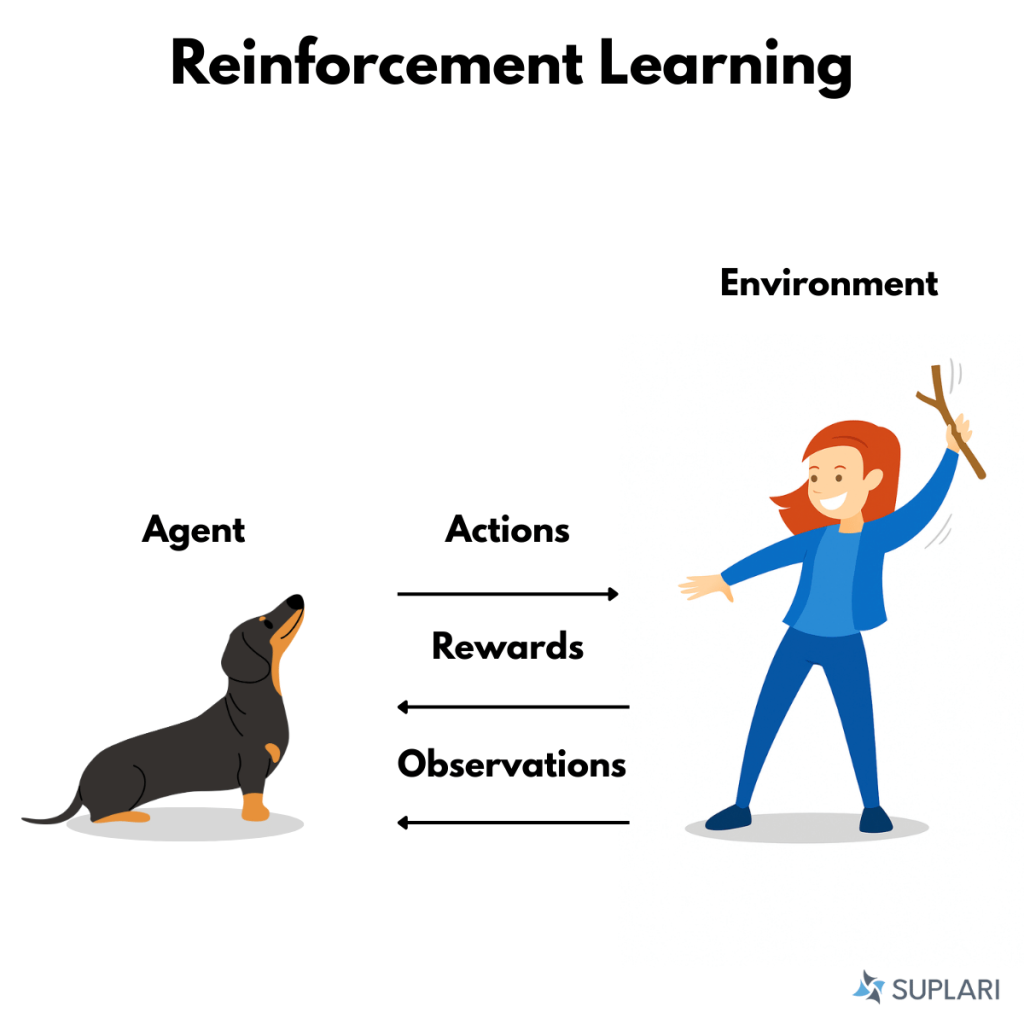
Let's review the above example. In reinforcement learning the AI system learns by interacting with an Environment (represented by the person with the stick).
Here's how the cycle works:
- Actions: The agent takes actions in the environment (like the dog performing tricks or behaviors)
- Rewards: The environment provides feedback in the form of rewards (like the person giving treats or praise when the dog does something right)
- Observations: The agent observes the results of its actions and the state of the environment (the dog sees how the person reacts)
- The agent then uses this information to decide what action to take next, creating a continuous learning loop
The key insight is that the agent learns through trial and error, not from pre-programmed rules. Just like training a dog, the agent discovers which actions lead to positive rewards and which don't. Over time, it develops strategies to maximize rewards.
In a procurement context, the agent would be the AI system, the environment would be your procurement ecosystem (suppliers, markets, contracts), actions would be procurement decisions (negotiate, consolidate, switch vendors), and rewards would be the outcomes you value (cost savings, quality improvements, risk reduction). The system learns which procurement strategies work best in different situations by trying them and observing the results.
Reinforcement learning vs. other forms of AI in procurement
Compare this to other AI approaches you might know from a procurement context.
- Rule-based machine learning is a popular approach in spend analysis, where ML algorithms look at historical data and predicts spend categories or even outliers (this invoice is likely fraudulent, this supplier is high risk).
- Natural language processing reads and understands human language, breaking down text into components to extract meaning, identify entities, and understand context.
- Generative AI uses large language models trained on vast amounts of text to generate human-like responses, create new content, and answer questions.
These tools are useful, but they're static. They apply predetermined patterns to new situations.
How reinforcement learning is different
Reinforcement learning is different because it optimizes for long term outcomes. It doesn't just classify or predict. It decides what to do next.
Here's why you should care: procurement is fundamentally about making sequential decisions that affect future outcomes. You negotiate a contract today that impacts supplier relationships tomorrow. You choose vendors whose performance affects next quarter's costs. You set payment terms that influence cash flow months down the line. Traditional AI struggles with these cascading decisions. Reinforcement learning doesn't.
Say you're managing supplier relationships across 500 vendors. Traditional AI procurement tools might rank suppliers by risk score or flag contracts needing renewal. Helpful, sure. But reinforcement learning would actually recommend specific actions: increase orders from Supplier A by 20 percent this quarter, renegotiate payment terms with Supplier B before their contract expires, consolidate purchases from Suppliers C and D to improve leverage. And here's the key part: it would learn from the outcomes of these recommendations to make better ones next time.
Where reinforcement learning beats traditional approaches
Procurement decisions rarely happen in isolation. When you change payment terms with one supplier, it affects your working capital, which influences your negotiating position with others. When you consolidate spend, you change market dynamics that ripple through your supply base.
Traditional predictive models treat each decision independently. They might tell you that extending payment terms saves money, and separately, that consolidating suppliers reduces costs. But they can't tell you which to prioritize when doing both isn't feasible.
Reinforcement learning handles these trade offs naturally. It learns that extending payment terms with critical suppliers might backfire if it damages relationships needed for supply chain resilience. It discovers that consolidating spend works better in some categories than others, not because someone programmed these rules, but because it observed the actual outcomes over time.
This matters for several procurement scenarios:
Dynamic market intelligence. Markets change. Supplier costs fluctuate. Demand shifts. Static pricing models based on historical data quickly become outdated. Reinforcement learning adapts to market conditions in real time. It learns when to push for discounts and when to accept higher prices to secure supply.
AI Agent example: what-if tariff response with Suplari
Supplier portfolio optimization. You need the right mix of suppliers for resilience, cost, and innovation. Too many suppliers, and you lose economies of scale. Too few, and you're vulnerable to disruptions. Reinforcement learning can continuously adjust this balance based on actual performance, not theoretical models.
AI Agent example: supplier portfolio analysis with Suplari
Contract term optimization. Every contract involves multiple variables: price, volume commitments, payment terms, service levels, penalty clauses. Optimizing one often means compromising on another. Reinforcement learning can find the combinations that work best for your specific situation.
AI Agent example: working capital improvement with Suplari
What reinforcement learning looks like in practice
Let's walk through a real scenario. Your company spends $50 million annually on packaging materials across 30 suppliers. Prices are volatile. Quality varies. Some suppliers are more reliable than others. You want to reduce costs while maintaining supply security.
A traditional AI system would analyze historical data and maybe suggest consolidating to your top 10 suppliers based on past performance. It might predict price trends and recommend when to lock in contracts.
A reinforcement learning system would do something more sophisticated. It would start by making small adjustments: shifting 5 percent of volume from Supplier A to Supplier B. Then it observes what happens. Did Supplier B maintain quality at higher volumes? Did Supplier A respond with better pricing to win back business? Did the change affect delivery reliability?
Based on these outcomes, the system adjusts its strategy. Maybe it learns that Supplier B struggles with larger orders, so it caps their volume at 15 percent of total spend. Maybe it discovers that maintaining competition between Suppliers A and C keeps prices lower than consolidating to either one alone.
Over months, the system develops nuanced strategies you wouldn't discover through analysis alone. It might learn to increase orders from certain suppliers before peak seasons when their capacity is strained. It might find that some suppliers offer better terms when orders are placed on specific days of the month. These aren't patterns you'd notice in spreadsheets. They emerge from systematic experimentation and learning.
The challenges you need to know about
Reinforcement learning isn't magic. It has real limitations you should understand before investing.
- RL needs room to experiment. The system learns by trying different actions and observing results. In procurement, you can't always afford experiments. You can't risk major supply disruptions just to see what happens. This limits where you can apply reinforcement learning effectively.
- RL takes time to learn. Unlike traditional AI that works immediately with historical data, reinforcement learning needs multiple cycles to develop good strategies. If your procurement cycles are annual, it might take years to optimize. This works better for categories with frequent transactions.
- RL requires clear success metrics. The system optimizes for whatever rewards you define. If you only reward cost savings, it might sacrifice quality or supplier relationships. You need to carefully design reward structures that capture all your priorities.
- RL is harder to audit. With rule based systems, you can trace exactly why each decision was made. Reinforcement learning develops strategies through experience that can be difficult to explain. This can be problematic for regulated industries or when you need to justify decisions to stakeholders.
What this means for procurement leadership
Reinforcement learning represents a fundamental shift in how we think about procurement automation. We're moving from systems that analyze to systems that act. From tools that support decisions to tools that make decisions.
As a procurement executive, you’re most likely to come across reinforcement learning only through your technology partners. A key question to ask them is “how is your AI learning?” If they don’t give you a good answer, you might as well keep using ChatGPT.
About Suplari
Suplari is a procurement intelligence solution that helps businesses modernize procurement operations using AI. Suplari provides actionable intelligence to manage suppliers, deliver savings and manage compliance beyond the limits of traditional spend analytics. Suplari’s unique AI data management foundation empowers enterprise businesses to modernize procurement operating models with reliable, AI-ready data.
To see an AI system that not just learns from your data, but makes it actionable, book a demo with Suplari today.

