




If you're looking to transform procurement's impact with data over the next 12 months, you must move beyond fragmented databases and manual processes for spend data management. You need a unified, automated platform that takes raw spend data from multiple systems, cleanses it, categorises it and links it with supplier and contract insights.
In this article we go through everything you need to unify, harmonize and enrich your procurement spend data based on a decade of experience supporting enterprise data management transformations at Suplari. In addition, we'll give you key tips to find the best-fit tools and solutions for the needs of enterprise procurement organizations.
Three key take-aways
- Focus first on ingesting and unifying all relevant spend data (ERP, P2P, AP, T&E, contract systems) rather than waiting for perfect data.
- Leverage automation and AI to cleanse, harmonise and classify your data. Manual data management effort alone will never scale.
- Enrich your unified data with supplier, contract and usage context and embed continuous monitoring so procurement turns into a value-creation engine rather than a cost centre.
Why fragmented spend data holds you back
Most procurement organisations still struggle with data trapped in silos: multiple ERPs, P2P platforms, expense systems, contract repositories and third-party supplier information platforms.
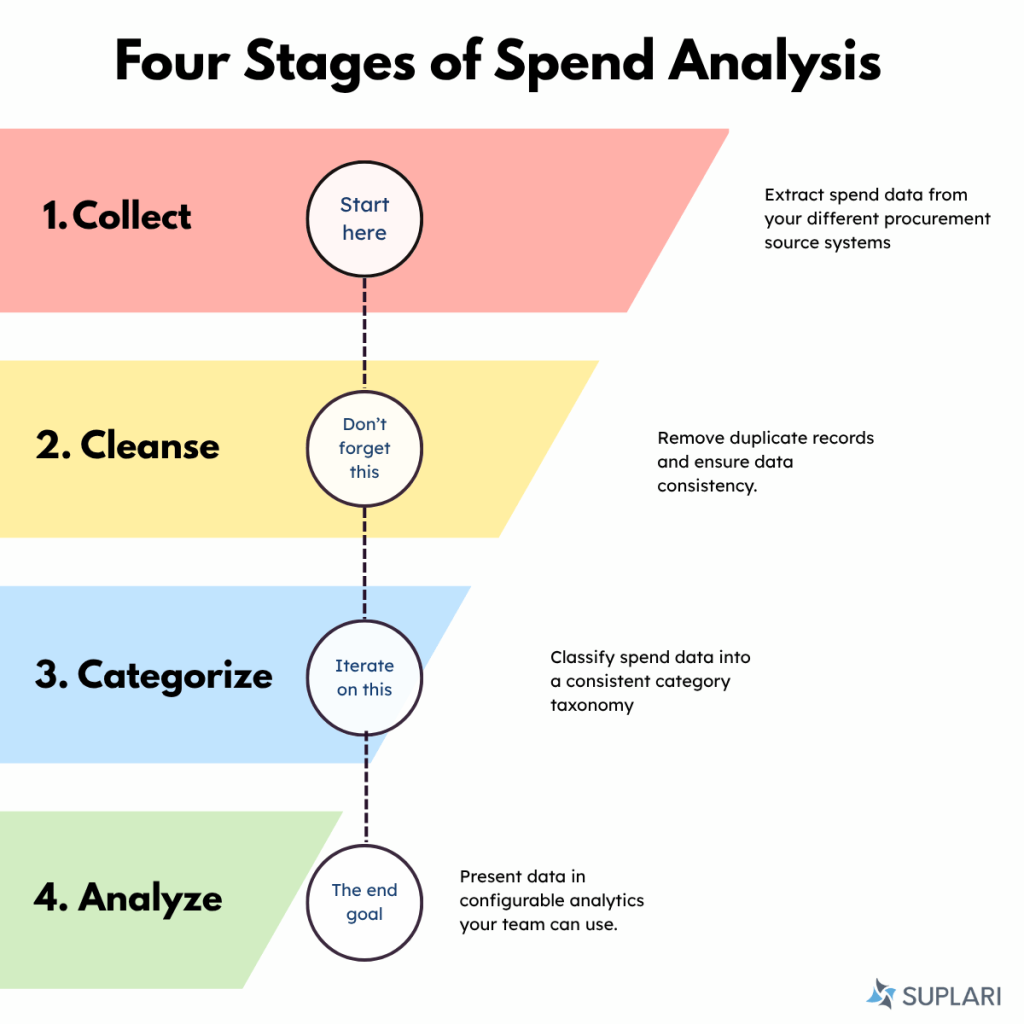
To make sense of your data, you'll need a spend analysis solution to collect data across systems, cleanse duplicates and inconsistencies, categorize spend into a taxonomy, and then analyze it for insight. The problem is that too many procurement teams still do spend analysis manually, or with an incomplete view of their full enterprise spend data.
When your spend data isn't unified you face:
- limited visibility into true enterprise spend (what you're buying, from whom, how much)
- missed volume discounts, inconsistent pricing and duplicate suppliers
- procurement teams reacting instead of leading, because they don't have trustworthy data to act on
- a huge barrier to scaling procurement analytics and AI-enabled procurement
In short: until your spend data foundation is solid, you'll lack actionable insights to transform procurement's impact in a measurable and scalable way.
What "unified spend data" means in practice
Unifying spend data isn't just pulling in reports. It means doing the following four stages: collect → cleanse → categorise → analyse.
Collect
You need to pull data from: ERP/finance systems, procure-to-pay systems, invoice and payment systems, contract management platforms, expense/T&E systems, SaaS/usage systems and external supplier/market-intel sources. Without broad coverage your view will be incomplete.
Cleanse / harmonise
Raw data will always be messy: inconsistent vendor names, duplicate records, missing categories, varying product/service descriptions. You do not need perfect data before you act — but you do need data that's cleansed enough to support analytics.
Categorise
To know "what we buy" you must categorise spend into consistent taxonomy (e.g., UNSPSC or custom). This allows you to answer key questions: what did we buy, from whom, at what cost, under what contract terms?
Analyse
With unified, cleaned, categorised data you can move to meaningful insight: trend analysis, supplier consolidation opportunities, contract leakage detection, pricing deviation, compliance monitoring. Modern platforms like Suplari offer AI-powered analysis, enabling real-time insights rather than static historical reports.
Benefits of effective spend data management
Getting your spend data management right delivers transformational benefits that extend far beyond basic spend visibility. Here's what you gain when you implement a unified, AI-powered approach:
Immediate transparency wins
The first unlock from effective spend data management is transparency. When you can see all your spend under management, properly categorized, with clean supplier data, you immediately identify opportunities that were invisible before.
Common immediate wins include supplier consolidation opportunities in the tail, duplicate supplier records masking true spend concentration, maverick spending patterns by category and business unit, and payment term optimization across the supplier base. One Fortune 2000 procurement leader discovered over $150,000 in working capital unnecessarily tied up from payment terms that should have converted to Net 60 eighteen months earlier, simply from having transparency into their spend data.
Strategic procurement transformation
Effective spend data management transforms procurement's role from tactical to strategic. Instead of being viewed as a roadblock in the way of getting things done, procurement becomes a business driver that influences fundamental company metrics.
The real prospect of procurement is that it can actually move the business. With proper data management and AI on top of it, procurement teams shift from answering "How fast can you process this PO?" to address strategic questions like: Should we even be doing this with this vendor? Should we be doing it with another vendor? Should we be doing it at a different time?
60-80% reduction in manual work
AI-powered spend data management automates routine tasks that traditionally consumed enormous procurement resources. Spend classification, invoice matching, contract monitoring, and supplier research can be automated with accuracy rates reaching 95% or higher.
Imagine if your category managers could shift from spending 60-70% of their time on data gathering and report building to focusing 35-40% of their time on strategic sourcing and category management, with another 25-30% on supplier relationships and negotiation.
Faster decision-making and real-time insights
Traditional spend analysis software required days or weeks to pull data, clean it, build reports, and interpret results. By the time insights arrived, conditions might have already changed. Modern spend analytics with AI agents collapses this timeline to minutes or seconds.
Teams can now explore multiple scenarios, test hypotheses, and validate assumptions in real-time during stakeholder meetings rather than scheduling follow-ups to gather more data. This responsiveness elevates procurement's credibility with internal customers and positions the function as a strategic partner rather than a cost control mechanism.
Proactive risk management
Effective spend data management enables continuous monitoring of supplier financial health, price volatility, contract compliance, renewal exposure, and payment term optimization. Instead of quarterly reviews and annual audits, you get real-time alerts weeks ahead of potential issues.
Suplari’s AI agents can validate supplier price increase claims within minutes by comparing internal spend with live market pricing indices, quantifying exposure, and providing negotiation strategies. This turns potentially costly situations into strategic opportunities with data-grounded negotiation positions.
Measurable financial returns
Organizations implementing modern spend data management platforms like Suplari typically see +75% faster spend analysis cycles and less than six-month payback periods. These returns come from discovered cash flow opportunities, supplier consolidation, contract leakage recovery, and pricing optimization that were invisible without unified data.
Common spend data management pitfalls to avoid
Even with the best intentions, procurement organizations frequently stumble into traps that undermine their spend data management initiatives. Here are the most common pitfalls and how to avoid them:
1. Start with technology instead of outcomes
Many procurement teams lead with "We need all our spend in Coupa" when they should lead with "We need to achieve X savings, compliance targets, or risk reduction." This shift in perspective frames changes everything from technology to outcomes.
Practical tip: When you start with technology selection rather than business objectives, you're asking stakeholders to support a tool rather than support measurable outcomes. Instead, use an "If Only" framework that works backwards from strategic goals to data needs. For example, if your strategic goal is 12% category spend reduction, your "If Only" statement might be: "If only I could see all tail spend by supplier and category," with expected value of $2M-$5M in consolidation opportunities.
2. Waiting for perfect data
Perhaps the most damaging mistake procurement executives can make is waiting for perfect data infrastructure. Many organizations with centralized IT functions tell their procurement teams to wait until the enterprise data lake initiative completes. It’s not uncommon for these types of projects to take 2-3 years to roll out, even before the needs of procurement can be assessed.
Practical tip: You do not need perfect spend data to start delivering value. While IT works on long-term data architecture, millions in savings opportunities sit locked away, and procurement remains stuck in tactical execution mode. Modern platforms like Suplari emphasize automated data management that works with imperfect data, delivering insights within weeks and measurable ROI within 6 months. You can use a value-based approach to justify immediate investments, while still aligning with long-term enterprise IT objectives.
3. Treat data access as a technical problem
Without executive buy-in, IT becomes a bottleneck for spend data unification. It's usually not because they're uncooperative, but because they're resource-constrained and managing competing priorities from every business unit. Procurement data access is an organizational alignment problem disguised as a technical problem.
Practical tip: The solution requires building a compelling business case that demonstrates value to multiple stakeholders: CFO through working capital impact and budget variance, CIO through data strategy validation, and line-of-business leaders through improved execution. Don't approach IT with "We need data extracts from these 15 systems." Instead, approach with "The CFO has approved this initiative to unlock $5M in savings. Here's the phased roadmap. Which milestone fits your Q1 capacity?"
4. Implementing big-bang approaches
Traditional S2C suite implementations follow a waterfall approach: spend 6-12 months integrating all source systems, then 3-6 months cleansing and normalizing all data, then 3 months building analytics and reports. Go-live happens 12-21 months after kickoff, with high likelihood of scope creep, changing requirements, and executive patience exhaustion.
Practical tip: Instead of a big-bang spend management initiative, design milestone roadmaps that deliver incremental value. Start with ERP spend data only in weeks 1-4, delivering top 100 supplier dashboards and tail spend optimization opportunities. Add contracts for top 20 suppliers in weeks 5-10, delivering pricing variance reports. Add invoice-level detail in weeks 11-16 for off-contract purchasing dashboards. This approach demonstrates ROI at each milestone, justifies continued investment, and builds organizational confidence.
5. Underestimating classification and enrichment complexity
Too many organizations approach spend classification as a one-time exercise rather than an ongoing process. They underestimate the complexity of maintaining accurate taxonomy as business units change, acquisitions occur, and new spending categories emerge.
Practical tip: Effective spend data management requires continuous classification with AI-powered automation that learns from corrections and adapts to organizational changes. Manual classification alone will never scale. Similarly, classification without enrichment (supplier risk scores, contract terms, usage metrics, market benchmark pricing) leaves money on the table by limiting insights to descriptive rather than prescriptive intelligence.
6. Selecting vendors without considering AI readiness
Not all "AI-powered" solutions deliver equal value. Generic AI tools layered on top of spreadsheets can't provide the contextual, high-fidelity answers that procurement-specific agents deliver.
Practical tip: Look for solutions with procurement-specific domain knowledge (not just ChatGPT for procurement), audit trail transparency for compliance and verification, intelligent orchestration architecture where AI coordinates validated calculation systems, and natural language query interface that understands procurement terminology. Ask proof questions like "Show me a customer who achieved measurable ROI within 90 days of deployment."
Why Suplari stands out as the AI-native procurement intelligence leader
When evaluating spend data management platforms for enterprise procurement, Suplari distinguishes itself through a decade of AI innovation, proven customer results, and a comprehensive approach that transforms spend data into strategic procurement intelligence.
Purpose-built for AI-powered procurement
Suplari was the first AI-native spend analysis platform designed specifically for enterprise businesses. While competitors added AI features as afterthoughts, Suplari's engineering team has been delivering cutting-edge AI capabilities for procurement teams for 10 years, refining countless insight algorithms and analyzing trillions of dollars in spend for trusted Fortune 500 companies.
This deep AI experience means Suplari handles the realities of enterprise procurement: imperfect data from 1 to 100+ source systems, complex multi-ERP environments, and messy, unstructured information. The platform doesn't require perfect data or extensive preparation overhead. It works with your data as it exists, delivering insights and ROI within weeks rather than requiring months of data cleansing.
Real-time continuous analytics, not batch reporting
Suplari's algorithms run continuously rather than in batch processes, providing immediate alerts and insights. This architectural difference means procurement teams get proactive intelligence before issues become critical, rather than discovering problems weeks later in quarterly reports.
When a category manager faced a supplier claiming price increases driven by hardware component costs, they simply asked Suplari's agent to validate the claim with an external perspective. Within minutes, the agent compared internal spend with live market pricing indices, verified the supplier's claim, quantified millions in exposure across contracts, and provided cost driver analysis, trends, and negotiation strategies. This turned a potentially costly situation into strategic opportunity with a data-grounded negotiation position.
Unified data model connecting all procurement context
Suplari's philosophy emphasizes that procurement requires holistic data to act strategically through an extensible, unified data model. The platform seamlessly transforms data from contracts, purchase orders, invoices, expenses, and supplier risk into a cohesive intelligence layer.
This unified approach enables insights impossible with fragmented data. The platform automatically matches PO pricing to contract terms, identifies off-contract spending, connects supplier performance across business units, links usage metrics to contract value realization, and surfaces hidden cash flow opportunities like the $150,000 in working capital one CFO discovered from payment terms that should have converted to Net 60.
AI procurement agents that automate 60-80% of routine work
Suplari's AI procurement agents represent the next evolution beyond basic spend analysis. Unlike generic AI tools like ChatGPT or Microsoft Copilot layered on top of spreadsheets, Suplari's agents are grounded in your specific procurement data, processes, and business outcomes.
The Suplari AI agents autonomously execute complex multi-step tasks including overcharge detection, dispute workflow launching, spend classification with 90%+ accuracy, supplier research and relationship summaries, contract analysis and renewal monitoring, and payment term optimization.
The time savings are dramatic. Tasks consuming hours or days now complete in seconds or minutes. Workflows requiring multiple handoffs execute autonomously with human oversight only for exceptions. Category strategies that previously took weeks now take minutes, with 75% reduction in RFP preparation time.
The Suplari difference in the age of AI
For procurement leaders seeking to unify data, cleanse it, classify it and turn it into action, Suplari provides a comprehensive platform — not just a tool or spreadsheet kit. The combination of purpose-built AI agents, continuous real-time analytics, unified data model, proven customer results, and fastest time-to-value makes Suplari the obvious choice for enterprises ready to transform procurement from tactical execution to strategic value creation.
Bottom line on procurement spend data management
You are at a pivotal moment: the foundation of strategic procurement is no longer just source-to-contract or procure-to-pay processes. It's the data infrastructure behind them. If you cannot quickly and reliably answer "What are we buying? From whom? Under what terms? Are we optimising spend?" you're leaving value on the table.
Start now: commit to a unified spend-data project, choose a platform built for procurement (not just generic BI), and ensure your team moves from reactive to strategic. With Suplari you can build that capability within weeks, not months and position procurement as a business-driving centre of insight, cost control and value creation.Book a demo to find out more about Suplari, the AI-native spend analysis solution.
About Suplari
Suplari is a procurement intelligence solution that helps businesses modernize procurement operations using AI. Suplari provides actionable intelligence to manage suppliers, deliver savings and manage compliance beyond the limits of traditional spend analytics. Suplari’s unique AI data management foundation empowers enterprise businesses to transform procurement operating models with reliable, AI-ready data.

