




Artificial intelligence is transforming how procurement teams work. AI technology can handle routine tasks that once took hours. It spots patterns humans miss. It can predict problems before they happen. AI can give you superhuman powers, if you know how to use it.
The business case is compelling:
- AI-powered solutions can deliver greater than 50% cost savings than legacy procurement software,
- AI agents can drive an additional 5 to 20% in value across category management functions,
- Procurement teams can capture 15 to 30% efficiency improvements through AI automation.
But success isn’t automatic. You need clean data. Your team needs training. Your processes need updating. Any new technology must fit your business goals and IT systems.
This guide shows you what works based on a decade of experience building AI platforms for procurement. You’ll learn where AI adds value. You’ll understand the challenges and key pitfalls.
Looking for tools rather than theory? This is a long explainer. If you're evaluating vendors right now, start with our comparison of the best AI procurement software and tools in 2026, or the top procurement intelligence platforms if you're specifically after spend and supplier intelligence. For the analytics layer underneath them, see the best spend analytics software in 2026 and the best procurement analytics software in 2026.
Otherwise, read on — this guide covers what AI actually does in procurement, where the ROI is real, and where it isn't.
How AI works in procurement
AI in procurement refers to the use of artificial intelligence technologies to automate or improve procurement processes. It’s all about using intelligent computer algorithms to improve process efficiency, reduce costs, and make more sourcing informed decisions.
Unlike traditional software that follows fixed rules, AI adapts and improves based on experience. It can recognize when a supplier’s delivery performance is declining. It spots unusual spending patterns that might indicate fraud. It predicts which contracts will need renegotiation soon.
AI systems don’t work in isolation. Most AI solutions are embedded in existing software solutions, where they are carefully trained to execute specific tasks.
Types of AI technology in procurement
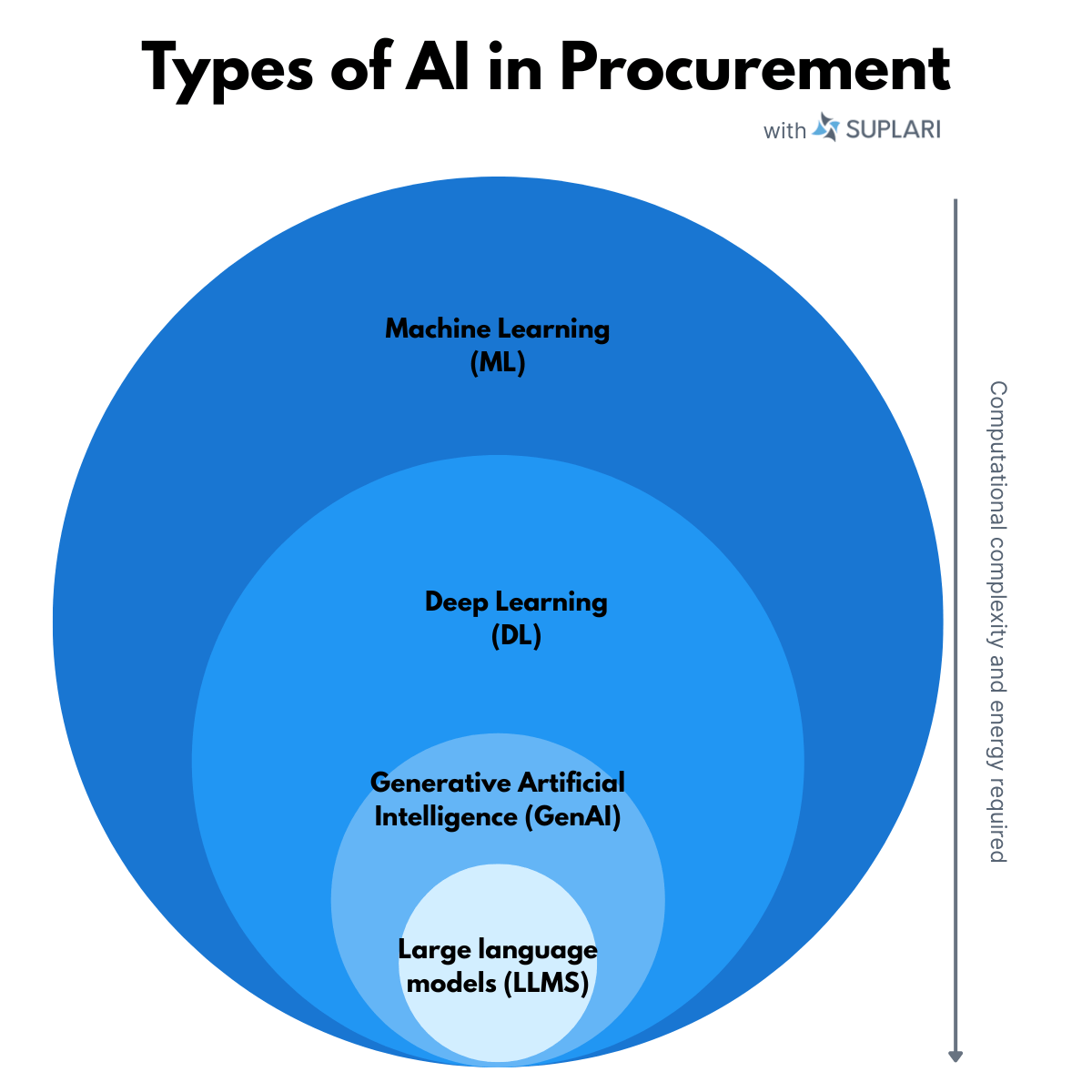
AI in procurement uses different layers of technology, each building on the previous one to create increasingly sophisticated capabilities. Understanding these layers helps you choose the right tools for your needs.
Machine Learning
Machine Learning (ML) forms the foundation of AI. It allows computers to learn from data and improve performance on specific tasks without explicit programming. It is widely used in procurement today to analyze spending patterns, supplier performance data, and contract terms to identify trends and opportunities.
Machine Learning technology powers modern spend classification engines, supplier risk scores, and demand forecasting solutions.
Deep Learning
Deep Learning (DL) handles more complex information using advanced computer systems called neural networks. It can process unstructured data like text found in contracts, supplier documents, and news articles without human intervention.
Deep Learning enables automatic contract review, supplier due diligence, and market intelligence gathering that would take humans hours to complete.
Generative AI
Generative artificial intelligence (Gen AI) can create entirely new content based on your procurement data. It can draft RFPs, write supplier evaluations, generate contract clauses, and create procurement KPI reports.
Generative AI is widely used in procurement through applications such as ChatGPT or Microsoft Co-Pilot to accelerate document creation while maintaining consistency with your policies and requirements.
Large Language Models (LLMs)
Large language models enable natural conversations with your procurement data. You can ask questions in plain English about spending patterns, supplier performance, or contract terms.
LLM systems understands context and provides detailed answers instantly, making procurement insights accessible to everyone on your team. They also form the foundation for AI agents, systems that can interact with their environment and take action on your behalf.
Other key terms related to AI in procurement
In addition to these core types, you may come across other key terms related to AI in procurement:
Natural Language Processing
Natural language processing reads and understands text like contracts and invoices. It extracts key terms from lengthy legal documents. It flags risky clauses automatically. It summarizes complex agreements in plain language. This technology eliminates hours of manual document review.
Computer Vision
Computer vision processes visual information from scanned documents. It reads handwritten invoices and receipts. It extracts data from various formats without human typing. It catches errors that slip past manual reviewers.
Robotic Process Automation
Robotic process automation handles repetitive tasks that follow clear rules. It processes routine purchase orders. It updates supplier information across multiple systems. It generates standard reports automatically. Traditional RPA is not considered AI, but increasingly procurement automation solutions combine elements of both technologies.
The current state of AI adoption in procurement
Despite the obvious value, most procurement organizations are still in early stages of AI adoption. Understanding where the market stands helps set realistic expectations.
According to the 2026 ProcureCon CPO Report, only 11% of procurement organizations describe themselves as fully ready to leverage AI. The majority, 65%, are currently piloting AI initiatives, while 24% are still building capabilities or evaluating opportunities. The biggest barriers? Data privacy and compliance concerns (67%), insufficient data quality and integration (54%), and an unclear business case for ROI (46%).
The Hackett Group's data tells a more optimistic story about momentum. Their 2026 study found that 43% of organizations are actively pursuing AI-enabled technology deployment, nearly double the level reported in 2025. AI-enabled technology has entered the top three procurement priorities for the first time, joining supply continuity and cost reduction. Seventy-one percent have adopted generative AI in some form, and 56% have deployed agentic AI at pilot or larger scale.
What this means in practice: AI in procurement is past the experimental stage but not yet mainstream. The window for early-mover advantage is closing. Organizations that build their AI capabilities now, starting with a clear AI procurement strategy, will be positioned to outperform peers who wait.
AI tools in procurement
Whether you build spend analysis solutions yourself or buy spend analytics software, the process follows the same four steps.
There are two ways you may encounter AI in procurement. Either by using tools created with AI for procurement, or by using generalist tools such as ChatGPT for use in a procurement function.
As of 2025:
- 94% of procurement professionals use generalist AI tools like ChatGPT each week,
- 90% of procurement leaders plan to adopt agentic AI solutions within the next year.
AI-enabled tools change how businesses buy things, approve purchases and engage with suppliers. It can automate manual tasks, give insights to influence your strategy, or simply help you get more work done with fewer resources.
The five most common applications of AI in procurement tools include:
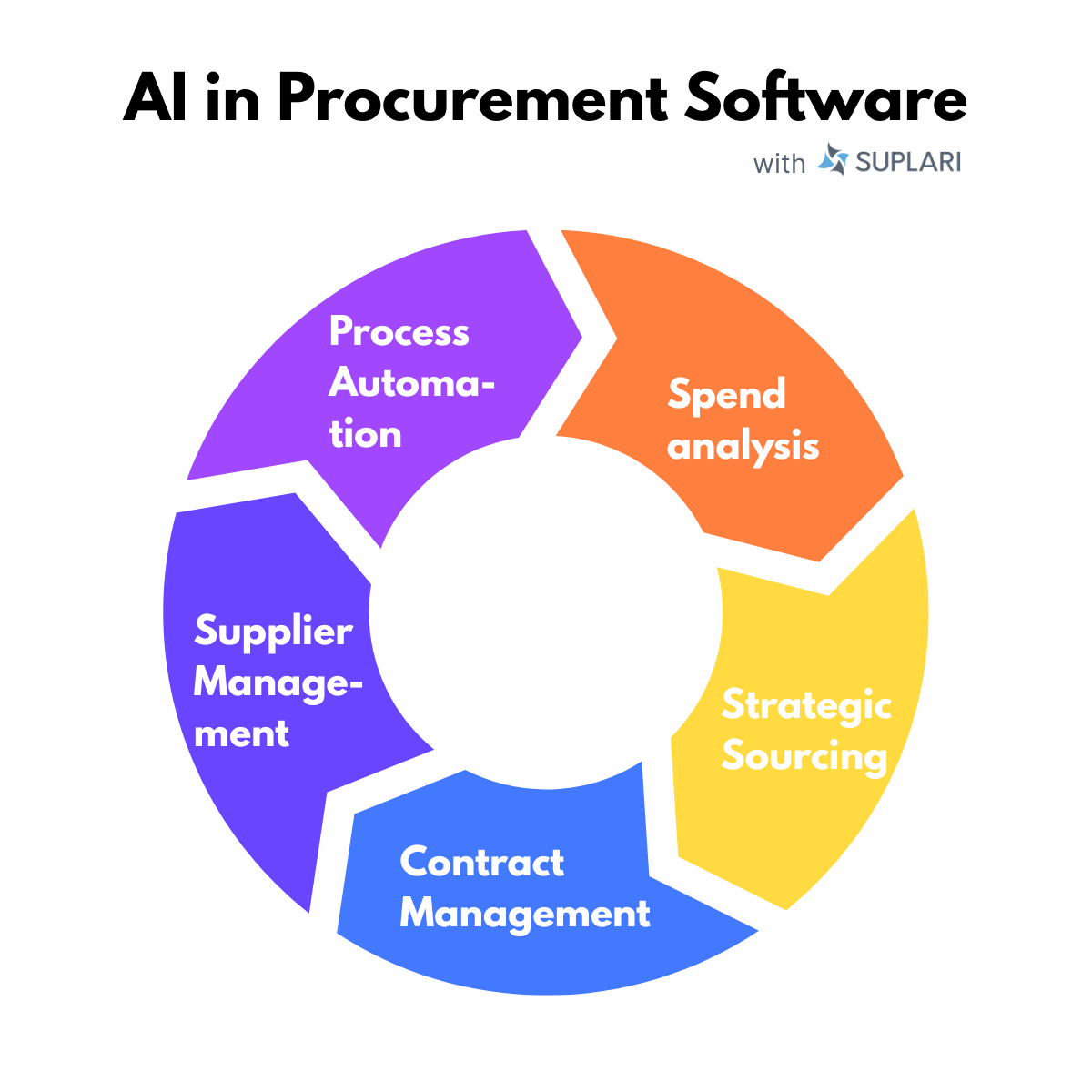
- Process Automation uses AI to do routine tasks. The software handles purchase orders, processes invoices, and manages approvals. This means people don’t have to do these tasks by hand anymore. Workers can spend time on more important jobs.
- Spend Analysis tracks how much money companies spend. AI looks at all purchases and finds patterns. It spots when people buy things outside of normal contracts. It also finds ways to save money by buying more from fewer suppliers.
- Strategic Sourcing tools help companies pick the best suppliers. AI looks at supplier data to see who performs well. It checks market prices and suggests the best buying strategies. The system learns from past purchases to make better choices.
- Contract Management tools keep track of all supplier contracts. AI reads contract terms and reminds people about important dates. It watches to make sure suppliers follow the rules. The system also finds chances to get better deals when contracts come up for renewal.
- Supplier Management solutions monitor how well suppliers perform. AI checks delivery times, quality scores, and other measures. It can predict problems before they happen. The system creates report cards for each supplier automatically.
With AI-enabled tools you can process more work done without growing the size of your team. You can also make better decisions because AI gives more information about your spending and suppliers. These tools won’t replace your need for other procurement software. More likely, most of the software you already use will embed AI within the next decade.
Key applications for AI in procurement
There are a number of areas where AI brings substantial advantage over traditional software and solutions. Let’s go through some key applications.
Machine learning spend classification
At Suplari, Machine Learning has been a core feature in spend classification since 2017. By training algorithms to recognize and classify line items into precise categories, you save hundreds of hours in work that used to be done manually. Not only that, you establish a reliable data foundation for deeper analysis.
This is the use case with the shortest path to value, because it's the one where AI outperforms humans on both speed and consistency.
Suplari Spend Classification categorises transactions from every source system — including the free-text P-card and non-PO invoice lines that never had a category code — and improves its own taxonomy as it goes.
AI in strategic sourcing
You can deploy AI across every stage of strategic sourcing to accelerate cycles and improve outcomes. The technology transforms sourcing from weeks-long manual processes into data-driven operations that deliver better results faster.
Automated sourcing tasks AI handles time-consuming activities that used to require significant manual effort. The technology scans internal and external databases to recommend suppliers based on pricing, quality, delivery reliability, and certifications. What previously took weeks of research now happens in minutes. AI also drafts RFP templates, evaluates supplier responses, and scores proposals against predefined criteria automatically.
Market intelligence AI processes massive datasets to uncover insights humans would miss. The technology can continuously monitor supplier performance, financial stability, and ESG ratings while tracking price movements, market shifts, and geopolitical risks. With AI you can gain real-time market intelligence that informs better sourcing decisions and negotiation strategies.
Strategic optimization AI evaluates thousands of potential supplier combinations to recommend optimal mixes that balance cost, quality, risk, and delivery requirements. The technology identifies ideal sourcing locations based on tariff impacts, labor costs, and supply stability. Companies achieve better sourcing outcomes through data-driven supplier portfolio optimization.
Predictive sourcing insights Machine learning models analyze historical spend patterns and market trends to forecast future demand and pricing. You can enter negotiations with accurate price predictions and demand forecasts, improving their bargaining position and budget planning accuracy. You can also create “what-if” scenarios on the fly that previously required data scientists and advanced data analysis.
AI in supplier performance management
You can use AI to transform supplier performance management from quarterly reviews to real-time oversight. The technology eliminates limitations of manual analysis and surfaces hidden risks automatically.
- Continuous KPI monitoring AI systems track supplier metrics like delivery times, quality scores, and cost changes across all procurement systems. Teams receive instant alerts when suppliers start underperforming, letting them act before problems escalate. Instead of waiting for quarterly reports, managers know immediately when delivery rates drop or costs spike.
- External risk intelligence Companies feed AI tools with market signals including financial data, news, and regulatory changes. The system flags which suppliers face potential problems from geopolitical tensions or industry disruptions. This gives teams visibility beyond internal performance data.
- Negotiation preparation Before supplier meetings, AI prepares teams with key facts about spending levels, performance trends, and relationship importance. Teams enter negotiations with complete context about leverage points and critical metrics. The system shows exactly where they have bargaining power.
- Performance benchmarking AI compares suppliers across categories and regions continuously. Companies see how each vendor performs against peers and industry standards. This identifies top performers and problem suppliers instantly rather than through annual assessments.
- Executive reporting AI generates summary reports for senior leaders who lack time for detailed dashboards. These briefings highlight key risks, cost trends, and performance issues in digestible formats. Leadership gets the insights they need without manual analysis.
AI agents for procurement compliance
You can deploy AI agents to handle procurement compliance tasks that previously required weeks of manual work. These systems automate monitoring and prevent violations before they become costly problems.
Contract lifecycle oversight AI agents scan all contracts continuously and identify upcoming expirations automatically. Companies receive detailed reports showing which agreements need renewal, budget requirements, and negotiation timelines. The system flags contracts with auto-renewal clauses that might need intervention, preventing unwanted extensions or price increases.
Policy enforcement AI monitors all purchasing activities against company policies and flags violations in real-time. The system catches off-contract spending, unauthorized suppliers, and approval bypasses immediately. Teams can address compliance gaps before they impact operations or create audit issues.
Documentation management AI ensures all required compliance documentation stays current across the supplier base. The system tracks certification expiration dates, insurance renewals, and regulatory filings automatically. Companies maintain complete compliance records without manual tracking spreadsheets.
Risk management with AI
Organizations use AI to monitor supplier risks continuously instead of relying on periodic manual assessments. The technology processes vast amounts of data to identify potential problems before they disrupt operations.
- Continuous health monitoring AI systems track supplier financial health through credit scores, market performance, and contract milestones around the clock. Companies receive alerts when suppliers face downgrades or approaching renewals before small issues become major shortages. The technology monitors thousands of suppliers simultaneously without human oversight.
- Predictive risk analytics Machine learning models analyze patterns in delivery performance, geopolitical events, and regulatory changes to flag suppliers that could face problems months ahead. Companies can reroute orders or secure alternative suppliers while still having time to negotiate favorable terms. The system identifies risk trends that humans typically miss.
- Natural language risk queries Teams ask questions like “Which suppliers expose us to rising freight costs in Southeast Asia?” and receive ranked lists with specific mitigation recommendations. The same interface handles quick checks on spending patterns, contract terms, and category benchmarks without requiring spreadsheet analysis.
Integrated opportunity identification AI identifies cost-reduction opportunities while monitoring risks, including early-payment discounts, vendor consolidation options, and payment term improvements. Each insight includes action plans and estimated financial impact, helping companies offset risk mitigation costs with savings discoveries.
Spend analytics and classification
AI-powered spend analysis is where most procurement teams start. Machine learning models classify raw transaction data from ERPs, P-cards, and AP systems into a unified taxonomy, often achieving 95%+ accuracy across millions of line items. This is the foundation for everything else: you cannot optimize spend you cannot see. Suplari's AI Data Platform ingests data from any source system and classifies it automatically, giving procurement teams full spend visibility within weeks, not months.
Contract management and intelligence
Generative AI can review contracts in minutes, extracting key terms, flagging unfavorable clauses, identifying auto-renewal dates, and benchmarking pricing against comparable agreements. Suplari's Contract Intelligence module goes further: it connects contract terms to actual spend data, so you can see whether the pricing and rebates you negotiated are actually being realized.
Suplari Contract Intelligence reads contracts against actual spend, so an auto-renewal clause surfaces as a dated alert tied to what you're paying, not as a search result in a repository.
Autonomous procurement and AI agents
AI agents represent the next evolution beyond copilots. Instead of summarizing data for a human to act on, agents execute multi-step tasks autonomously: triaging intake requests, running competitive sourcing analyses, monitoring tail spend for consolidation opportunities, and enforcing compliance policies. Suplari's AI Agents are purpose-built for procurement workflows and operate within your existing governance framework. This is the path toward autonomous procurement that scales your team's capacity without scaling headcount.
Predictive sourcing and market intelligence
AI enables procurement teams to move from backward-looking reports to forward-looking strategy. Predictive models analyze commodity price trends, demand forecasts, and macroeconomic indicators to recommend when to lock in pricing, which categories face inflationary pressure, and where supply disruptions are likely. Combined with market intelligence capabilities, this gives procurement a genuine strategic advantage.
Savings tracking and value orchestration
One of the hardest problems in procurement is proving that negotiated savings actually hit the P&L. AI solves this by continuously comparing contracted pricing to actual invoiced amounts, tracking compliance to sourced agreements, and attributing cost avoidance to specific initiatives. Suplari's Savings Tracking and Value Orchestration products automate this process so finance teams get the proof they need and procurement teams get the credit they deserve.
How AI is changing procurement jobs
AI won’t eliminate procurement entirely, but it will transform how work gets done. Recent research shows 94% of procurement executives already use AI tools weekly. By 2035, nearly every procurement role will change because of AI.
Implementation considerations and challenges
Despite all the potential, there are major risks related to AI implementation. According to recent research by Gartner, 40% of enterprise AI pilots will still fail by 2027 due to escalating costs, unclear business value or inadequate risk controls. Here are some of the most common pitfalls to avoid:
Data foundations
Clean data is essential for AI success. Your systems must provide accurate, complete information. Inconsistent formats and missing fields limit AI effectiveness.
Usually data standardization comes first. Product codes, supplier names, and categories need consistent formatting. Address variations and duplicate entries.
Integration challenges require planning. AI tools must connect to your ERP, P2P, and contract systems. APIs make this easier, but older systems may need custom work. Plan for data migration and synchronization. Establish clear governance policies.
Historical data depth affects AI performance. More history enables better predictions. Plan to clean and standardize at least two years of spending data. Consider external data sources for market intelligence.
Change management determines adoption success. Users need training on new processes. They must understand how AI helps them work better. Address concerns about job security honestly.
Technology selection and vendor evaluation
Build versus buy decisions depend on your capabilities. Most companies buy proven solutions rather than building from scratch. Focus your internal resources on configuration and adoption.
Integration capabilities matter more than features. The best AI tool is useless if it can’t access your data. Prioritize vendors with strong connectivity and API capabilities.
Pilot programs reduce implementation risk. Start with a specific use case and limited scope. Measure results carefully. Use lessons learned to refine your approach before scaling.
Scalability planning prevents future problems. Choose solutions that grow with your business. Consider global requirements and multi-currency support. Plan for increased data volumes and user counts.
Organizational readiness
Skills assessment identifies training needs. Your team needs to understand AI capabilities and limitations. They must learn new processes and tools. Plan for significant learning time.
Process redesign often accompanies AI implementation. Automation changes how work flows. Some steps become unnecessary. Others require new approval points. Map new processes carefully.
Stakeholder alignment prevents resistance. Finance, legal, and operations teams all affect procurement success. Get early buy-in from key influencers. Address concerns before they become obstacles.
Communication strategy manages expectations. Explain what AI will and won’t do. Share quick wins to build momentum. Be honest about challenges and timelines.
Measuring AI success and ROI
Key performance indicators must align with business goals. Here are some core tips to develop your KPIs and ROI calculations for AI investments.
- Cost savings matter, but don’t ignore efficiency and risk metrics. Track both leading and lagging indicators.
- Financial metrics provide the clearest ROI calculations. Measure hard cost savings from better pricing and reduced maverick spending. Ultimately, these are what CFOs are looking to see.
- Calculate soft savings and cost avoidance in a way your finance team recognizes. Include risk avoidance in your total value calculation.
- Operational metrics show process improvements. Track cycle times for key processes. Measure error rates and rework frequency. Monitor user satisfaction and adoption rates.
- Quality indicators can also demonstrate better outcomes. Measure supplier performance improvements. Track compliance rates and audit findings. Monitor customer satisfaction with procurement services.
Here are a few things you need to remember:
- Timeline expectations must be realistic. Simple automation shows results in weeks. Complex AI implementations take months to show full value. Plan for gradual improvement rather than instant transformation.
- Continuous improvement ensures lasting success. Regular reviews identify optimization opportunities. User feedback drives enhancement priorities. Data quality improvements increase AI effectiveness over time.
- Benchmarking can provide context for your results. Compare your metrics to industry standards. Track improvement trends over time. Share success stories to maintain momentum.
Common misconceptions about AI in procurement
The AI hype cycle has produced some persistent misunderstandings that lead procurement teams to either overestimate what AI can do out of the box or underestimate what it requires to succeed. Here are the ones we see most often.
"AI will replace procurement professionals"
This is the most common fear and the most misguided. AI automates the data-heavy, repetitive aspects of procurement work: classifying transactions, scanning contracts, monitoring supplier news feeds. It does not replace the relationship management, strategic thinking, and business judgment that define great procurement. The 2026 ProcureCon CPO Report found that 51% of organizations cite resistance to change rooted in concerns about AI replacing human judgment as a top barrier to adoption. But the same report shows that organizations investing in AI are expanding their teams' strategic influence, not shrinking their headcount.
"You need perfect data before you can use AI"
This misconception has delayed more AI deployments than any technical challenge. Yes, data quality matters. The Hackett Group's 2026 Procurement Key Issues Study found that 54% of organizations not fully ready for AI cite insufficient data quality and integration as a top barrier. But modern AI systems are designed to work with imperfect data. Machine learning models can handle inconsistencies, duplicates, and gaps far better than the manual spreadsheet processes they replace. The goal is not perfect data, it is better data than what you had yesterday, and AI itself accelerates that improvement.
"AI is just ChatGPT for procurement"
Large language models like ChatGPT are one form of AI, useful for summarization, drafting, and conversational interfaces. But the AI that drives procurement value is mostly specialized machine learning: classification models trained on spend data, anomaly detection algorithms tuned to invoice patterns, and predictive models built on supply chain signals. These are purpose-built systems, not general-purpose chatbots. Suplari's AI Operating System combines multiple AI approaches, including generative AI, within an architecture designed specifically for procurement data and workflows.
"AI delivers value immediately after implementation"
Some AI capabilities do deliver fast results. Spend classification, for example, can produce actionable visibility within weeks. But the full value of AI in procurement compounds over time as models learn from your organization's data, users refine their workflows, and the system accumulates institutional knowledge. Teams that expect instant transformation set themselves up for disappointment. Teams that approach AI as a capability that improves continuously build lasting competitive advantage.
"Only large enterprises can benefit from AI in procurement"
Cloud-based AI platforms have dramatically lowered the barrier to entry. You no longer need a data science team or on-premise infrastructure to deploy machine learning for spend analytics or supplier risk monitoring. Mid-market procurement teams are adopting AI-native solutions that deliver enterprise-grade capabilities without enterprise-grade budgets or implementation timelines.
Future outlook and emerging trends
Generative AI opens new possibilities for procurement. Large language models can draft RFPs and contracts. They can summarize complex supplier evaluations. They can answer policy questions in natural language.
Conversational interfaces, like Suplari’s AI Procurement Agent make AI more accessible. Procurement professionals can ask questions in plain English. They get instant answers from their data. They don’t need to learn complex query languages.
Autonomous procurement represents the next frontier. AI systems will make routine purchasing decisions independently. They’ll negotiate simple contracts within predefined parameters. They’ll manage supplier relationships proactively.
Industry-specific innovations address unique needs. Manufacturing companies get predictive maintenance insights. Healthcare organizations track regulatory compliance automatically. Retail needs bespoke solutions, like Tariff Management insights.
Category strategy will be completely transformed by AI agents. Imagine a scenario as described by Elouise Epstein of Kearney, where every employee will be a manager of agents. For every 10 category managers you might have 100 agents that they orchestrate.

Ethical AI principles guide responsible implementation. Bias detection prevents unfair supplier treatment. Explainable AI enables decision transparency. Human oversight remains essential for critical decisions.
Integration ecosystems are expanding. AI platforms connect with more business applications. Data flows more freely between systems. Real-time insights become standard across the enterprise.
Getting started: A practical roadmap
Maturity assessment establishes your starting point. Evaluate your current data quality and system capabilities. Assess your team’s readiness for change. Identify the biggest pain points to address first
Business case development requires specific metrics. Calculate current process costs and inefficiencies. Estimate potential savings and efficiency gains. Include risk mitigation value in your ROI calculations.
Pilot program design focuses on quick wins. Choose a specific use case with clear success criteria. Limit scope to reduce complexity and risk. Plan for measurement and learning throughout the pilot.
Vendor selection follows a structured process. Define your requirements clearly. Evaluate multiple options thoroughly. Check references and request demonstrations. Negotiate implementation support carefully.
Implementation planning prevents common pitfalls. Allocate sufficient time for data preparation. Plan user training and change management activities. Establish clear project governance and decision-making processes.
Scaling your AI strategy for procurement builds on pilot success. Use lessons learned to refine your approach. Expand to additional use cases systematically. Build internal capabilities for ongoing optimization.
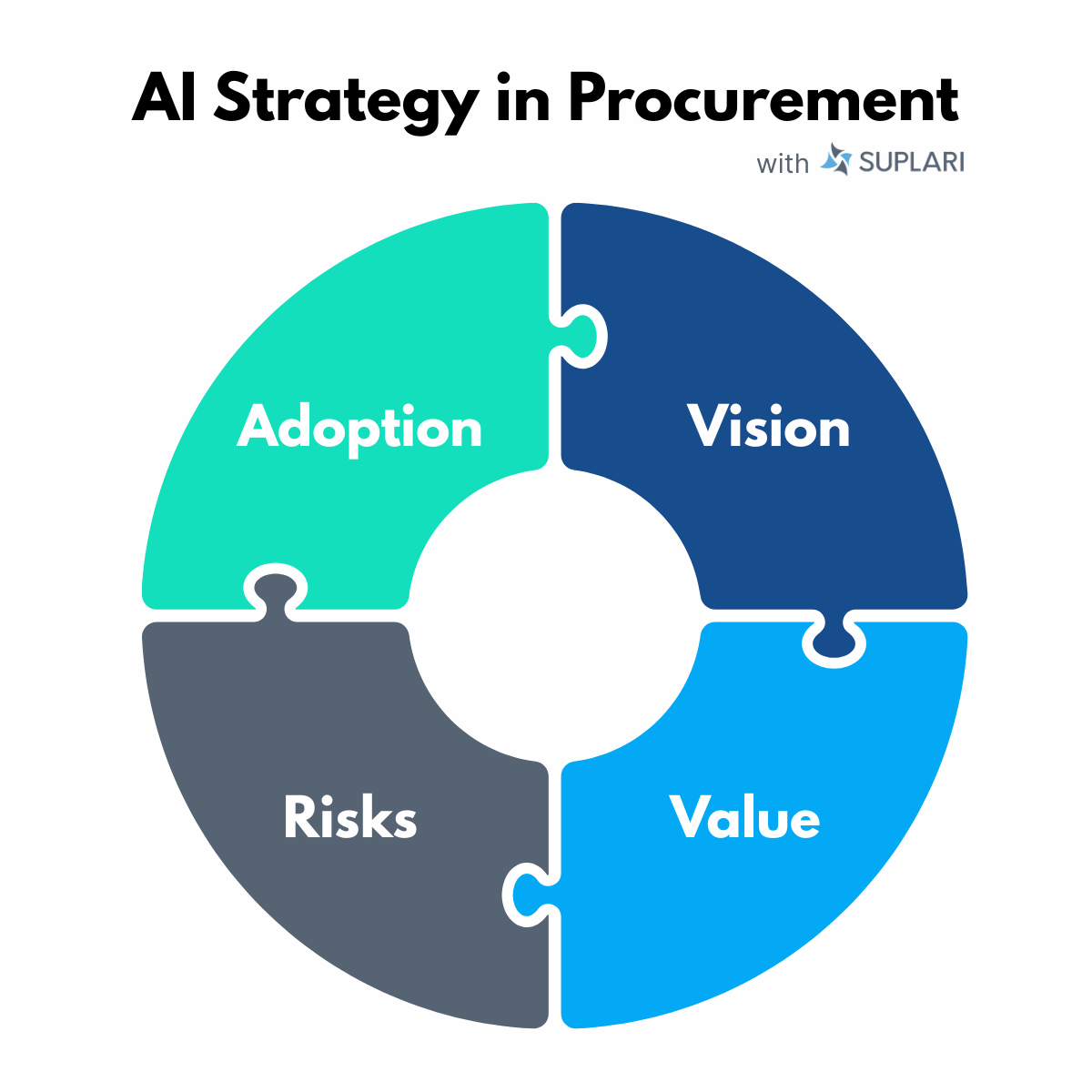
Success measurement validates your investment. Track metrics consistently from day one. Share results with stakeholders regularly. Use data to guide future AI investments and improvements.
Best practices for AI adoption in procurement
Success with AI depends on how you implement it. Organizations that follow proven adoption practices see measurable value within months. Those that rush in without planning face disappointing results.
Here are the essential practices from hundreds of enterprise implementations:
Define clear business objectives
Start with your most painful problems, not with technology. Your AI initiative needs measurable goals tied to business priorities.
Successful objectives target specific outcomes:
- Reduce spend analysis time from days to minutes
- Achieve 90%+ automated spend categorization accuracy
- Recover millions in contract pricing leakage annually
- Free 200+ analyst hours monthly for strategic work
Frame goals in business language that resonates with different executives. CFOs care about working capital and budget variance. CIOs care about data strategy validation. Category managers care about faster insights and strategic capacity.
Secure executive sponsorship
AI adoption fails without leadership support. You need an executive sponsor who champions the initiative, removes organizational barriers, and secures necessary resources.
Without executive buy-in, IT becomes a bottleneck. Procurement data access is an organizational alignment problem disguised as a technical problem. Your sponsor helps navigate these political challenges and protects the project from competing priorities.
Build a compelling business case that demonstrates value across multiple stakeholders: CFO through working capital impact, CIO through data strategy validation, and line-of-business leaders through improved execution.
Establish cross-functional collaboration
AI procurement projects touch multiple departments. You need collaboration across procurement, IT, finance, operations, and business units.
Form a cross-functional steering committee with decision-making authority. Use regular meetings to address integration challenges, resolve data access issues, and align on priorities.
Define clear roles and responsibilities:
- Who owns data quality
- Who approves integrations
- Who validates AI outputs
- Who measures results
Strategic procurement requires co-creating strategy with stakeholders rather than executing in isolation.
Prioritize data quality and governance
You don’t need perfect data to start, but you need data clean enough to support analytics. Poor quality training data leads to unreliable outputs and erodes trust.
Modern platforms work with imperfect data, delivering insights within weeks and measurable ROI within six months. The key is starting with available data rather than waiting for perfect conditions.
Focus your data initiatives on:
- Supplier name normalization
- Spend category standardization
- Contract data completeness
- Invoice-to-PO matching accuracy
When procurement teams implement AI agents, classification accuracy jumps from less than 80% through manual processes to over 90% with AI-powered pattern recognition. This requires high-quality training data that teaches the system your organization’s specific logic.
Establish data governance policies. Assign data stewards who monitor accuracy, resolve inconsistencies, and ensure systems stay synchronized.
Implement secure and ethical AI models
AI systems handle sensitive information including supplier pricing, contract terms, and competitive intelligence. You need robust security measures and ethical guidelines.
Security essentials include:
- Role-based access controls
- Encryption for data in transit and at rest
- Detailed audit trails
- Compliance verification capabilities
Ethical AI requires transparency in decision-making. Users should understand why the system made specific recommendations. At Suplari, AI acts as an orchestrator accessing validated calculation systems through APIs, ensuring all data queries happen in auditable systems.
Monitor for bias in AI outputs. Check whether recommendations unfairly favor certain geographies, company sizes, or ownership structures. Establish governance policies covering AI usage, output validation, error handling, and sensitive recommendations.
Start with pilot programs
Design milestone roadmaps that deliver incremental value rather than big-bang approaches taking 12-21 months.
Choose pilot use cases based on impact and complexity:
- Weeks 1-4: ERP spend data for top 100 supplier dashboards
- Weeks 5-10: Top 20 supplier contracts for pricing variance reports
- Weeks 11-16: Invoice detail for off-contract purchasing dashboards
One enterprise pulled in just their marketing contracts and used AI agents to analyze performance. Within two months, they identified $1.2 million in optimization opportunities and reduced their agency count from 47 to 31 suppliers.
Define success criteria before you start: accuracy thresholds, time savings targets, financial impact goals. Measure rigorously and share learnings with stakeholders.
Invest in training and change management
Technology implementation is easy. Changing how people work is hard.
Your team needs to understand:
- What AI can and cannot do reliably
- How to frame questions effectively
- When to trust AI recommendations
- How to validate outputs and override decisions
The most successful teams follow a trust-but-verify approach, viewing AI agents as colleagues requiring training and feedback rather than static tools.
Address job security concerns directly. AI elevates procurement work from tactical to strategic. Category managers spend more time on supplier relationships than analysis. Analysts shift from manual classification to strategic insights.
Build confidence through parallel operation periods where teams use both old and new approaches simultaneously. When they see AI delivering better results faster, adoption becomes easier.
Enable continuous learning with reinforcement learning
The most sophisticated AI systems learn and improve through experience. Reinforcement learning enables AI to take actions, observe results, and adjust strategies based on outcomes.
Unlike traditional machine learning that applies predetermined patterns, reinforcement learning optimizes for long-term outcomes. It decides what to do next based on what works best.
This matters because procurement involves sequential decisions affecting future outcomes. You negotiate contracts impacting tomorrow’s supplier relationships. You choose vendors whose performance affects next quarter’s costs.
Practical applications include:
- Dynamic market intelligence adapting to real-time conditions
- Supplier portfolio optimization adjusting the mix for resilience and cost
- Contract term optimization finding the best combinations
Start with lower-risk categories where you can tolerate experimentation. Track results carefully. As the system proves itself, expand to critical areas with appropriate guardrails.
Build self-service analytics capabilities
AI works best when it connects people across your organization to procurement intelligence. Self-service analytics reduce bottlenecks and elevate procurement’s strategic role.
AI agents eliminate bottlenecks through conversational interfaces. When sales asks “How much do we spend with this customer who’s also a supplier?”, they get instant responses without creating work for procurement analysts.
One enterprise deployed AI agents for sales, finance, and operations teams. Results: 75% reduction in data request tickets, 90 hours monthly freed for strategic work, and improved cross-functional satisfaction scores.
Design workflows balancing autonomy with appropriate controls. Automate routine decisions like purchase order validations. Require human judgment for strategic supplier selections and major contract negotiations.
Measure success across multiple dimensions
There isn’t one ROI metric, there are many. Transparency is the first unlock, and from there you build toward multiple value streams.
Track hard dollar savings:
- Contract compliance improvements recovering pricing leakage
- Supplier consolidation reducing administrative costs
- Payment term optimization freeing working capital
- Maverick spend reduction through visibility
Measure efficiency gains:
- Analyst time redirected to strategic work
- Reduced cycle times for RFPs and category reviews
- Elimination of manual categorization work
- Self-service analytics reducing bottlenecks
Monitor risk mitigation:
- Early warning systems for supplier concentration
- Compliance monitoring preventing audit findings
- Faster identification of supply chain disruptions
- Better visibility into geographic and category exposure
According to the 2025 Deloitte Global CPO Survey, Digital Masters who allocate approximately 20% of their procurement budget to technology achieve 2.8x ROI on GenAI investments compared to 1.6x for their peers.
Build three ROI scenarios: conservative, moderate, and optimistic. Present the conservative case to over-deliver rather than under-deliver.
Plan for continuous optimization
AI adoption doesn’t end after initial implementation. The most successful organizations treat AI as an ongoing capability requiring continuous refinement.
Regular reviews identify improvement opportunities. Analyze which queries produce the best results. Review where AI recommendations get overridden and understand why.
User feedback drives enhancement priorities. Some teams build custom agents for specific use cases: component risk agents monitoring pricing daily, renewal readiness agents gathering usage data 90 days before contract renewals.
Expand systematically after proving value with initial pilots. Build internal capabilities for ongoing optimization rather than remaining dependent on vendors.
The organizations that lead in AI procurement treat it as a journey of continuous improvement rather than a one-time project. They build learning cultures where teams experiment, share insights, and constantly push for better results.
Conclusion and call to action
AI in procurement isn’t optional anymore. It’s becoming essential for competitive success. Companies that embrace it gain significant advantages. Those that delay fall behind quickly.
The technology is ready for mainstream adoption. Proven solutions exist for most procurement challenges. Implementation approaches are well-established. The risks of waiting now exceed the risks of moving forward.
Your next steps should be immediate and concrete. Assess your current state honestly. Identify the highest-impact opportunities. Start with a pilot program to build experience and confidence.
Success requires commitment beyond technology selection. Invest in your team’s capabilities. Redesign processes thoughtfully. Measure results consistently and share them widely.
The procurement leaders who act now will shape their organizations’ futures. They’ll deliver better results for their companies. They’ll build more valuable careers for themselves. They’ll help create more efficient and sustainable supply chains for everyone.
The question isn’t whether AI will transform procurement. It’s whether you’ll lead that transformation or respond to it. The choice is yours, but the window for first-mover advantage is closing quickly.
If you want to see what that looks like on your own data, Suplari is an AI-native procurement intelligence platform that unifies spend, supplier and contract data, then runs AI agents across it continuously — surfacing savings opportunities, contract leakage and supplier risk without anyone having to go looking. Book a demo to see it against your spend.
Not ready for a conversation? Two useful next reads: how to build the business case for AI in procurement, and why AI pilots in procurement fail — which is the more useful of the two if you've already tried once.


