




Supplier Performance Management (SPM) is a strategic, ongoing process of monitoring, analyzing, and improving vendor performance to maximize value, ensure quality, and mitigate supply chain risks. By utilizing tools like scorecards and KPIs, organizations evaluate metrics such as on-time delivery, quality, and cost. Key steps include setting metrics, regular evaluation, and fostering supplier collaboration.
In today’s volatile supply landscape, managing suppliers goes far beyond ticking boxes on a quarterly scorecard. It’s not enough to know if a supplier delivers on time or hits basic quality metrics. You need a way to manage your full supplier portfolio with trusted data and timely insights.
Why does this matter? Over $1.6 trillion is tied up in global supply chains due to inefficiencies and underperforming suppliers according to PwC’s 2025 Working Capital Study.
What is supplier performance management (SPM) software, and which is best in 2026?
Supplier performance management software monitors, scores, and improves how suppliers perform — tracking KPIs like on-time delivery, quality, cost, and compliance, and turning that into corrective action. The newest generation shifts SPM from periodic scorecards to continuous AI monitoring that predicts problems before they occur and guides teams through fixing them.
The best fit depends on whether you want an AI-native intelligence layer, a dedicated SRM specialist, or SPM inside a broader suite:
- Suplari — best AI-powered SPM command center: combines performance metrics with spend and risk in one model.
- Kodiak Hub, Vizibl, TealBook, Graphite Connect, HICX, State of Flux — specialists across SRM, collaboration, supplier data, onboarding, and information management.
- EcoVadis — sustainability/ESG performance. MasterControl, ComplianceQuest — supplier quality for regulated industries.
Supplier Performance Management (SPM) in a nutshell
Supplier Performance Management (SPM) is the practice of evaluating, tracking, and improving supplier performance to meet business goals. It helps procurement leaders answer critical questions:
- Are our suppliers helping or hurting our business objectives?
- Where are the risks in our supply base?
- Who deserves a larger share of our spend—and who doesn’t?
At its core, SPM ensures that suppliers consistently deliver quality, cost, and service levels as promised. But it also goes a step further. When done right, SPM helps unlock innovation, reduce supply chain risk, and create a culture of continuous improvement across the value chain.

5 key supplier performance criteria
A strong supplier performance management program is only as good as the criteria it uses to measure success. While every organization may customize metrics based on its industry and goals, these five core performance criteria are the foundation of most effective SPM programs:
Why traditional supplier scorecards fall short
Many organizations still rely on basic supplier scorecards to evaluate supplier performance. These typically measure a few standard KPIs like:
- On-time delivery rates
- Defect rates or return rates
- Price compliance
- Responsiveness
While useful, these metrics alone offer a limited view. They are often backward-looking, isolated from business outcomes, and disconnected from supplier engagement. Worse, they can feel punitive to suppliers rather than collaborative.
If you want suppliers to improve, innovate, and share risk, you need more than data—you need dialogue, development, and trust.
A modern approach to SPM
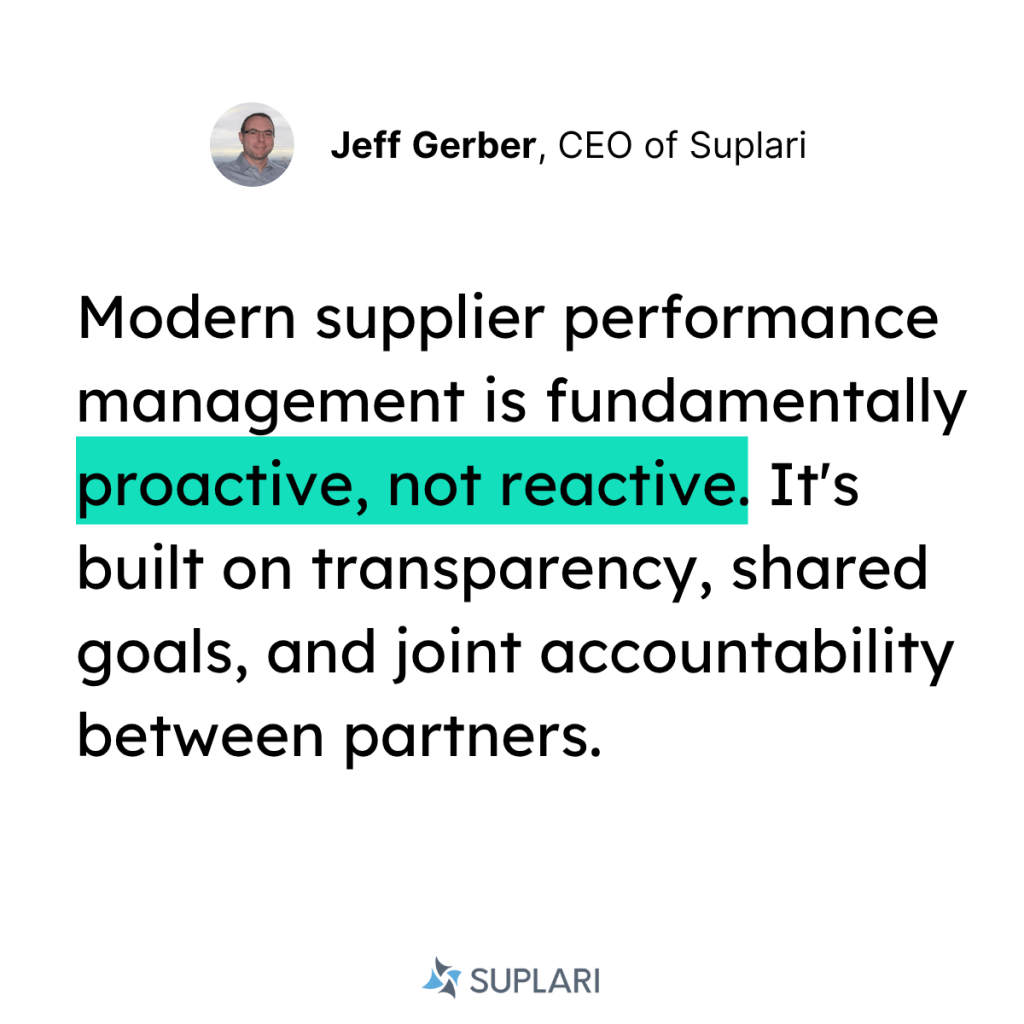
According to Jeff Gerber, CEO of Suplari, modern supplier performance management is proactive, not reactive. It’s built on transparency, shared goals, and joint accountability. Most importantly, modern SPM is based on data.
Here are the key components:
1. Clear performance expectations
Start with clarity. Before you measure, align. Define what success looks like for each supplier relationship. Tailor metrics to the category and contract type. Include both operational KPIs (delivery, cost, quality) and strategic KPIs (innovation, ESG compliance, resilience).
2. Ongoing monitoring with real-time data
Use AI-assisted spend analysis reports to track live supplier performance, not just quarterly snapshots. Integrate data from ERP systems, logistics platforms, quality audits, and even supplier portals. Spot trends early and act quickly.
Example tools and metrics:
- Purchase order cycle times
- Quality incident reports
- Fill rate percentages
- Sustainability and DEI metrics
3. Regular supplier reviews
Host structured reviews that go beyond numbers. Include both procurement and business stakeholders. Discuss what’s working, what’s not, and where value can be created. Use a mix of data and supplier self-assessments to foster open dialogue.
4. Supplier development plans
When performance gaps emerge, work with suppliers to fix them. Create formal development plans with timelines, milestones, and shared responsibilities. High-performing procurement teams often provide coaching or even co-invest in supplier capabilities.
5. Segmented supplier strategies
Not all suppliers should be managed the same way. Segment your supply base (e.g., strategic, tactical, bottleneck, transactional) and tailor SPM efforts accordingly. Strategic suppliers get deeper engagement. Transactional suppliers may only need automated monitoring.
Benefits of going beyond the scorecard
When you elevate supplier performance management, the returns are significant:
Common SPM pitfalls to avoid
Even well-intentioned SPM programs can stall. Watch out for these traps:
- Too many KPIs: Focus on what matters. Five high-impact metrics are better than 20 scattered ones.
- One-size-fits-all approach: Tailor your program to supplier size, spend level, and risk profile.
- Lack of follow-through: Measurement without action demoralizes suppliers.
- Overly punitive tone: Remember, the goal is improvement—not punishment. Use performance data as a basis for collaboration, not blame.
The role of technology in SPM
Technology has changed what’s possible in supplier performance management. Tools like AI spend analytics, supplier scorecard platforms, and supplier risk monitoring systems help teams get better visibility and react faster.
Emerging capabilities include:
- Predictive analytics for supplier risk
- Natural language processing to scan contract compliance
- AI-powered suggestions for supplier development priorities
- Automated alerts when performance dips
But even with great tech, success still depends on leadership, process, and communication.
How to Use AI for Smarter Supplier Performance Management
Modern supplier performance management is increasingly powered by AI—and for good reason. AI procurement tools eliminate manual analysis, surface hidden risk, and deliver real-time insights that help procurement teams make faster, smarter decisions.
Here’s how you can use AI to elevate every part of your supplier performance program:
1. KPI monitoring
AI procurement agents can continuously track supplier KPIs—like on-time delivery, quality scores, and cost deviations—across all your systems. Instead of waiting for quarterly scorecards, you get real-time alerts when a supplier starts to underperform, allowing you to act before issues escalate.
Example Use Case:
"Which suppliers missed delivery SLAs this quarter?" – AI instantly retrieves this data across POs and shipments.
2. Supplier risk intelligence
AI tools ingest external market signals—like financial instability, geopolitical tensions, and regulatory changes—and flag which suppliers are at risk. This helps you monitor supply chain health beyond internal performance metrics.
Example Use Case:
"Analyze my geopolitical risk in Israel and Iran over the next 6 months" – AI provides a geo-financial risk profile in minutes.
3. Negotiation leverage
Before supplier reviews or renegotiations, AI can prep your team with key facts: what you’re spending, how the supplier is performing, where you have leverage, and how critical the relationship is to their revenue.
Example Use Case:
"I have a meeting with Cisco. Tell me what I need to know." – AI returns their performance trends, contract exposure, and financial ties.
4. Supplier benchmarking
AI enables continuous benchmarking by comparing suppliers across categories, regions, and market norms. You can see how each vendor stacks up and identify leaders and laggards at a glance.
Example Use Case:
"Benchmark World Wide Technology’s performance vs. peers" – AI surfaces a performance dashboard with comparative analytics.
5. Automate executive briefings
Senior leaders often lack time to dive into supplier dashboards. AI can generate digestible executive summaries that highlight key risks, cost trends, and supplier performance summaries tailored to the audience.
Example Use Case:
"Create a supplier performance briefing for the CFO on top 20 suppliers" – AI delivers a visual, C-suite-ready report.
Final thoughts
Supplier performance management is no longer a back-office task. It’s a strategic lever that impacts cost, risk, innovation, and business continuity. Basic scorecards are a start—but they won’t get you very far on their own.
AI doesn’t replace your role in supplier management, it makes you more effective. With AI, you move from reactive to proactive. You spend less time gathering data and more time improving supplier outcomes.
Book a demo to see the future of SPM with AI.


