



Contract intelligence software uses AI to turn static contracts into actionable business insight — and, critically, it analyzes contract terms alongside actual procurement performance data to surface value leakage, compliance gaps, and savings that a document repository can't see.
Unlike traditional contract lifecycle management (CLM) tools that mainly store and search documents, contract intelligence platforms continuously monitor whether negotiated terms are being honored in practice — tracking volume-discount thresholds, payment terms, price-escalation clauses, and contract utilization against real spend and purchase-order activity.
The practical difference:
- CLM / contract automation — removes bottlenecks in review, approval, and storage. Answers "where is the contract and what does it say?"
- Contract intelligence — connects contract terms to spend and executes actions. Answers "are we actually getting the terms we negotiated, and where are we leaking value?"
Suplari approaches contract intelligence as a spend-connected layer: its AI agents monitor contracts, spend, and suppliers continuously and can trigger compliance actions automatically, rather than producing a report someone has to read and act on.
So, what is contract intelligence?
Contract intelligence uses AI to turn static legal agreements into useful business insights. You extract key terms, obligations, and deadlines from contracts automatically. You can analyze pricing against market standards, or ensure suppliers are keeping to agreed terms. You can also identify risks before they become problems, and ensure compliance to agreed guidelines.
Contract intelligence is the core of modern-day contract management. Where contract automation helps you eliminate bottlenecks in contract reviews and storage, contract intelligence gives you insights for strategic sourcing.
Why is contract intelligence software important?
You've invested in contract management tools that promise millions in savings. Yet your team still spends weeks manually reviewing agreements and chasing down compliance issues. The problem isn't your contracts. It's solutions that manage contracts without giving real actionable intelligence.
Recent advances in artificial intelligence (AI) have transformed contract analysis for procurement teams. They highlight how legacy solutions that only store and analyze documents produce expensive reports. They don't drive business transformation.
The key difference?
In the age of AI, leaders increasingly seek a solution that connects contract data with actual spend patterns and executes automatic actions. Here is what you need to know about contract intelligence based on a decade of experience supporting enterprise procurement at Suplari.
Key aspects of contract intelligence solutions
Modern contract intelligence solutions combine multiple technologies to extract value from your agreements to give you actionable insights.
Core technologies
- Natural language processing reads contract text and identifies key terms automatically
- Machine learning algorithms analyze patterns across thousands of contracts to spot anomalies and opportunities
- AI-powered analytics let you compare your terms and supplier performance across all your different contracts
System integration features
- Connections match contract terms with actual spend
- Supplier database links track performance against contractual commitments
- Procurement system sync enables automated decision-making
Advanced analytics
- Predictive forecasting of renewal outcomes based on historical patterns
- Risk identification for contracts at risk of non-compliance before violations occur
- Strategic recommendations or what-if scenarios to guide future actions.
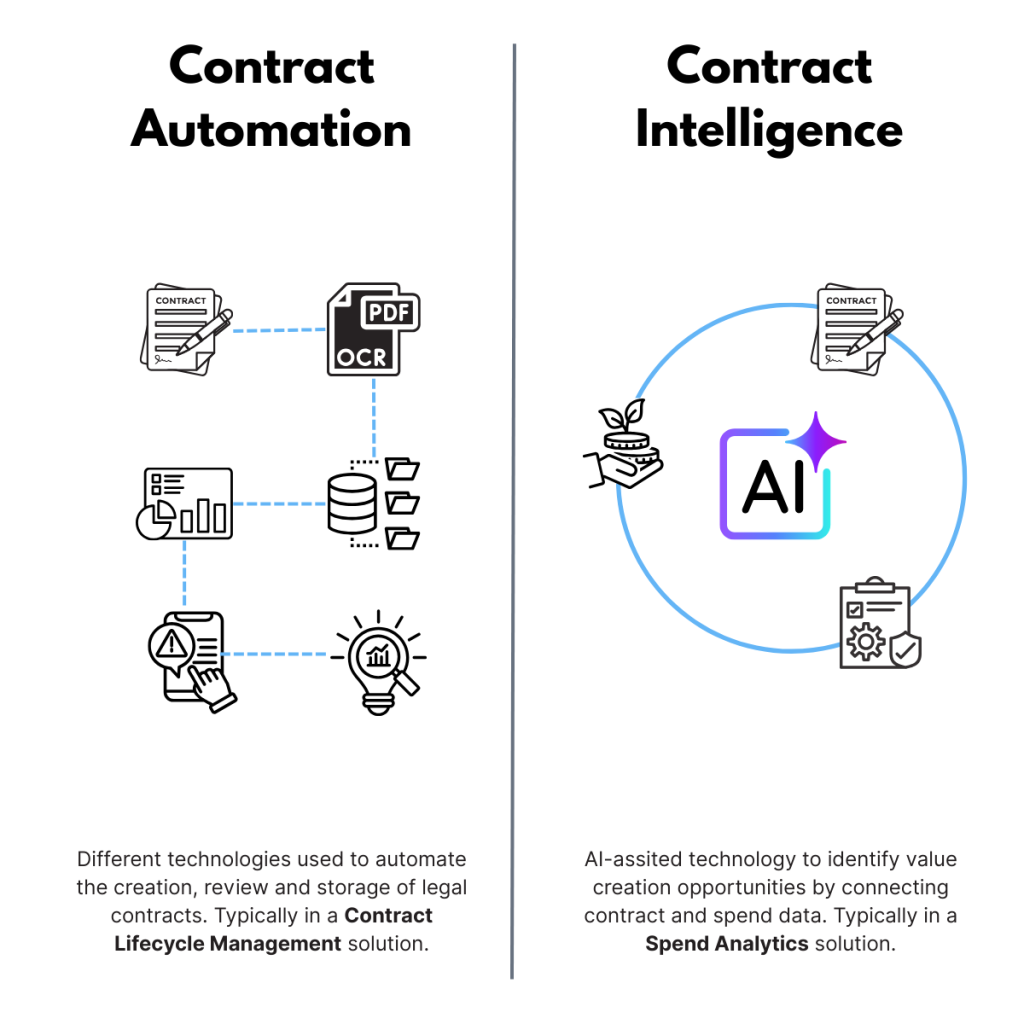
Contract intelligence vs contract automation
Contract intelligence solutions most often get confused with contract automation solutions. This is especially common when many contract lifecycle management (CLM) solutions offer broad sets of functionality in both areas.
The key difference is that contract automation focuses on the management and storage of contracts, while contract intelligence focuses on the actionable insights gained from contract data.
Many contract automation tools focus primarily on document analysis often without connecting to live spend data. This creates a gap between contract insights and procurement execution that limits their strategic value.
Benefits of contract intelligence in procurement
Contract intelligence delivers measurable benefits across your procurement organization:
Efficiency improvements:
- Reduce manual contract review, monitoring and management time,
- Enable stakeholders to focus on strategic negotiations rather than administrative tasks,
- Eliminate human errors in contract interpretation and compliance tracking.
Risk management:
- Identify potential compliance violations before they impact your business,
- Monitor supplier performance against contractual obligations in real-time,
- Receive early warnings about contract expirations, renewal deadlines, and performance penalties.
Cost optimization:
- Identify pricing discrepancies automatically and trigger recovery actions,
- Capture volume discounts and rebates that manual processes often miss,
- Benchmark your terms across suppliers and highlight renegotiation opportunities.
Supplier relationship management:
- Track performance metrics consistently across all agreements,
- Provide objective evidence for supplier discussions and negotiations,
- Identify top-performing suppliers for expanded partnerships and flag underperformers for improvement plans.
Strategic procurement planning:
- Understand spending commitments across categories and time periods,
- Identify consolidation opportunities and optimize supplier portfolios,
- Make informed decisions about contract renewals, extensions, and terminations.
On the whole, contract intelligence forms a crucial part of any procurement team’s contract management initiatives, contributing significantly to procurement performance. According to McKinsey, lack of effective contract management erodes the value of sourcing equal to the value of 9 percent of annual revenues. For Fortune 500 companies, this erosion equals $2.5 trillion in lost value annually.
The critical problems with CLM platforms for contract intelligence
Most procurement teams start their contract intelligence journey with a contract lifecycle management platform. CLM tools consolidate agreements into searchable repositories. They automate basic workflow steps and integrate contract data from your ERP. They provide valuable document management and process standardization.
However, CLM platforms have serious limitations. Data migration can be a hurdle if historic agreements lack structured fields. Automation benefits plateau unless the CLM connects to ERP, sourcing and AP systems where commercial terms actually hit the P&L.
The data isolation problem
Your CLM platform often stores contract terms separately from actual spend patterns, or requires error-prone integrations with your different ERP systems. As a result, you know your negotiated rates but can't see if suppliers bill correctly. You track procurement compliance requirements but miss violations in your payment systems. You monitor renewal dates but lack visibility into actual usage patterns.
This creates a dangerous gap between your contract terms and procurement reality. You negotiate better payment terms but don't capture early payment discounts. You secure volume rebates but can't track qualifying spend. You establish procurement performance metrics but measure them manually.
The execution bottleneck
CLM platforms excel at document management but struggle with execution. You identify contract opportunities but still need human teams to act on them. You spot compliance violations but require manual investigation and response. You see performance issues but can't trigger automatic supplier conversations.
Most contract lifecycle management tools have serious limitations. Automation benefits plateau unless the CLM connects to ERP, sourcing and AP systems where commercial terms actually hit the P&L.
Your procurement team becomes a bottleneck between insights and action. Contract intelligence becomes another reporting tool rather than a value-creation engine.
The strategic limitations
CLM platforms optimize individual contracts but miss portfolio-level opportunities. You negotiate each agreement separately without considering broader category strategy. You track supplier performance separately rather than in competitive context. You manage renewals based on calendar dates instead of market conditions.
This tactical approach limits your strategic impact. You achieve small improvements rather than big change. You react to contract events instead of driving proactive optimization.
Why spend analytics transforms contract intelligence
AI-enabled spend analytics software changes contract intelligence by connecting contract data with actual procurement performance. You see how negotiated terms translate into real business outcomes. You identify gaps between contract promises and supplier delivery. You execute automatic responses to market changes.
Real-time contract performance intelligence
Spend analytics platforms can analyze contract performance continuously, not just during review cycles. You track spend against negotiated rates automatically. You measure supplier delivery against contract commitments in real-time. You identify pricing deviations before they impact your performance.
Market conditions change weekly, supplier risks emerge overnight, tariffs disrupt supply chains and competitive advantages disappear before procurement teams can mobilize traditional analysis-to-action workflows.
An AI-powered contract intelligence system can compare every invoice against contract terms. You catch pricing errors automatically and recover overpayments immediately. You spot volume threshold opportunities and trigger rebate discussions proactively. You monitor payment terms compliance and optimize cash flow continuously.
Automatic execution capabilities
AI-enabled spend analytics moves beyond analysis to autonomous procurement. Your system doesn't just identify contract opportunities—it executes responses within strategic parameters you define. You capture savings automatically while your team focuses on strategic initiatives.
Rather than humans analyzing AI insights and manually executing responses, AI agents can continuously monitor business conditions, identify opportunities, and take immediate action within pre-defined strategic parameters.
Examples of automatic contract actions include renewal optimization based on spend patterns, real-time pricing negotiation triggers, and suggestions for proactive supplier performance reviews. Your system responds to market changes in minutes, not weeks.
Strategic portfolio optimization
Spend analytics provides category-level visibility that many CLM platforms miss. You optimize contract portfolios based on actual spend patterns and market intelligence. You negotiate renewal terms using competitive benchmarking data. You make supplier decisions considering total cost of ownership.
Automated savings opportunity detection worth millions annually becomes possible when contract terms integrate with comprehensive spend analysis.
Your contract strategy aligns with broader procurement objectives. You capture synergies across supplier relationships and categories. You drive transformation rather than just compliance.
The case for purpose-built procurement analytics
Generic contract analysis tools treat all documents equally. Purpose-built procurement analytics software understands the unique requirements of enterprise purchasing. It connects your contrat data and spend data natively to any other internal or external data sources. As a result, you get domain-specific insights that generic tools cannot provide.
Domain expertise built-in
Suplari's AI Procurement Agent understands procurement terminology, processes, and best practices automatically. You don't need to train the system on contract language or supplier relationship dynamics. The platform recognizes industry-specific terms and regulatory requirements without configuration.
Example of AI-enabled procurement analytics: Suplari AI Agent
Purpose-built solutions understand procurement terminology, processes, and best practices. They provide industry-specific insights and benchmarking capabilities.
You get accurate contract analysis from day one. The system identifies savings opportunities that generic tools miss. You benefit from procurement-specific benchmarking and market intelligence.
Enterprise-grade security and governance
Contract data requires special security handling that traditional contract automation solutions cannot provide. Suplari offers audit trails, governance controls, and compliance frameworks designed for procurement environments.
Purpose-built solutions handle sensitive procurement and financial data securely. They provide audit trails and governance controls.
You maintain complete visibility into AI decisions affecting contracts. The system provides documentation for audit requirements and regulatory compliance. You can control access to sensitive contract information with role-based permissions.
Measurable business transformation
Purpose-built procurement AI delivers measurable results that justify investment. You see specific improvements in supplier performance, cost reduction, and risk mitigation. The platform provides clear ROI metrics and business impact measurement.
Which contract intelligence solution do you choose?
The technology exists today to transform contract intelligence from document analysis to automatic execution. The question is whether you'll implement AI-enabled spend analytics or settle for traditional CLM approaches.
Start by assessing your contract intelligence maturity and identifying automation opportunities. Consider how spend analytics integration could amplify your contract optimization results. Evaluate purpose-built procurement AI solutions that deliver measurable business transformation.
Ready to see how AI-enabled spend analytics transforms contract intelligence? Schedule a demonstration to experience automatic contract optimization in action.


