




World-class companies average 97.3 percent of total direct Spend Under Management, with other organizations at 70 percent. That gap represents millions in unrealized savings, unmitigated risk, and lost strategic value.
This guide explains what Spend Under Management means for your procurement organization and how you can close the gap.
This guide is based on a decade of experience supporting enterprise procurement transformation at Suplari.
What is Spend Under Management?
Spend Under Management (SUM) measures the percentage of total organizational spending that procurement actively manages through strategic sourcing, preferred suppliers, and negotiated contracts. It represents the portion of spend where procurement has visibility, control, and influence over purchasing decisions.
It serves as a key performance indicator (KPI) representing the portion of purchases made through approved, strategic channels rather than unmanaged ("maverick") spending, aiding in cost reduction, risk mitigation, and operational efficiency.
In practical terms, SUM captures every dollar that flows through strategic sourcing, preferred suppliers, and negotiated contracts. When procurement "manages" spend, it means the team has visibility into the transaction, control over supplier selection and pricing, and influence over the terms and conditions that govern the relationship.
Suplari tracks SUM as the foundational metric in every client engagement because it determines how much leverage procurement actually has. An organization that only manages 60 percent of addressable spend is leaving 40 percent of its purchasing power on the table, often paying premium prices, accepting unnecessary risk, and missing opportunities for consolidation.
How to calculate Spend Under Management (SUM)
The calculation is straightforward: divide managed spend by total organizational spend, then multiply by 100. If your company spends €100 million annually and procurement manages €70 million through contracts and preferred suppliers, your SUM is 70%.
But the definition goes deeper than numbers. True spend under management means procurement has:
- Strategic oversight over supplier selection and contract terms.
- Price visibility through negotiated rates and volume discounts.
- Compliance control to ensure purchases follow approved processes.
- Risk management through supplier diversification and performance monitoring.
- Data access to track spending patterns and identify opportunities.
Companies with high SUM percentages typically see 10-15% better pricing than those relying on ad-hoc purchasing. The difference stems from consolidated volumes, strategic supplier relationships, and systematic contract management.
How do you measure Spend Under Management
Measuring SUM requires clean data and clear definitions. Most organizations struggle because spending data sits scattered across multiple systems—ERPs, credit card platforms, petty cash, and department-specific tools.
The basic SUM calculation
Start with total organizational spend from your financial systems. Include everything: payroll, facilities, IT, marketing, professional services, raw materials, and indirect purchases. This becomes your denominator.
Next, identify managed spend. This includes:
Purchases through negotiated contracts with preferred suppliers. Spending via procurement-controlled catalogs and systems. Orders processed through official purchase order workflows. Transactions with pre-approved vendors at negotiated rates.
Exclude employee reimbursements, one-time legal settlements, and other non-manageable expenses from both sides of the equation.
Key components and levels of Spend Under Management
Not all spend is managed equally. Understanding the spectrum from fully managed to completely unmanaged helps procurement teams prioritize where to focus their efforts. Suplari categorizes organizational spend into four distinct levels:
Fully Managed
Fully managed spend passes through the complete procurement process for both direct and indirect categories. This includes competitive sourcing events, negotiated contracts, purchase orders, and three-way matching. The procurement team has end-to-end visibility and control, from requisition through payment. Fully managed spend delivers the greatest cost savings, compliance assurance, and supplier performance management benefits.
Partially Managed
Partially managed spend adheres to some, but not all, official procurement processes. For example, a department might use a preferred supplier from the approved list but bypass the formal purchase order process, or a buyer might negotiate terms without conducting a competitive sourcing event. Partially managed spend represents an opportunity: the relationship with procurement already exists, and closing the remaining process gaps is typically straightforward.
Influenced
Influenced spend occurs when procurement provides guidance, such as preferred supplier lists, market intelligence, or recommended contract terms, but does not control the final transaction. Business units retain purchasing authority and may or may not follow procurement's recommendations. Suplari's spend analytics platform helps teams identify influenced spend that could be moved into the fully managed category with the right policies and stakeholder engagement.
Unmanaged (Maverick)
Unmanaged or maverick spending happens entirely outside official procurement processes. Employees purchase directly from non-approved suppliers, often at list prices, without contracts, and without procurement's knowledge. Maverick spend is the most expensive and highest-risk category. It creates compliance exposure, eliminates volume leverage, and makes it impossible to maintain accurate spend classification.
Moving spend from unmanaged to managed is the single highest-value activity in procurement optimization. Suplari's AI-powered platform identifies maverick spend patterns automatically, flagging transactions that fall outside established procurement channels and recommending corrective actions.
Advanced SUM metrics
Leading organizations track SUM by category to spot specific improvement areas:
- Category-level SUM reveals which spend areas need attention. Software might hit 90% while office supplies sit at 30%.
- Supplier-level SUM shows concentration risk. If your top 10 suppliers represent 80% of managed spend, you might have over-dependence issues.
- Department-level SUM identifies business units that bypass procurement processes. Marketing and IT often show lower SUM percentages due to urgent, specialized purchases.
- Time-based SUM trends track progress over quarters and years. Successful procurement teams typically improve SUM by 5-10 percentage points annually.
Data challenges and solutions
Most SUM measurement fails due to data quality issues. Supplier names appear inconsistently across systems. Invoice descriptions lack category codes. Purchase card transactions miss supplier details.
AI-powered spend analytics platforms like Suplari solve these problems by automatically cleaning and categorizing spending data. They normalize supplier names, classify purchases by category, and identify relationships between parent companies and subsidiaries.
Why is Spend Under Management important
SUM directly impacts procurement's ability to deliver value. Low SUM means fragmented buying power, missed savings opportunities, and limited strategic influence. High SUM creates leverage for better negotiations, risk control, and innovation partnerships.
Cost impact and savings potential
Organizations with SUM below 50% typically pay 15-25% more than necessary for goods and services. Fragmented purchasing prevents volume discounts, standard terms, and strategic pricing agreements.
Risk mitigation benefits
Unmanaged spend creates hidden risks. Departments might select suppliers without financial health checks, security assessments, or compliance reviews. This leads to supply disruptions, data breaches, and regulatory violations.
Strategic supplier relationships
Managed spend enables long-term supplier partnerships. When procurement controls significant volumes, suppliers invest more in innovation, dedicated support, and competitive pricing. These relationships become strategic assets during market disruptions or capacity constraints.
Compliance and governance
Regulatory requirements increasingly demand spending transparency. SOX compliance, ESG reporting, and supply chain due diligence all require detailed supplier and spending data. High SUM provides the visibility necessary for accurate reporting and audit trails.
What does a high SUM actually mean?
According to research by the Hackett Group, world-class companies average 97.3 percent of total direct spend under management, with other organizations at 70 percent. For indirect spend, the figures are 95 percent and 66.5 percent, respectively.
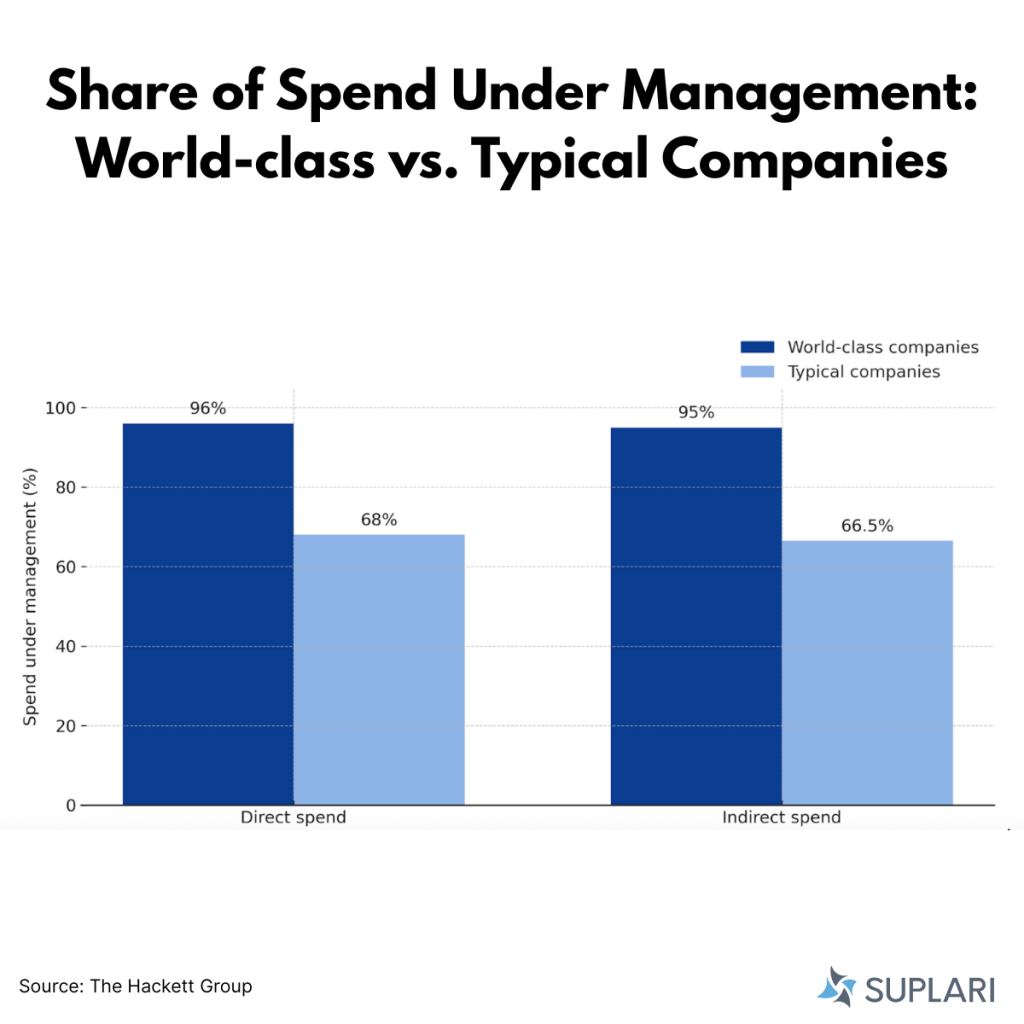
High Spend Under Management—typically 80% or above—indicates mature procurement operations with strong organizational alignment. But the number alone doesn't tell the complete story. Context matters significantly.
Industry and organizational factors
Manufacturing companies often achieve higher SUM percentages than service organizations. Direct materials procurement naturally falls under procurement control, while service companies deal with more discretionary, department-specific spending.
Company size affects SUM potential. Large enterprises have dedicated procurement teams and sophisticated systems that support higher SUM percentages. Smaller organizations might plateau at 60-65% due to resource constraints.
Organizational culture plays a crucial role. Companies with strong procurement mandates and executive support achieve higher SUM. Organizations where departments operate independently often struggle to consolidate spending control.
Quality over quantity considerations
A 90% SUM built on forced compliance might deliver less value than 70% SUM achieved through strategic partnerships. The best outcomes come from balancing control with business unit flexibility.
Smart procurement teams focus on high-impact categories first. Controlling 80% of your organization's software spending creates more value than managing 100% of office supplies. Strategic prioritization beats blind coverage.
Some spending categories resist management by design. Emergency repairs, specialized consulting, and unique R&D materials often require department-level decision-making. Forcing these into standard procurement processes can slow business operations without adding value.
Ways to increase Spend Under Management
Improving SUM requires systematic effort across people, processes, and technology. The most successful approaches combine quick wins with long-term capability building.
Increasing Spend Under Management is not a one-and-done initiative. Monitor SUM trends monthly and adjust strategies based on results. What works for one category might not suit another. Flexible, data-driven approaches deliver better long-term outcomes than rigid policy enforcement.
Transform spend visibility with Agentic AI
AI agents in procurement eliminate the traditional barriers to SUM improvement. Instead of months spent analyzing spending data, procurement teams can instantly identify opportunities, track progress, and optimize strategies. The technology transforms spend management from a reactive compliance exercise into proactive value creation.
Suplari's AI Agent accelerates SUM improvement through:
- Autonomous spend discovery - Continuously monitor all organizational spending in real-time, automatically identifying unmanaged purchases and quantifying financial impact across departments and categories.
- Real-time optimization - Evaluate spending patterns as they happen, redirecting purchases to preferred suppliers and existing contracts while flagging opportunities for future sourcing initiatives.
- Proactive stakeholder engagement - Identify when departments would benefit from procurement involvement and offers better alternatives that make compliance the easier choice rather than bureaucratic friction.
- Intelligent prioritization - Automatically rank SUM improvement opportunities by potential savings impact and implementation complexity, ensuring teams focus on the highest-value initiatives first.
- Continuous performance monitoring - Provide real-time SUM executive summaries with key next steps, enabling immediate course corrections rather than waiting for quarterly review cycles.
Bottom line on Spend Under Management
Suplari's AI Procurement Agent provides instant spend visibility and actionable recommendations for increasing managed spending across your organization.
Book a demo to discover how much value is hiding in your unmanaged spend faster using AI agents.
About Suplari
Suplari is a procurement intelligence solution that helps businesses modernize procurement operations using AI. Suplari provides actionable intelligence to manage suppliers, deliver savings and manage compliance beyond the limits of traditional spend analytics. Suplari’s unique AI data management foundation empowers enterprise businesses to transform procurement operating models with reliable, AI-ready data.

