




Suplari Data Assistant is an AI agent that handles procurement data ingestion and transformation from end to end. It reads incoming files in whatever form a source system produces them, loads them into a customer's Suplari environment, resolves common data faults without escalating to a person, and repairs connectors when upstream systems change. It is available now to all Suplari customers.
The launch targets the step where most procurement AI programs stall. Getting data into a usable state is invisible work, and it is where the time goes.
How the Suplari Data Assistant solves procurement data management
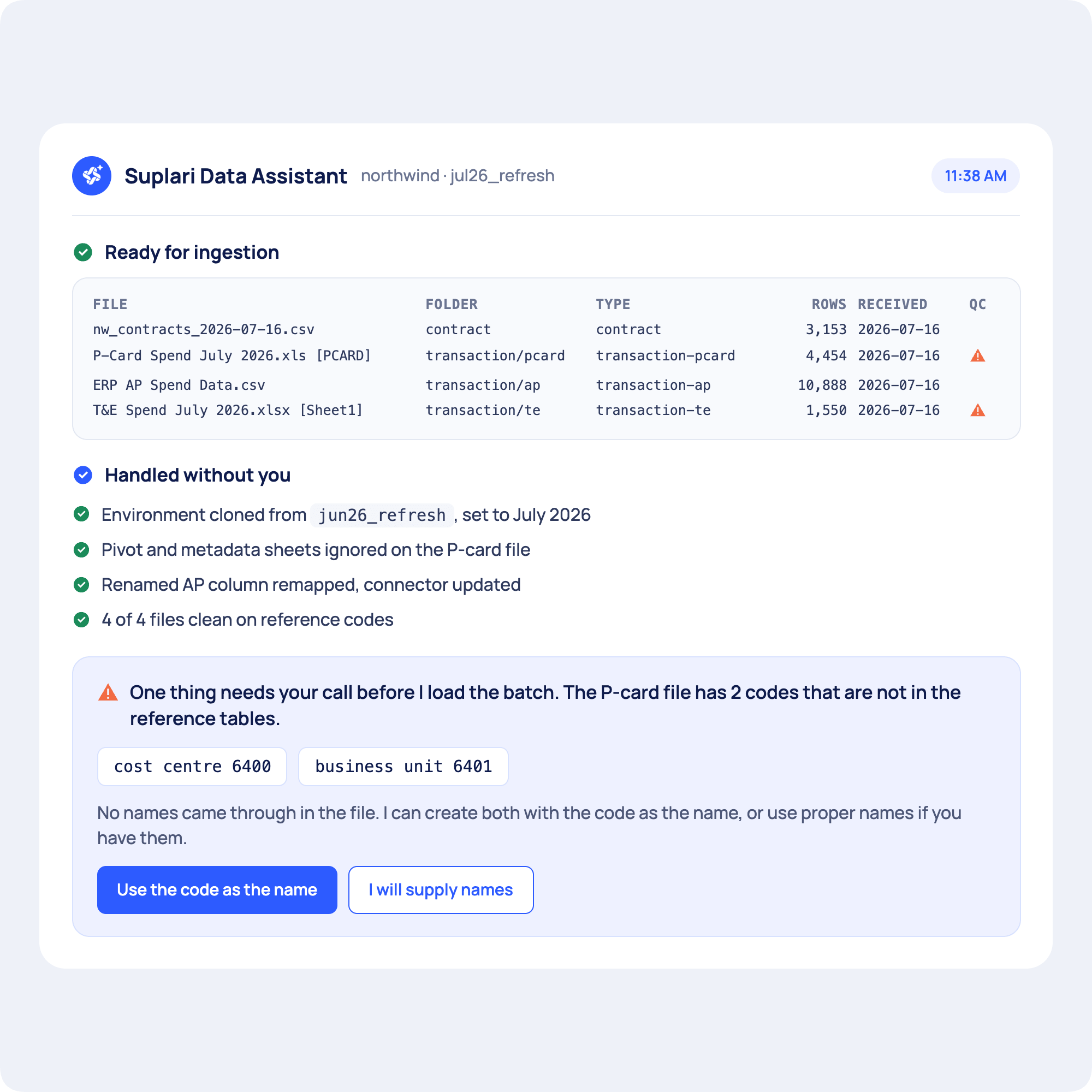
The agent covers six areas of the data lifecycle. Each one removes work that somebody on the procurement, data or engineering team used to do by hand.
The hard part is not the first load, it is every load after that
Procurement data rarely arrives twice in the same shape. A source system gets upgraded and a new column appears. A business unit goes missing. An account code changes. The identifier that links an invoice to its purchase order is absent.
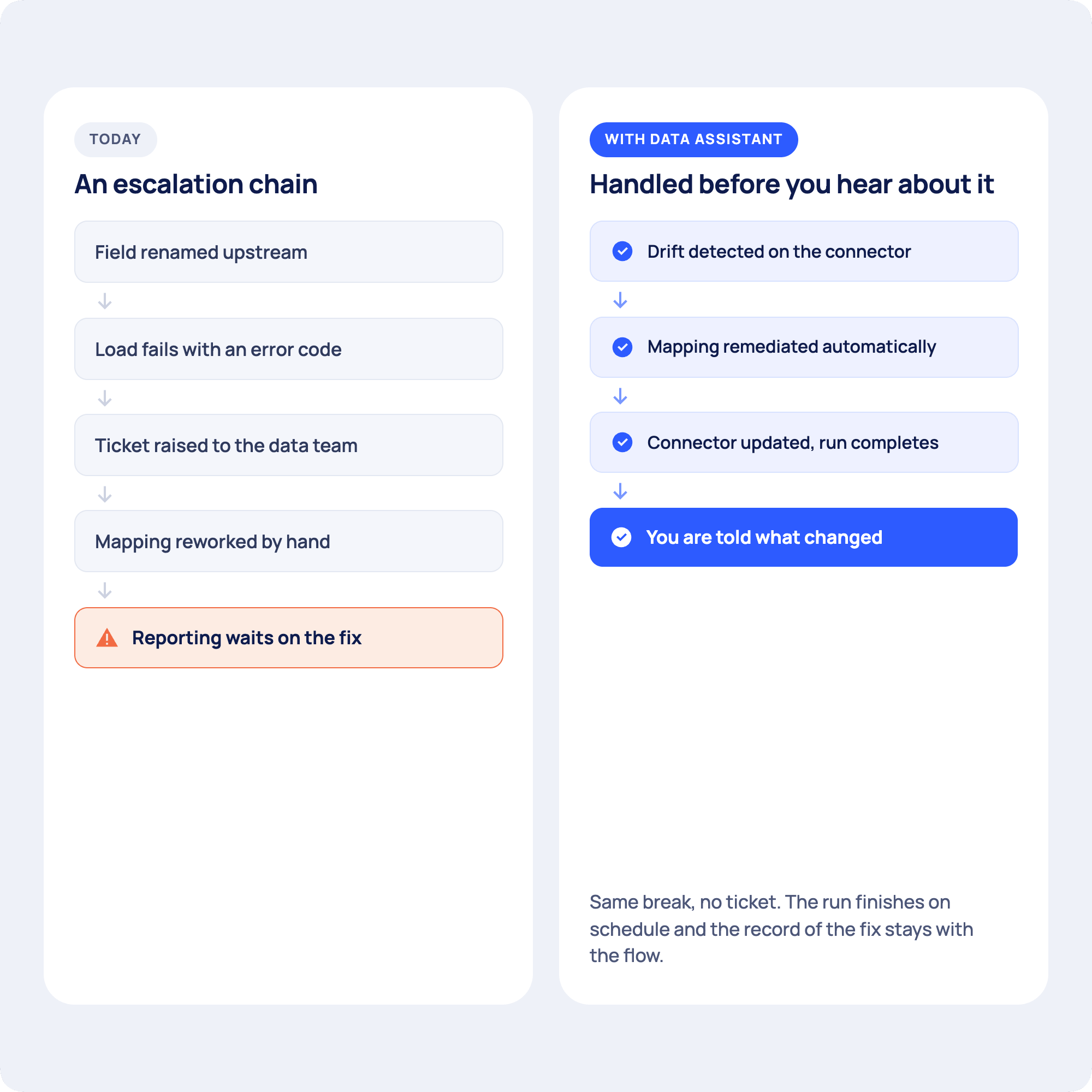
Each of those is a small break, and each one used to produce the same sequence: an error code, an escalation, and a person somewhere fixing it by hand before anyone could run a report.
The same fragility applies to connectors. A pipeline that has run cleanly for eleven months stops working in the twelfth because a field was renamed upstream. Nobody notices until the numbers look stale. Diagnosing and repairing that break is routine work. It recurs across every system a procurement team touches, and it is expensive precisely because it is routine.
HFS Research (2025) found that 65% of procurement leaders cite poor data quality as their biggest barrier to scaling AI. That number usually gets read as a data quality problem. In the environments we work in it behaves more like a data logistics problem, because most of the quality issues that block AI are generated by the pipeline itself, every time it runs.
What separates this from a legacy procurement data connector
Enterprise data connectors are configured once, by hand, against the shape a source system happens to have on the day of implementation. They carry no view of what the data means and no ability to respond when it changes. When a field is renamed or an export format shifts, the connector either fails or keeps running against data it no longer understands. The second outcome costs more, because nobody notices until a report looks wrong.
Data Assistant treats the connection as something to be maintained. It watches the connectors it owns for data drift and structural change. When something moves, it remediates what it can and updates the connection itself. The difference shows up on the day a source system changes, which is the day a hand-configured connector needs an engineer.
"Connectors always break. That is the unglamorous reality of enterprise data, and it is exactly the work this agent is best at," said Jeff Gerber, CEO and Co-founder of Suplari. "We have automated data ingestion for years. What is different now is that the agent can own the whole lifecycle. It detects issues, it remediates them, and it understands when data drifts or a connector needs updating."
What separates this from general-purpose AI for procurement data management
A general-purpose model can read a spreadsheet and answer a question about it. What it cannot do is produce data that persists inside a system where enrichment, classification, analytics and filtering are already built. The output is a one-off, either a static answer or a session that has to be rebuilt from scratch the next time you need it, usually with engineering help.
Data Assistant delivers data into a platform where all of that capability is reusable, governed and traceable from the moment the data lands.
Where it fits in the Suplari procurement intelligence platform
Data Assistant joins Suplari's platform capabilities alongside the AI Data Platform, the AI Operating System, and AI Agents.
The division of labor is straightforward. The AI Data Platform is the unified, supplier-centric foundation that procurement data lives in. Data Assistant is the agent that puts data there and keeps it correct. Everything downstream, from spend analytics to savings tracking to contract intelligence, depends on that foundation staying accurate as source systems change.
Why we are shipping this now
Many procurement teams are in the middle of a procurement orchestration program or a P2P replacement, and are holding other work until those land. In the deals we see, those programs run six to nine months before they show measurable savings, which puts the current fiscal year out of reach for anything that depends on them.
Data foundation work behaves differently. It is a prerequisite for each of those programs, and it can start returning value while they are still in flight. A team that fixes its data logistics this quarter gets a cleaner orchestration rollout next year and a savings number this year.
Availability
Suplari Data Assistant is available now to all Suplari customers. The full capability breakdown lives on the Suplari Data Assistant product page.
Frequently asked questions
What is automated procurement data management?
It is the ingestion, transformation, validation and correction of procurement data without manual intervention. An AI agent recognizes incoming data, applies your processing rules, and resolves common faults on its own, so nobody prepares each file or fixes each error. It also maintains the connections to your source systems as those systems change.
What file formats and data sources does Suplari Data Assistant support?
Excel, CSV, Word, PDF and zip archives, including bulk sets of PDFs. Your data can arrive three ways. Send it directly to Suplari, push it through an API integration, or let a Suplari connector pull it from a source system such as an ERP or P2P platform. The Data Assistant identifies what each file contains and works out where the data belongs.
What happens when a connector breaks?
Connectors break when source systems change. A field gets renamed, a new column appears, or an export format shifts. The Data Assistant monitors for that drift, remediates what it can, and updates the connector. Under the older model this produced an error, an escalation and a delay before anyone could report on the data.
Does a person ever need to get involved?
Only for genuine ambiguity. The Data Assistant resolves what it can, including missing business units, absent account codes, and PO identifiers that fail to link an invoice to its purchase order. When it cannot determine something, it asks a specific question through the product, email, Slack or Teams, then applies your answer to future cycles. Your involvement decreases over time.
How is this different from using ChatGPT on our spend data?
A general-purpose model gives you a one-off. It reads a file and answers a question, and the following time you need it, the session gets rebuilt from scratch, usually with engineering help. Suplari Data Assistant delivers your data into a platform where enrichment, classification, analytics and filtering are already built, and where every run is governed and traceable.
How does this relate to the Suplari AI Data Platform?
The AI Data Platform is where your procurement data lives, as a unified, supplier-centric foundation that is cleansed, enriched and traceable. The Data Assistant is what puts your data there and keeps it correct as your source systems change.

