




Agentic AI is the most significant shift in procurement technology since the move to cloud-based platforms. But what does "agentic" actually mean — and how does it differ from the AI features most procurement tools already claim to have?
How does agentic AI work in procurement?
Agentic AI in procurement refers to AI systems that pursue goals autonomously — breaking a complex objective into steps, executing them, and adapting based on results — rather than just recommending actions or drafting content. In practice, an agent can classify spend, check contract compliance, assess supplier risk, and prepare a sourcing event without a human pushing each step.
It works through a perceive → reason → act loop:
- Perceive — the agent continuously monitors spend, contract, and supplier data.
- Reason — it interprets context, weighs tradeoffs, and documents an explainable logic path.
- Act — it executes or recommends a specific action based on configured triggers and guardrails.
How it differs from other AI:
- Predictive AI forecasts outcomes from data.
- Generative AI / copilots produce content when prompted.
- Agentic AI acts autonomously — identifying goals, breaking them into tasks, and completing multi-step workflows with human oversight on strategic decisions.
Suplari has enhanced its AI-native procurement intelligence platform with autonomous, LLM-powered AI agents that plan, analyze, and execute procurement tasks — making it the most advanced agentic AI solution purpose-built for procurement. This article explains what agentic AI is, how it works in procurement, and how Suplari's approach compares to competitors.
The Current Enterprise Software Landscape
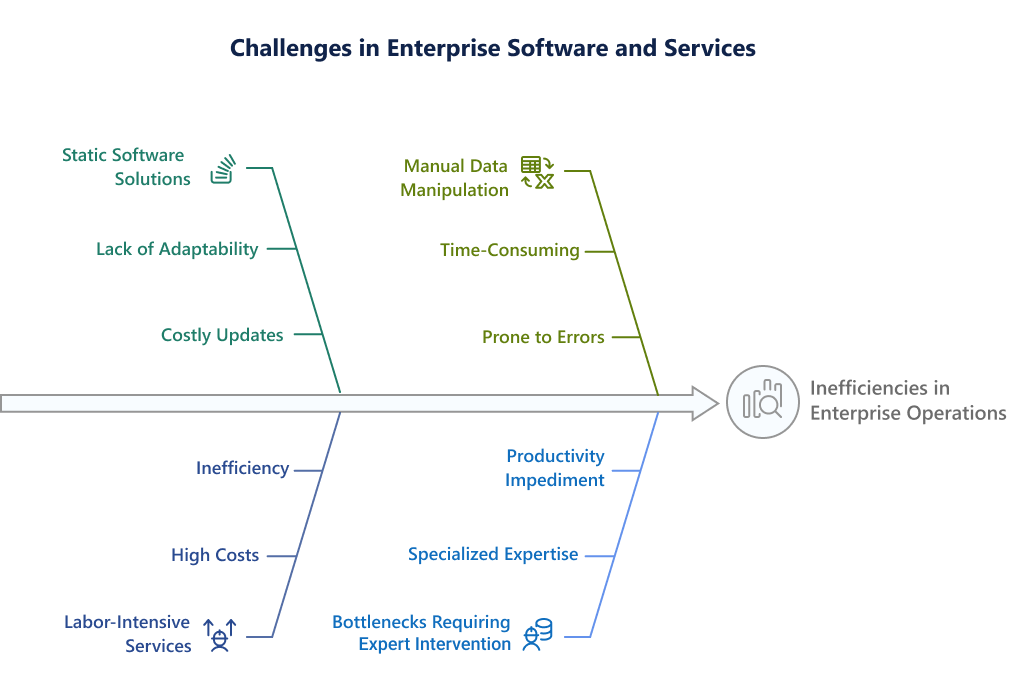
Static Software Solutions
Traditional enterprise SaaS implementations are designed for specific use cases but struggle to adapt to evolving requirements. These systems do not automatically learn or evolve after deployment, often facing integration challenges with existing systems. They require lengthy development cycles for new features and demand significant time and resources for upgrades and maintenance. As software portfolios grow, compatibility issues and lack of integrations between products create additional complexity that further slows business operations.
Labor-Intensive Services
Many enterprises rely heavily on consulting firms like KPMG, McKinsey, and Accenture, which deliver costly, one-off implementations that aren't easily replicated without additional investment. These firms often focus on billable hours rather than efficiency, maintaining complexity to justify their
services. This approach creates dependency relationships that hinder innovation while failing to build sustainable, scalable solutions that grow with the business. The traditional services model fundamentally conflicts with the goal of true digital transformation.
Manual Data Manipulation and Analysis
Businesses continue to struggle with manual data manipulation and spend analysis prone to human error. Teams spend countless hours on time-consuming report creation and alignment processes, often repeating similar work across departments. Workflow bottlenecks requiring scarce expert intervention create delays in critical processes. Each team must validate their own datasets and constantly explain and align with other groups to maintain consistency, resulting in duplicated efforts and inconsistent outcomes. These inefficiencies drain resources that could otherwise be directed toward strategic initiatives.
Bottlenecks Requiring Expert Intervention
Certain tasks within enterprise workflows require specialized expertise that only a few individuals possess. These bottlenecks can significantly slow down processes and impede overall productivity.
The Transformative Potential of AI Agents
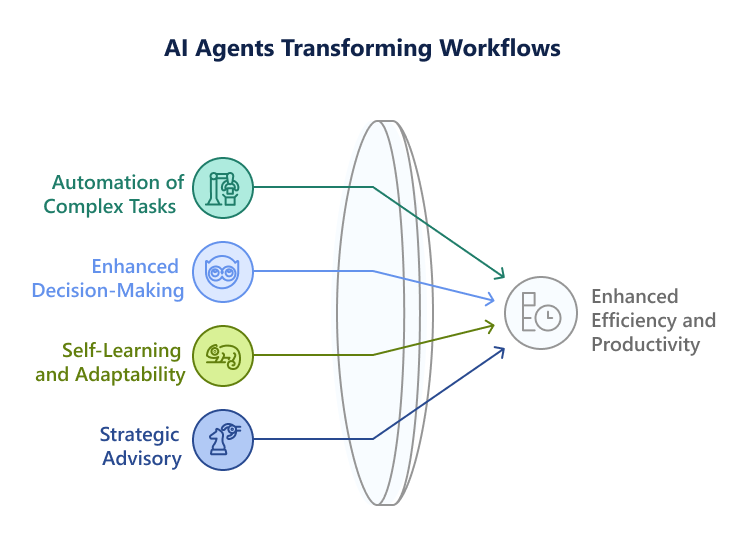
Automation of Complex Tasks
AI agents represent a paradigm shift in enterprise software by offering capabilities that go far beyond traditional automation. Unlike traditional automation tools, AI agents can handle multistage tasks requiring judgment and decision-making. They integrate with diverse source systems to access comprehensive data, creating a holistic view that enables more intelligent processing. These agents learn continuously from new data and execution history, becoming more effective over time. Their ability to adapt workflows in real-time based on changing conditions makes them particularly valuable in dynamic business environments where static solutions quickly become obsolete.
Enhanced Decision-Making and Productivity
AI agents elevate enterprise productivity by planning and executing complete workflows from a single prompt. They collaborate seamlessly with other agents and human team members, creating a hybrid workforce that leverages the strengths of both machine and human intelligence. These agents validate outputs against quality benchmarks and operate across multiple tools and systems simultaneously, eliminating the need for manual handoffs
between different platforms. This end-to-end capability dramatically reduces cycle times for complex business processes.
Self-Learning and Adaptability
AI agents are designed to continuously learn and improve their outputs over time. They can leverage best practices from a corpus of subject matter documents and execution history to perform like experts in their area of application. They can rapidly adapt to new data and changing business
needs, making them highly effective in dynamic environments.
Strategic Advisory and Task Management
Beyond basic automation, advanced AI agents can serve as strategic advisors to business teams. They generate comprehensive plans based on data analysis from multiple sources, identifying opportunities that might be missed by human analysts constrained by time or specialized knowledge. These agents can assign and monitor tasks across departments, ensuring proper execution and follow-through. By maintaining focus on business objectives throughout the process, they help ensure that tactical execution remains aligned with strategic goals.
Why AI Agents Matter Now?
The timing for AI agent adoption is critical. Generative AI has matured beyond supervised assistants to autonomous agents capable of more complex reasoning and execution. According to recent research by Deloitte, 74% of companies plan to deploy agentic AI within two years, up from 23% using it moderately today. Agentic AI is expected to have the highest impact in customer support, supply chain management, R&D, knowledge management, and cybersecurity. 85% of companies expect to customize agents to fit their unique business needs.
Competitive pressures are forcing companies to seek deeper automation solutions that address both efficiency and effectiveness. Additionally, the technology infrastructure required to support AI agents has reached maturity, making
implementation more feasible than ever before.
Real-World Applications in Procurement
Spend Category Strategy Development
AI agents can transform category management by collecting and analyzing all category-related data from P2P and ERP systems. They incorporate supplier intelligence and market trends, creating a comprehensive view that would take procurement teams weeks to assemble manually. These agents identify optimization opportunities based on spending patterns across the organization, detecting anomalies and potential consolidation opportunities. They can then generate comprehensive category strategies with actionable recommendations that procurement teams can implement
immediately, dramatically reducing the time from analysis to action.
Contract Performance Optimization
AI agents drive contract value by analyzing payment terms, dates, and supplier performance metrics in context. They identify early renewal opportunities and favorable renegotiation terms by comparing current contracts against market benchmarks. These agents create supplier-specific action plans to improve terms based on leverage points identified through comprehensive analysis. They can then assign targeted tasks to appropriate team members or other agents, ensuring that opportunities for value capture don't fall through the cracks. This proactive approach transforms contract management
from a reactive, compliance-focused function to a strategic value driver.
What Makes AI "Agentic"?
The word "agent" in AI means a system that can take independent action toward a goal. Agentic AI doesn't just respond to prompts — it reasons about what needs to be done, plans a sequence of steps, executes those steps using available tools and data, and evaluates whether the outcome meets the goal.
In procurement, the difference looks like this:
Traditional AI: You ask "What did we spend on IT consulting last quarter?" and get a number.
Agentic AI: The system notices IT consulting spend increased 18% without a corresponding contract change, investigates whether the increase is driven by rate changes or volume, compares pricing against market benchmarks, identifies three suppliers charging above contracted rates, and drafts a savings recovery plan — all before you asked.
The key capabilities that make AI agentic are planning (breaking complex goals into steps), tool use (querying databases, running calculations, pulling external data), memory (maintaining context across multi-step analyses), and self-evaluation (checking whether results make sense before surfacing them).
Suplari's Agentic AI Architecture
Suplari's AI procurement agents are built on an architecture designed specifically for procurement intelligence workflows. Here's how each component works:
What makes this architecture genuinely agentic is that these components work together. The Insight Generator identifies an opportunity. A Worker agent monitors whether it's been acted on. The Assistant lets a procurement leader dig deeper. And AI Studio allows the team to codify the response into a repeatable process.
How Suplari's Agents Compare to Competitors
Several procurement platforms now claim "AI agent" capabilities. But the depth and approach vary significantly:
Suplari vs. Zycus Merlin AI. Zycus added its Merlin cognitive engine to an existing source-to-pay suite. Merlin handles document analysis and spend classification well, but it operates as a feature within Zycus — not as an autonomous agent layer. Suplari's agents are the platform's core architecture, not a bolt-on.
Suplari vs. Jaggaer JAI. Jaggaer's agentic AI (JAI) focuses on procurement workflow automation — routing approvals, managing intake, automating compliance checks. It's strong on process automation but lighter on the analytics and intelligence side. Suplari's agents focus on intelligence — understanding spend, surfacing insights, and driving strategic decisions.
Suplari vs. GEP SMART AI. GEP's AI capabilities span their S2P suite with predictive analytics and NLP. Like Zycus, GEP's AI enhances existing workflows rather than operating autonomously. Suplari's analytics-first approach means deeper insight generation and faster time-to-value for teams that need intelligence, not just automation.
The key distinction: Most competitors add AI to workflows. Suplari builds workflows around AI. The AI data platform that powers Suplari's agents normalizes and enriches procurement data automatically, which means agents start delivering insights within 90 days — without the data cleansing and taxonomy projects that delay competitors.
Transformative Impact of AI Agents
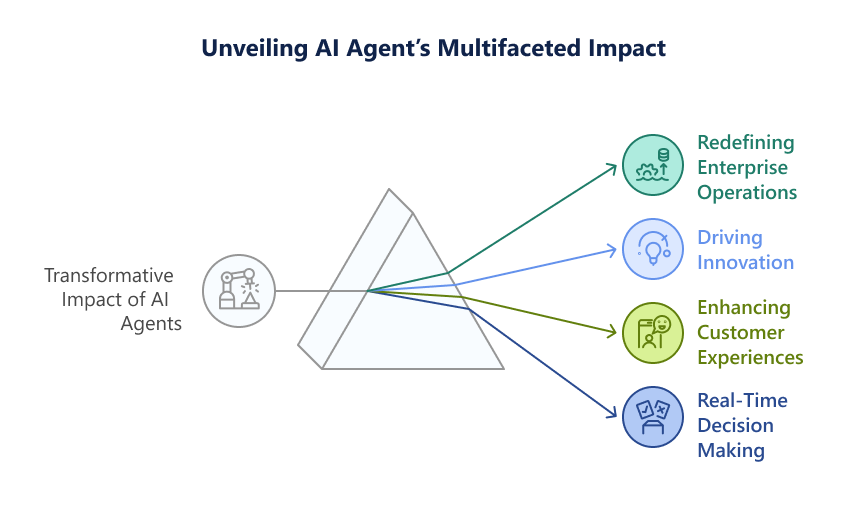
Redefining Enterprise Operations
AI agents elevate enterprise operations by automating complex tasks previously considered impossible to automate. They reduce operational costs by converting high-cost services to software implementations that can be deployed repeatedly at minimal incremental cost. Organizations experience increased execution speed for critical business processes, allowing them to respond more quickly to market changes and opportunities. Perhaps most significantly, AI agents enable the scaling of specialized expertise across the organization, democratizing access to capabilities previously limited
to a small number of experts.
Driving Innovation
By handling routine tasks, AI agents enable reallocation of human talent to higher-value strategic initiatives. Teams find themselves with expanded scope of what they can accomplish, as AI agents take on the time-consuming background work that previously limited capacity. This reallocation of human resources allows faster exploration of new business opportunities and greater competitive responsiveness in rapidly changing markets. When freed from mundane tasks, human workers naturally gravitate toward innovation, creating a powerful synergy between human creativity and AI
efficiency.
Enhancing Customer & Supplier Experiences
AI agents improve customer interactions through personalized service based on comprehensive data analysis that considers the full context of the customer relationship. They enable rapid resolution of complex inquiries by accessing information across systems instantaneously. Organizations achieve consistent quality across all touchpoints through standardized processes enhanced by AI judgment. Perhaps most valuably, these agents enable proactive identification of customer needs, allowing businesses to address issues before they become problems and identify opportunities to strengthen
relationships.
Real-Time Decision Making
AI agents can process vast amounts of data in real time, enabling them to make informed decisions quickly. This capability is particularly valuable in dynamic environments where timely decisions are critical, such as financial trading or emergency response.
Implications for Procurement Organizations
A financial services firm implemented AI agents to monitor market trends and execute trades. The AI agents analyzed real-time data, identified profitable trading opportunities, and executed trades autonomously. This implementation resulted in a 20% increase in trading profits and reduced the need for human traders.
Essential Components of an AI Agent Platform
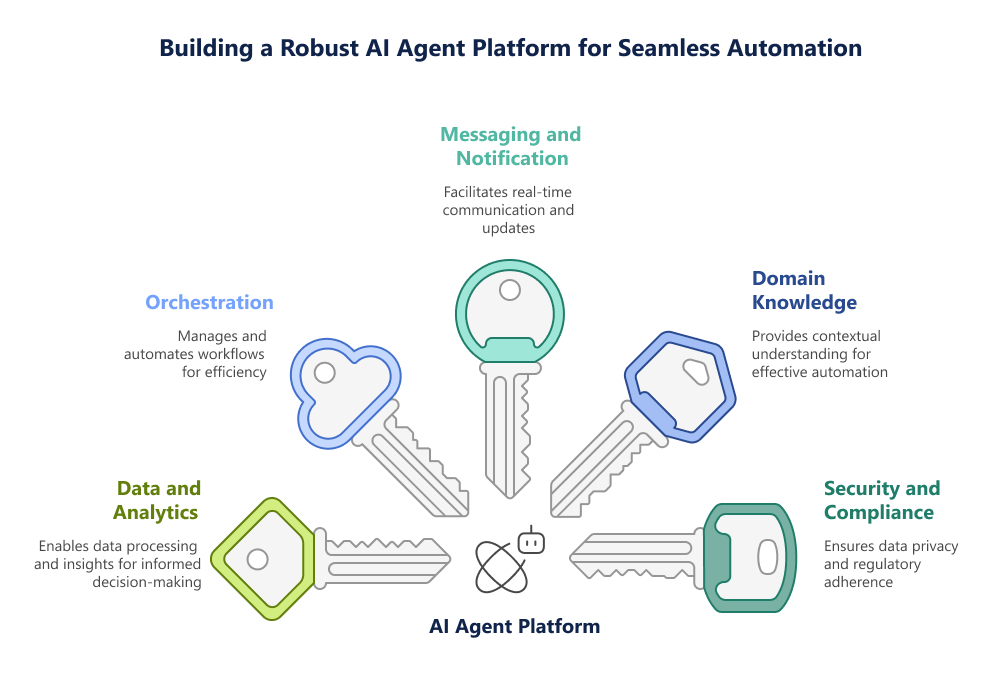
Data and Analytics
A robust AI agent platform requires advanced data ingestion capabilities for diverse sources ranging from structured database information to unstructured documents and communications. The platform must provide sophisticated data cleansing, normalization, and harmonization processes to create a consistent foundation for analysis. Connecting internal data to external intelligence about suppliers, categories and world events is also essential to deliver a 360 view of the business. Real-time spend analytics capabilities enable timely decision-making in dynamic business environments. Underlying all of this
are machine learning algorithms for pattern identification and prediction that continuously improve as they process more data.
Orchestration
Effective agent coordination depends on seamless management of complex workflows across systems. The platform must ensure proper sequencing of tasks with dependency handling to prevent bottlenecks and errors. Coordination between AI agents, human users, and software systems requires sophisticated communication protocols and handoff mechanisms. Adaptable workflow design that responds to changing conditions is essential for maintaining effectiveness as business requirements evolve. The orchestration layer is what transforms individual AI capabilities into cohesive business
processes.
Messaging and Notification
Communication infrastructure must include real-time messaging between agents, users, and systems to ensure all participants have current information. Event-based notification logic triggered by specific conditions ensures that critical situations receive immediate attention. Alert systems for critical information delivery must be designed to provide the right information to the right people at the right time. Feedback mechanisms for continuous improvement allow the system to learn from both successes and failures, creating a continuously improving ecosystem.
Domain Knowledge
For quality outcomes, agents need a deep understanding of the specific business domain they operate within. Access to documented best practices and successful execution examples provides models for emulation and benchmarking. Industry-specific knowledge bases inform decisions with relevant context and constraints. Continuous learning from execution history allows agents to improve their performance over time, adapting to the specific needs and patterns of the organization they serve. This domain expertise transforms generic AI capabilities into business-specific solutions.
Enterprise-Grade Requirements
Additional essential components include robust security and compliance controls that protect sensitive information and maintain regulatory compliance. The platform must offer scalability to accommodate growing enterprise needs without performance degradation. Intuitive user interfaces for monitoring and guidance allow business users to understand and direct agent activities. Comprehensive integration capabilities with existing systems ensure that agents can operate within the current technology ecosystem. Continuous learning mechanisms enable perpetual improvement, ensuring the system becomes more valuable over time.
The Data Foundation Problem
Here's a reality most AI procurement vendors don't discuss openly: agentic AI requires clean, connected data to function well. If your spend data isn't classified, your contracts aren't digitized, and your supplier records are fragmented across systems, no AI agent — no matter how sophisticated — will deliver useful results.
This is where Suplari's approach is fundamentally different. Suplari's AI data platform doesn't assume clean data. It ingests raw data from ERPs, AP systems, contract repositories, and supplier databases, then uses AI to normalize, classify, and connect it. Spend classification happens automatically. Procurement data integration happens without manual mapping.
This means Suplari's agents start working with your real data immediately — they don't need a 6-month data preparation project before they can deliver value.
Suplari's Insight Generator runs 175+ prebuilt algorithms to surface savings and risks the moment data is connected. Other platforms require you to define what you're looking for. Suplari's agents find what you didn't know to ask about.
Unique Advantage of Procurement AI Agents
Suplari's AI Procurement Agents leverage the enterprise-grade Suplari platform and services that customers have been enjoying since 2017. Supari’s robust data layer and analytics services as well as messaging and alerting capability will empower AI agents to interact and orchestrate a diverse set of source systems to collect, analyze, report and take action. The system is enriched by a wealth of encoded procurement knowledge and best practices accumulated over years of working with leading organizations. Each agent is informed by a corpus of successful project executions from Suplari
Connect, providing models for emulation. AI has been a focus from the beginning and the expertise developed over the journey will allow the Suplari product teams to build a world class AI Agent framework. Most importantly, the entire platform is designed with deep understanding of procurement workflows and challenges, ensuring that automation addresses real needs rather than theoretical use cases.
Bottom line on AI procurement agents
The future of enterprise software lies in AI agents that can transform how businesses operate by automating complex processes while providing strategic insights. By addressing the limitations of traditional SaaS and services, AI agents like those being developed by Suplari promise unprecedented efficiency and innovation in business operations.
As we move toward this AI-driven future, organizations that embrace these technologies early will gain significant competitive advantages through enhanced productivity, reduced costs, and more strategic allocation of human resources. Suplari is positioned at the forefront of this revolution, ready to partner with forward-thinking enterprises to realize the full potential of AI agents in procurement and beyond. The transformation won't happen overnight, but the journey has begun, and the destination promises a fundamentally more effective approach to enterprise operations.


