



Most procurement benchmarks tell you what to measure. Very few tell you where you actually stand against the rest of the industry — especially as AI rewrites what "good" looks like.
This page is built on something different: original survey data from 121 procurement professionals across 6 continents, 30+ industries, and organizations ranging from under 500 to 50,000+ employees. It comes from the AI Readiness in Procurement 2026 report, a joint study by Procurement Tactics and Suplari published in May 2026.
Use the benchmarks below to see where your organization sits, where the industry is heading, and which gaps to close first.
The headline number: 2.1 out of 5
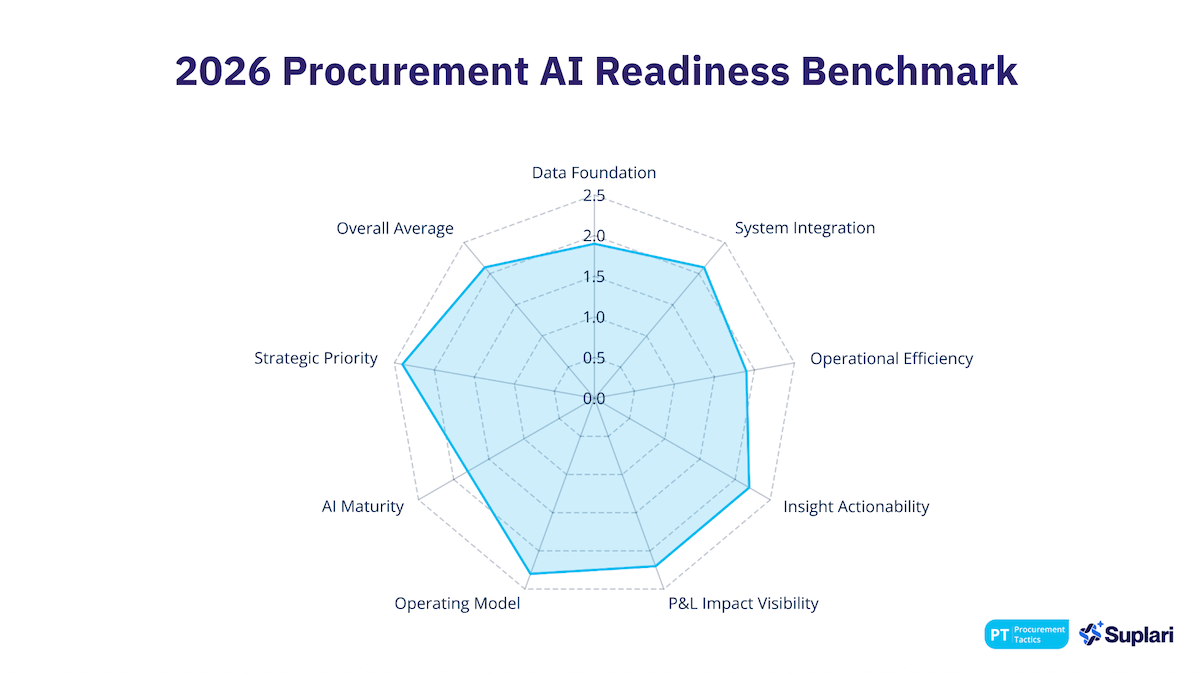
The 2026 industry average for AI readiness in procurement is 2.1 out of 5. That sits between "Foundational" and "Developing" on a five-level maturity scale, and below the 2.5 threshold the report identifies as the minimum for effective AI deployment at organizational scale.
Not a single one of the eight AI readiness dimensions reached 2.5.
The maturity scale, for context:
- 1.0–1.5 — Foundational. Fragmented data, manual processes, no AI in use.
- 1.5–2.5 — Developing. Data consolidating, first integrations exist, AI exploration has begun. Industry average sits here.
- 2.5–3.5 — Established. Systems connected, workflows structured, AI pilots running.
- 3.5–4.5 — Advanced. Data governed, processes proactive, AI deployed in key areas.
- 4.5–5.0 — Leading. Intelligent data ecosystems, AI-driven operations, continuous optimization.
If you want to see where your own team scores against this scale before reading further, take the AI Readiness Assessment — it returns a personalized score across all eight dimensions in about five minutes.
Benchmark 1: AI adoption in procurement is bimodal
Procurement teams either use AI nearly every day or barely at all. The middle has collapsed.
58% of procurement professionals use AI at least four days per week. Once teams start, daily usage becomes the norm.
The takeaway for procurement leaders: assume your team is already using AI, whether you've sanctioned it or not. The right question isn't "should we adopt AI?" — it's "how do we move from individual usage to organizational deployment?" See our breakdown in AI in Procurement Explained for the long version.
Benchmark 2: General-purpose AI dominates by 11x over platform AI
The tools procurement teams actually use:
Almost 90% of AI usage in procurement today is general-purpose — ChatGPT, Copilot, Gemini, or Claude. Only 8% use AI that's actually integrated into their procurement platform.
That gap defines the current state: high AI activity, near-zero connection to procurement data. It's also why so many AI initiatives feel productive at the individual level and stall at the team level. We unpack the structural reasons in ChatGPT vs AI Agents for Procurement.
Benchmark 3: 83% of teams have no enforced AI policy
Procurement handles confidential pricing, competitive bids, contract terms, and supplier data. Yet the governance picture in 2026 looks like this:
Only 17% of procurement organizations have a policy that's actually enforced. The remaining 83% are sharing sensitive procurement data with consumer AI platforms without organizational guardrails.
The report identifies this as the single largest governance liability in the dataset — and the one that doesn't require budget to fix. A defined policy is a decision, not an expense. If your team is in the 83%, the AI Readiness Assessment flags governance as a dimension and shows you where to start.
Benchmark 4: The reclaimable time is 10.6 hours per week
The average procurement professional estimates that 10.6 hours per week of their current work could be automated by AI.
That's more than a full working day. Every week. Per person.
The supporting data:
- 74% of procurement teams spend 40% or more of their time on manual data work.
- 41% spend over 60% of their time on manual tasks.
- Only 6% have less than 20% manual workload.
This is the largest untapped efficiency gain in the function — and it's the number that makes the business case for AI in procurement almost build itself. For a structured way to translate hours into dollars, see Calculate Your AI-Native Procurement ROI and The Business Case for AI in Procurement.
Benchmark 5: The 8 AI readiness dimensions — where the industry actually scores
The full readiness picture, scored 1.0–5.0:
The pattern is consistent and important. The scores split into two groups:
- Intent dimensions (Strategic Priority, Operating Model, Insight Actionability, P&L Impact) average 2.3.
- Capability dimensions (System Integration, Data Foundation, Operational Efficiency, AI Maturity) average 2.0.
The report names this the Intent–Capability Gap: organizations know what they want, but haven't built what they need. Ambition without infrastructure is the universal pattern across the industry.
For the methodology behind each dimension, see the Procurement Maturity Model for 2026. For practical fixes to the lowest two scores, see Procurement Data Quality and AI-Ready Procurement Data.
Benchmark 6: The cost-pressure trap — what your strategic priority predicts about your readiness
The report cross-referenced each team's stated strategic priority against their actual AI readiness score. The relationship is direct, and not in the direction most CFOs would expect.
The 38% of teams whose primary focus is cost savings score lowest on AI readiness — 1.8/5.
The report calls this the Cost-Pressure Trap: a self-reinforcing cycle where short-term savings pressure prevents investment in data and governance, which keeps the team dependent on manual processes, which reinforces the cost pressure. Breaking out requires reframing procurement from a cost center to a capability builder. See Cost Savings vs. Cost Avoidance: Why Both Matter for the broader argument.
Even the most ambitious group — teams prioritizing AI-enabled scale — averages only 2.6/5. No strategic priority group has built the foundation to deliver on its ambition.
Benchmark 7: AI readiness by company size
Only the largest enterprises (50,000+) clear the threshold of 2.5. Size brings resources but doesn't automatically solve the readiness challenge — AI Maturity remains the weakest dimension in every size category except the largest.
Benchmark 8: AI readiness by role and seniority
C-level scores 2.4 vs. analysts at 1.9 — a 0.5-point gap. Either leaders are overestimating organizational readiness, or investments aren't reaching the frontline. Both interpretations are useful: validate your assumptions with the people actually doing the work. If you're a new CPO, our first 90 days as a procurement leader playbook covers the diagnostic questions that close this gap quickly.
Benchmark 9: AI readiness by region — there's no head start
Only 0.26 points separate the highest and lowest region. No geography has a clear head start.
The implication is direct: competitive advantage in 2026 will come from execution speed, not location. Europe leads slightly on Data Foundation and Strategic Priority; Asia-Pacific leads slightly on Insight Actionability and Operating Model. Every region has gaps to close.
Benchmark 10: The barriers to AI adoption — knowledge, not budget
When asked what's blocking AI adoption, procurement teams ranked it like this:
Knowledge gaps are the #1 barrier by a wide margin — nearly 2x bigger than IT/policy restrictions and 3.4x bigger than budget. That reframes the AI investment conversation: the highest-ROI first move isn't a tool, it's structured training.
This also means most AI pilots don't fail for the reasons people expect. See Why AI Pilots in Procurement Fail for the breakdown.
Benchmark 11: Where teams are on the AI adoption journey
The report measured organizational AI maturity on a five-stage progression. Here's how the industry is distributed:
Only 8% of procurement organizations have moved past pilots into deployment. Over half the industry is still in the earliest stage.
The funnel narrows sharply between "experimenting" and "deploying" — that's where most teams stall, because the jump requires organizational infrastructure (data, governance, integration) that most haven't built. Autonomous Procurement: How to Get Ahead in 2026 covers what the 8% are doing differently.
What the benchmarks actually mean for your 2026 plan
Three patterns thread through every benchmark on this page:
1. Personal AI usage does not produce organizational readiness. Daily AI users (5 days/week) score 2.2/5 on organizational readiness — no higher than peers who use AI far less often. The report calls this the Frequency Paradox: more individual usage doesn't make your organization more ready. Bridging the gap requires governance, integration, and shared workflows — not more logins.
2. The gap is in the foundation, not the ambition. Strategic Priority is the highest-scoring dimension at 2.4. The lowest are AI Maturity (1.8) and Operational Efficiency (1.9). Every organization wants to do more with AI; very few have built what's required. Fixing data and governance is the fastest path to closing the gap.
3. The early movers will compound their lead. Organizations that reach readiness 3.0+ by end of 2026 will have months of clean data, trained teams, and governance frameworks in place when enterprise-grade procurement AI tools mature. Laggards will still be cleaning data while leaders are already optimizing.
Where to start
If you remember nothing else from this page, remember these three numbers:
2.1, 83, and 10.6.
2.1 out of 5 — the industry's AI readiness score.83% of teams have no enforced AI governance policy.10.6 hours per week is the time AI could give back to each procurement professional.
Most teams have to act on all three at once.
The fastest way to find your starting point is to benchmark your own organization against these scores.
Take the AI Readiness Assessment →A 5-minute self-assessment scored across the same 8 dimensions used in this report. You'll get a personalized spider chart, dimension-by-dimension scoring, and a prioritized action plan.
For the full methodology, sample sizes, and segmentation cuts, download the AI Readiness in Procurement 2026 report.

