




For the last three years, "we need better data first" has been the standard answer when procurement leaders are asked why they haven't moved on AI in procurement. It's an honest answer. It's also become a stalling one.
Most procurement teams asking "is our data ready for AI?" are using a definition of ready that's a decade out of date. Clean rows, standardized vendor names, deduplicated suppliers — these are necessary, but they're not what "AI-ready" means in 2026. The bar moved when AI agents started reasoning over procurement data instead of just visualizing it.
This isn't a niche concern. Gartner now forecasts that the share of AI spend going to AI data readiness will grow roughly sevenfold through 2029 — the largest single shift in how enterprise AI budgets are allocated. For procurement leaders, that means the question isn't whether AI-ready data becomes a strategic line item; it's whether the function defines what AI-ready means on its own terms, or has the definition imposed from outside.
This guide is about what AI-ready procurement data actually means today, why the bar is higher than "clean," and the tests that tell a procurement leader whether they're at the AI-ready bar or still working toward it.
The old definition: clean and unified
For most of the past decade, AI-ready data in procurement meant one thing: get the foundations right.
- Standardize vendor names so the same supplier isn't counted as three different ones
- Reconcile categories so each transaction maps to a single, governed spend taxonomy
- Fill in missing fields so reporting doesn't have holes
- Connect ERP, P2P, and contract systems so a single dashboard can answer cross-system questions
This is the work most spend analytics and master data programs have focused on. It's necessary. The trouble is that it produces clean data, not necessarily AI-ready data. The two are not the same.
What is AI-ready procurement data in 2026?
AI-ready procurement data is buying information that is clean, unified, governed, and contextual — organized, consistent, findable, and connected to real decisions. The 2026 bar moved past "clean and deduplicated": because AI agents now reason and act on the data (not just visualize it), every field the AI needs must be populated, and the data needs a contextual/semantic layer telling the AI what it means. Six tests of AI-ready data: unified across systems, governed at entity level, complete for the use case, structured/queryable, contextual, and current. (Gartner: the share of AI spend going to AI-data-readiness grows ~7× through 2029.)
What changed is what AI now does with the data. Traditional procurement analytics tools read procurement data to populate dashboards. AI agents read it to make decisions — about supplier consolidation, contract renewals, savings opportunities, risk events. That shift moves the requirements bar from "the rows are formatted correctly" to "the AI can ground its decisions in data it understands and can defend."
In practice, AI-ready procurement data has four characteristics that go beyond cleanliness:
- Unified across source systems, so the AI isn't reasoning over partial slices of spend
- Governed at the entity level, with a single source of truth for suppliers, categories, contracts, and savings definitions
- Contextually meaningful, with the semantic relationships between entities explicit and machine-readable
- Continuously refreshed, so the AI is reasoning over the current state of the function, not a Q3 snapshot
The first two are what most procurement data programs have been working on. The third and fourth are where the bar has moved.
The contextual layer is where most teams fall short
When Gartner's data and analytics team flagged semantics as the new strategic priority for AI-ready data at its London summit in May 2026, the underlying argument was that schema-level cleanup isn't enough. The AI also has to know what the data means in the context of the organization using it. Without that contextual layer, even clean data produces inaccurate AI outputs at scale.
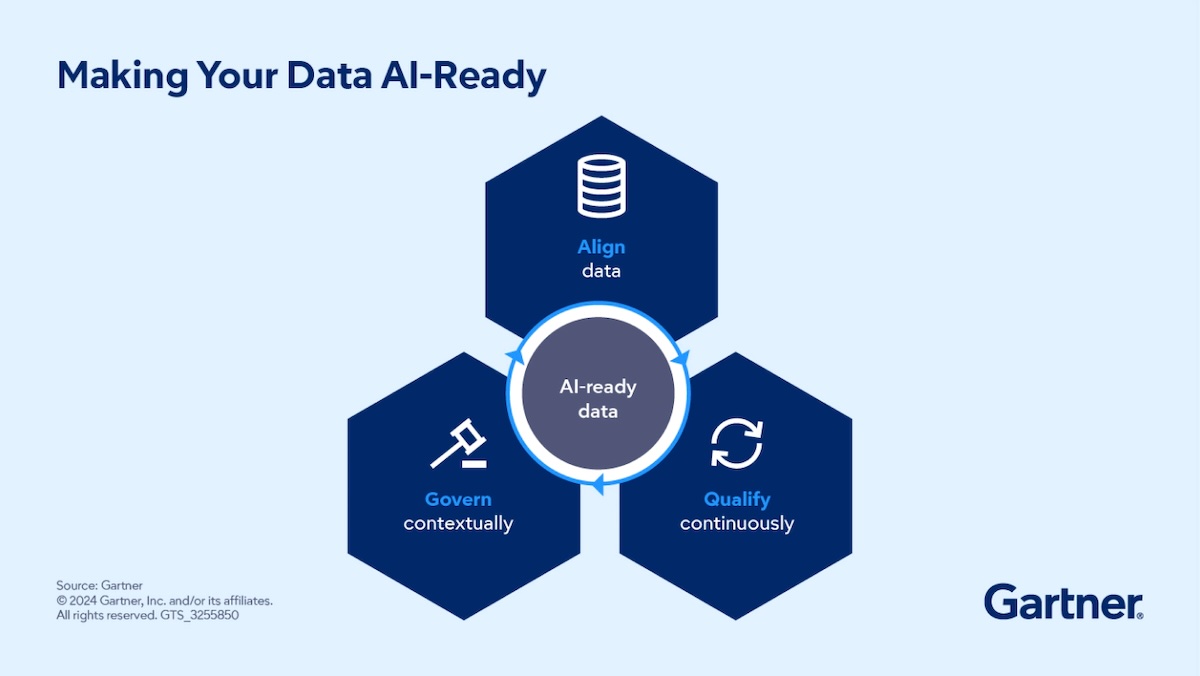
For procurement, the contextual layer is a familiar set of things, just elevated from analyst spreadsheets and master data files into a governed, machine-readable form: your spend taxonomy, your reconciled supplier master, your category-to-account mappings, and your operational definitions for the metrics that matter (savings, addressable spend, spend under management, compliant spend, realized value). We cover this in more depth in our piece on the procurement semantic layer.
The practical implication for a procurement leader assessing readiness: if your taxonomy and supplier master only live in documents and analyst memory, your data is clean but not contextual. AI agents grounded on it will improvise — and the improvisation is what produces the verification tax procurement teams talk about quietly but rarely raise in vendor demos.
The six tests of AI-ready procurement data
You don't need a maturity model or a 40-question audit to know whether your data is AI-ready. Six practical tests will tell you most of what you need.
1. The same question produces the same answer
Ask three different people in the procurement function — an analyst, a category manager, and the CPO — "how much did we spend with our top ten suppliers last quarter?" If the three answers don't reconcile within a percentage point, your data is either not unified or not governed. AI agents will reproduce that inconsistency at scale.
2. A new supplier is correctly classified within hours, not weeks
The single best operational test of whether your data foundation supports AI is how fast a new supplier (especially a parent-child case or a name with regional variants) gets resolved into the right place in your spend taxonomy and supplier master. If the answer is "a senior analyst reviews it at the next monthly cycle," your classification layer is human-paced — and AI agents grounded on it will be slow and brittle. If the answer is "the platform classifies it automatically with a confidence score, and humans only intervene on edge cases," your foundation is AI-paced.
3. The definitions are explicit, not implicit
Walk through these definitions with your team and see if they're written down somewhere a machine could read:
- What counts as addressable spend?
- What counts as realized savings (versus negotiated discount on list price)?
- What counts as compliant spend on a given category?
- What counts as off-contract spend — and is the threshold the same for direct and indirect categories?
- What's the rule for assigning a transaction to a category when the supplier sells across categories?
If any of these definitions live only in conversations between senior analysts and the controller, the AI agent doesn't have access to them. The agent will pick a definition itself, and it won't be the one your CFO would accept.
4. The supplier master is reconciled at the parent level
A supplier master that lists "Acme Corp," "ACME Corporation," and "Acme Holdings LLC" as three separate vendors is not AI-ready, no matter how clean the individual records are. Reconciliation at the parent-child level — including M&A history, affiliated entities, and tier classifications — is what lets an AI agent reason about supplier consolidation, leverage, and risk consistently across the function.
5. The data the AI uses today reflects what happened yesterday
AI agents make poor decisions on stale data. If the spend data the platform reasons over is refreshed monthly or quarterly, the agents will surface opportunities the team has already acted on and miss the ones that just emerged. Continuous (or at minimum daily) refresh from source systems is the prerequisite for moving AI agents from "monthly insight generator" to "operational decision support."
6. The AI can reason across structured spend and unstructured documents
This is the test most procurement data programs aren't designed for, and it's the one that increasingly separates AI-ready functions from the rest. The structured side of procurement data — the PO header, the invoice amount, the vendor ID — typically accounts for a small share of what makes a procurement decision good. The contract terms, the supplier's disclosure documents, the proposal narrative, the line-item description on a services invoice — the unstructured side — is where most of the meaning lives. Gartner estimates unstructured data accounts for 70 to 90 percent of all organizational data; in procurement, the share is at the high end of that range.
An AI agent that can analyze spend trends but can't read the contract that governs that spend is a partial agent. The platform you ground your AI on should treat contract parsing, supplier-document ingestion, and unstructured-text classification as first-class capabilities — not as a roadmap item. If your function can ask "show me every supplier whose contract auto-renews in the next 90 days and whose realized savings is below the negotiated target" and get a defensible answer in seconds, your data foundation has crossed into AI-ready territory. If that question requires a senior analyst and three days of work, it hasn't.
What it takes to get there
If your function passed all six tests, you're at the AI-ready bar. Most procurement functions don't, and the gap usually isn't surprising. The two tests that block the most teams are #3 (explicit operational definitions) and #6 (reasoning across structured and unstructured data). Both are solvable problems — and both are problems where AI itself is part of the solution.
Three pragmatic moves close most of the gap:
- Codify your spend taxonomy as a governed asset. This is the central act of building the contextual layer. Treat the taxonomy as a versioned, owned product — not a one-time design exercise. Suplari's deep dive on spend taxonomy design walks through the design principles.
- Move classification from rules-based to AI-native. A 75–85% accuracy ceiling on rules-based classification is the practical ceiling on AI accuracy downstream. AI-native classification reaches 98%+ across structured and unstructured spend, with transparent confidence scoring on the rest. See spend classification for the mechanics.
- Write down the operational definitions and have finance sign off. Two pages — addressable spend, savings, compliant spend, off-contract, spend under management — agreed and dated. This is the single highest-leverage piece of governance most procurement functions can do this quarter. Once the definitions exist, an AI platform can ground on them. Until they exist, every AI agent improvises.
How AI-ready data connects to the maturity model
The six tests above are a quick read on the Data Foundation pillar of the Suplari AI Readiness in Procurement assessment. The assessment scores Data Foundation on a five-level scale — Fragmented, Consolidating, Unified, Governed, and AI-Ready — and shows you where you sit relative to the rest of the maturity model. Teams that hit Level 5 on Data Foundation are also usually on Level 4 or 5 across System Integration and Insight Actionability, because the same investments lift all three.
For the full picture across the eight pillars that determine whether your function can ground AI agents reliably, the assessment is the fastest path. Ten minutes, no software install, results plotted on a spider graph against benchmark data.
→ Take the AI Readiness in Procurement assessment
Bottom line
AI-ready procurement data is no longer about clean rows and unified systems. Those are table stakes. The bar moved when AI agents started making decisions on procurement data instead of just visualizing it — and the new bar adds governed entities, explicit operational definitions, and a contextual layer the AI can ground on.
The six tests above give you a directional read in under an hour. The functions that pass them get AI outputs reliable enough to take to finance without rework. The ones that don't keep paying a verification tax that scales with every new AI agent they deploy.


